ai

McKinsey Boss Says There Are 3 Skills AI Models Can’t Do That Young Professionals Should Focus On
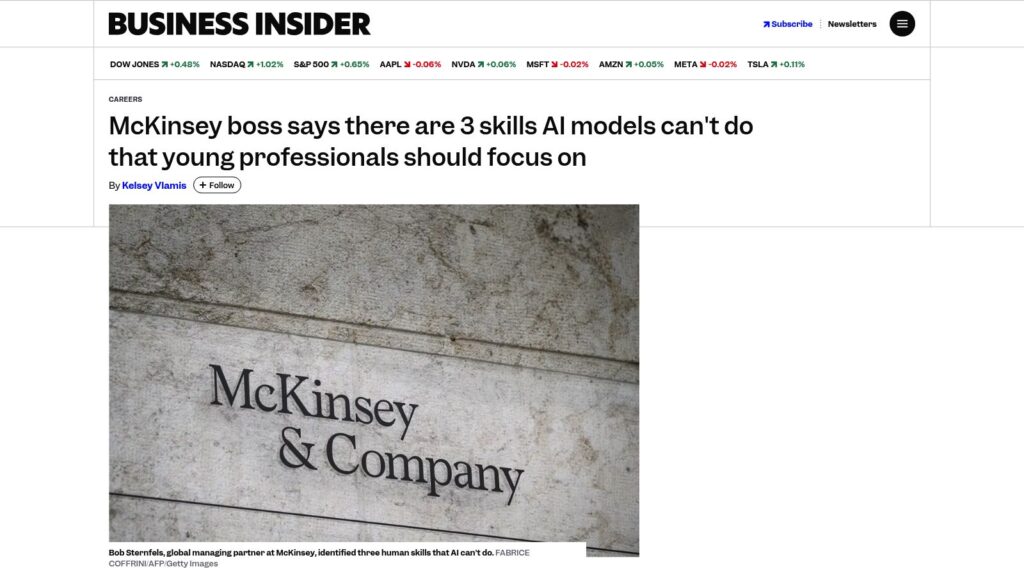
McKinsey’s Bob Sternfels highlights three essential human skills that AI can’t replicate: the ability to aspire, judgment, and true creativity. He stresses the importance of these skills for young professionals as AI changes talent requirements, suggesting that education background may become less significant compared to practical skills demonstrated in portfolios.

https://www.businessinsider.com/mckinsey-boss-shares-human-skills-ai-models-cant-do-2026-1
Workers Rank AI Among Top Trends Shaping Their Workplace

Workers rank AI and generative AI as top workplace trends, with AI as the leading concern. According to The Adecco Group’s report, based on 37,500 workers and 2,000 executives, salary and work-life balance are primary reasons for job retention. AI training struggles persist, as many feel undertrained. The report emphasizes the demand for stability and growth opportunities in employment.

https://www.staffingindustry.com/news/global-daily-news/workers-rank-ai-among-top-trends-shaping-their-workplace

Can AI Do Your Job? See the Results From Hundreds of Tests.

A study comparing AI systems and human workers on real tasks shows AI is far from replacing jobs. Despite impressive capabilities, the best AI only completed 2.5% of projects successfully, failing mostly due to lack of long-term memory and poor visual understanding. AI produced subpar work for projects like floor plans and dashboards, highlighting its limitations. Although AI may reduce dependence on human workers, the study suggests it won’t fully automate jobs soon.

https://www.washingtonpost.com/technology/interactive/2026/ai-jobs-automation/

Four Ways AI and Talent Trends Could Reshape Jobs by 2030

AI advancements may reshape jobs by 2030 through four scenarios: 1) Supercharged Progress – rapid AI development boosts productivity but causes job displacement; 2) The Age of Displacement – swift automation outpaces workforce adaptation, leading to high unemployment; 3) Co-Pilot Economy – gradual AI integration fosters collaboration and new opportunities; 4) Stalled Progress – slow tech advance with skill shortages results in uneven productivity gains. Businesses must adopt flexible strategies to navigate these uncertainties and invest in human-AI collaboration.

https://www.weforum.org/stories/2026/01/four-ways-ai-impact-job-markets/

AI Layoffs Are Looking More and More Like Corporate Fiction That’s Masking a Darker Reality, Oxford Economics Suggests

Oxford Economics suggests that AI layoffs are often used as a cover for routine headcount reductions, rather than a result of automation. Companies may be attributing job cuts to AI to present themselves as innovative and to appease investors, rather than admitting to business failures. Despite headlines, data show that AI-related job losses account for only a small share of total reported job losses.

https://finance.yahoo.com/news/ai-layoffs-looking-more-more-210954693.html

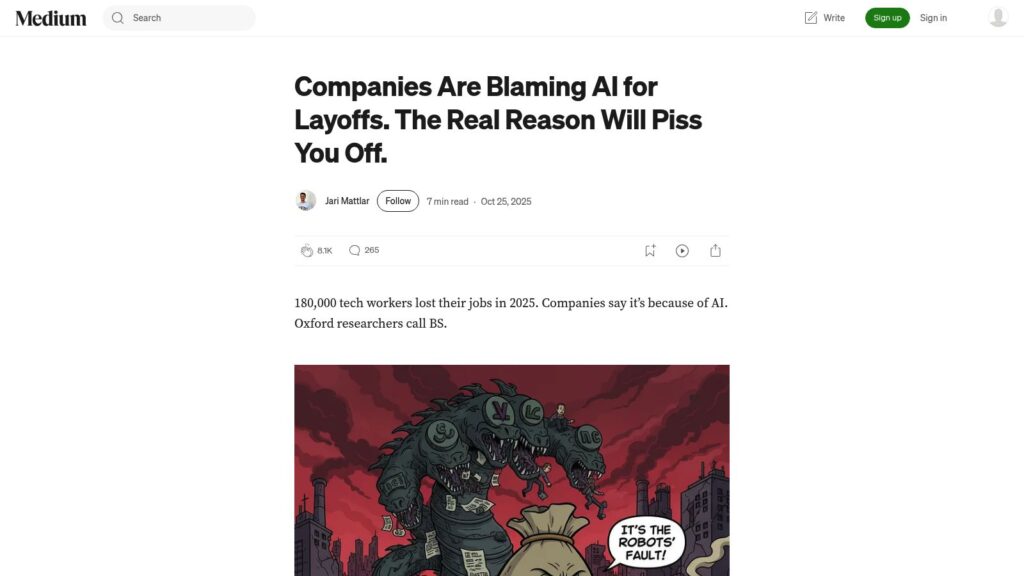
Companies Are Blaming AI for Layoffs. The Real Reason Will Piss You Off.

Companies falsely blame AI for layoffs; a study shows 95% of investments yield no ROI. Instead, firms are cutting jobs to rectify overhiring from COVID-19. Young workers face increased job losses, particularly in entry-level positions. To safeguard your career, document your achievements, learn AI tools for productivity, and recognize the difference between actual AI displacement and opportunistic layoffs labeled as “AI-driven.”

https://medium.com/@mattlar.jari/companies-are-blaming-ai-for-layoffs-the-real-reason-will-piss-you-off-149639ce47cf

How to Build an AI-Augmented Workforce: The CIO’s Guide

CIOs are shifting to AI-augmented workforces, enhancing human capabilities instead of replacing jobs. AI improves decision-making, reduces mundane tasks, and fosters innovation. Best practices for implementation include prioritizing augmentation, investing in training, and redesigning workflows. Challenges include employee resistance, skills gaps, and data integration issues. Examples across industries illustrate AI’s transformative role in customer support, finance, product development, and HR. Future trends involve personalized AI assistants, embedded generative AI tools, and an increased focus on human judgment, redefining roles and skills necessary for an AI-driven workplace.

https://www.techtarget.com/searchenterpriseai/tip/How-to-build-an-AI-augmented-workforce-The-CIOs-guide

8 Skills You Need To Manage The New AI Agent Workforce

The workforce of the future is being shaped by AI agents, autonomous digital workers that handle complex tasks. To manage this new workforce, professionals need to develop skills in strategic thinking, AI literacy, responsible AI implementation, agentic workflow design, human communication, change management, data governance, and continuous learning. These skills will enable organizations to leverage AI agents effectively while empowering human workers to focus on creative and strategic tasks.

https://bernardmarr.com/8-skills-you-need-to-manage-the-new-ai-agent-workforce/

10 HR Trends That Matter Most As AI Transforms Organizations

AI is becoming a strategic imperative for organizations, reshaping how they compete and innovate. As AI transforms work, companies are prioritizing AI fluency, revamping hiring processes, and addressing employee concerns about job security. While some entry-level jobs are decreasing, new roles are emerging, and organizations are shifting from AI adoption to AI transformation, embedding AI into core business operations.

https://www.forbes.com/sites/jeannemeister/2026/01/06/10-hr-trends-that-matter-most-as-ai-transforms-organizations/

The ‘Godfather of SaaS’ Says He Replaced Most of His Sales Team With AI Agents: ‘We’re Done With Hiring Humans’

SaaStr founder Jason Lemkin replaced most of his sales team with AI agents, aiming for enhanced productivity and efficiency after two high-paid human sales reps quit. His company now employs 20 AI agents, which autonomously handle tasks previously managed by humans, and plans to train them based on top human sales practices. While concerns about data security remain, Lemkin believes AI agents can outperform human workers in scalability and effectiveness.

https://www.businessinsider.com/godfather-of-saas-jason-lemkin-replace-humans-ai-agents-sales-2026-1

AI Is Collapsing The Corporate Pyramid — Experts Say This New Shape Is The Future Of Work

AI is disrupting traditional corporate structures, reducing entry-level positions by 30% and middle management roles, prompting a shift towards flatter, more adaptive organizations. Experts suggest a pentagon-shaped workforce to maintain human judgment and adaptability, ensuring long-term resilience amid AI advancements.

https://allwork.space/2026/01/ai-is-collapsing-the-corporate-pyramid-experts-say-this-new-shape-is-the-future-of-work/

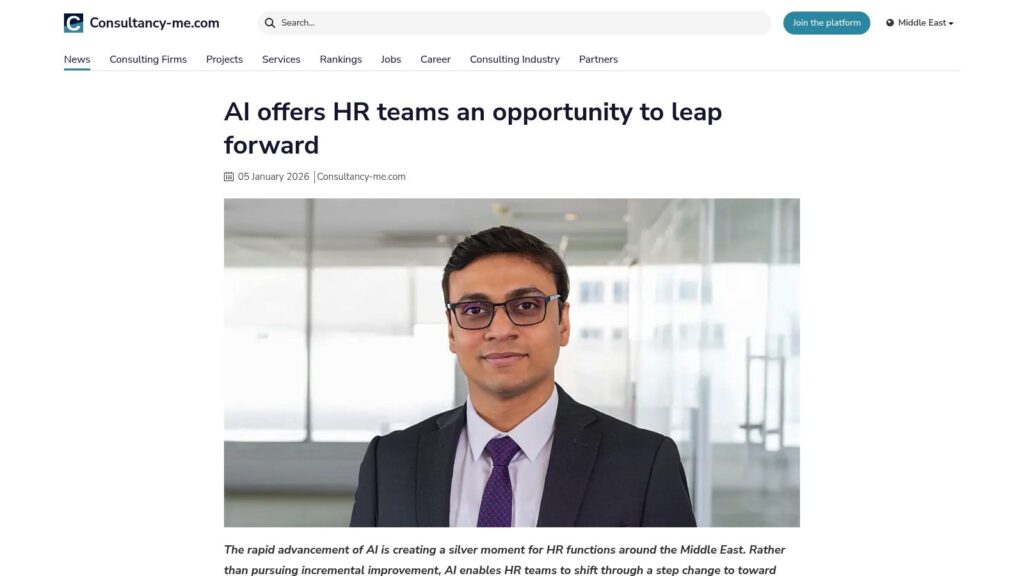
AI Offers HR Teams an Opportunity to Leap Forward

AI is revolutionizing HR in the Middle East, enhancing efficiency and decision-making. Key benefits include automating repetitive tasks, personalizing employee experiences, and improving recruitment. While adoption offers productivity gains, risks like bias and transparency issues must be managed. CHROs are encouraged to start small, invest in governance, and maintain the human touch in HR. Ultimately, AI is expected to create a more strategic, efficient HR function that balances technology with empathy.

https://www.consultancy-me.com/news/12409/ai-offers-hr-teams-an-opportunity-to-leap-forward

AI and the Human Condition

The rise of AI presents a paradox for content producers: while AI offers endless topics to cover, it also competes as a content producer itself. However, the author remains optimistic about the future of content creation, believing that AI’s individualized nature will drive people towards communal experiences centered around human-created content. This optimism extends to the belief that humans will continue to value human interaction and creativity, even in a world dominated by AI.

https://stratechery.com/2026/ai-and-the-human-condition/

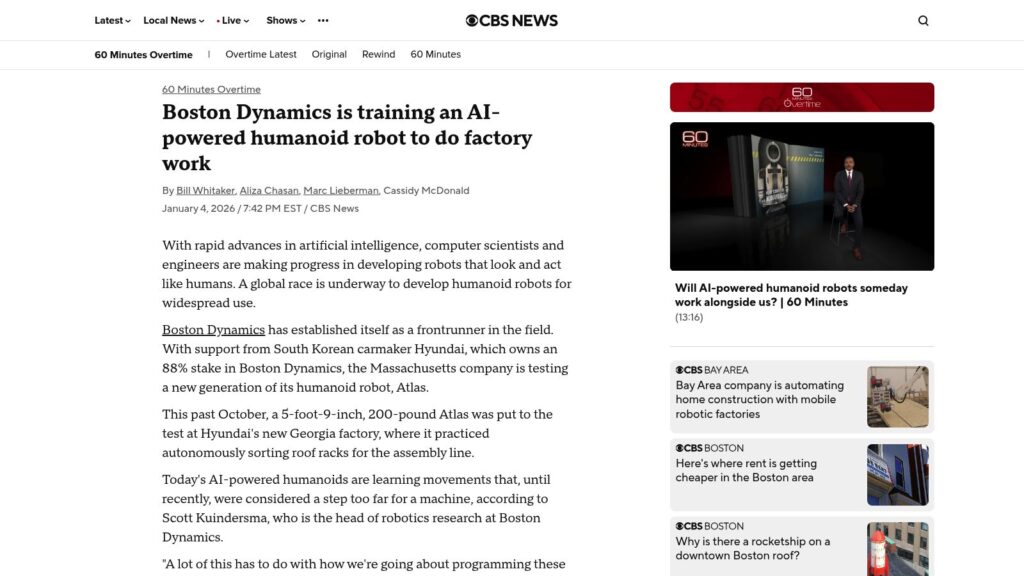
Boston Dynamics Is Training an AI-powered Humanoid Robot to Do Factory Work

Boston Dynamics is advancing AI-powered humanoid robots, notably its Atlas model, to perform factory tasks, demonstrating significant progress in robotics. The company employs innovative training techniques like demonstration and machine learning, enabling Atlas to execute complex movements. Although Atlas can perform some tasks autonomously, routine jobs remain challenging. The humanoid robotics market is projected to grow significantly, with Boston Dynamics leading, amidst competition from global firms, particularly in China. Concerns over job displacement exist, though officials indicate these robots are not yet autonomous enough to fully replace humans.

https://www.cbsnews.com/news/boston-dynamics-training-ai-humanoids-to-perform-human-jobs-60-minutes/

Will AI Take My Job in 2026? What the Data Actually Says

AI won’t fully replace jobs by 2026; it will reshape tasks, leading to 92 million job displacements but creating 170 million new ones (net gain of 78 million). Many roles will shift, with significant automation in customer service and admin. Workers should focus on tasks rather than titles, as automation will particularly target routine, rules-based tasks. Industries like finance and tech face high exposure, while healthcare and education may rely more on AI as an assistive tool. Adapting to these changes and gaining AI skills will be crucial for maintaining job security.

https://www.nucamp.co/blog/will-ai-take-my-job-in-2026-what-the-data-actually-says

Scroll to Top