technology

The AI Talent Shortage Is Creating New Pathways in Tech

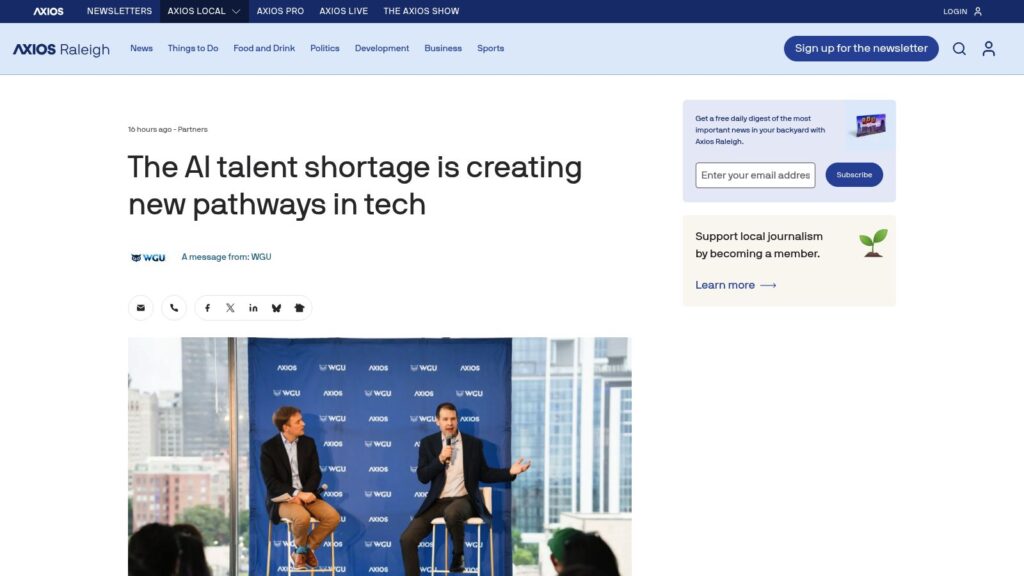
The growing shortage of AI talent is pushing businesses to create new pathways in tech, as companies struggle to find qualified workers to deploy AI systems despite rapid adoption. Programs like Western Governors University’s Bachelor of Science in AI Engineering aim to address this gap by focusing on practical AI deployment skills, helping workers develop competencies needed to build and manage AI-powered systems in real-world applications.

https://www.axios.com/local/raleigh/sponsored/the-ai-talent-shortage-is-creating-new-pathways-in-tech

Are Humanoid Robots the End of Human Work?

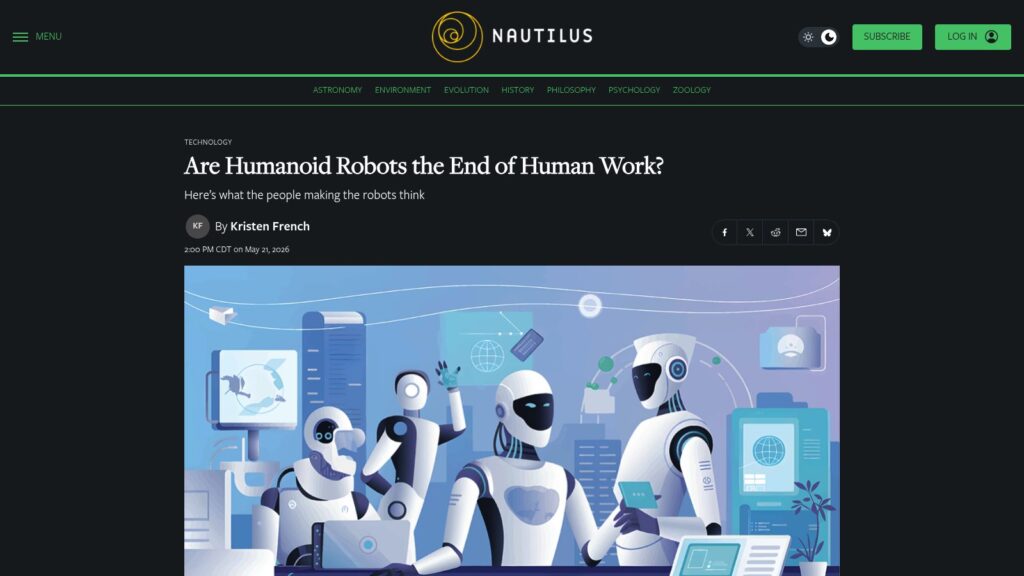
Despite advances in humanoid robotics and AI, experts at a recent conference overwhelmingly believe these machines will not replace most human workers by 2050 due to current limitations in dexterity and autonomous capabilities. Historical perspectives also suggest that while technology disrupts jobs, it typically creates new ones, and humanoid robots are seen more as tools to augment human labor—especially in care roles—rather than replace it entirely.

https://nautil.us/are-humanoid-robots-the-end-of-human-work-1281110

From Digital to Physical: AI as a Working Entity

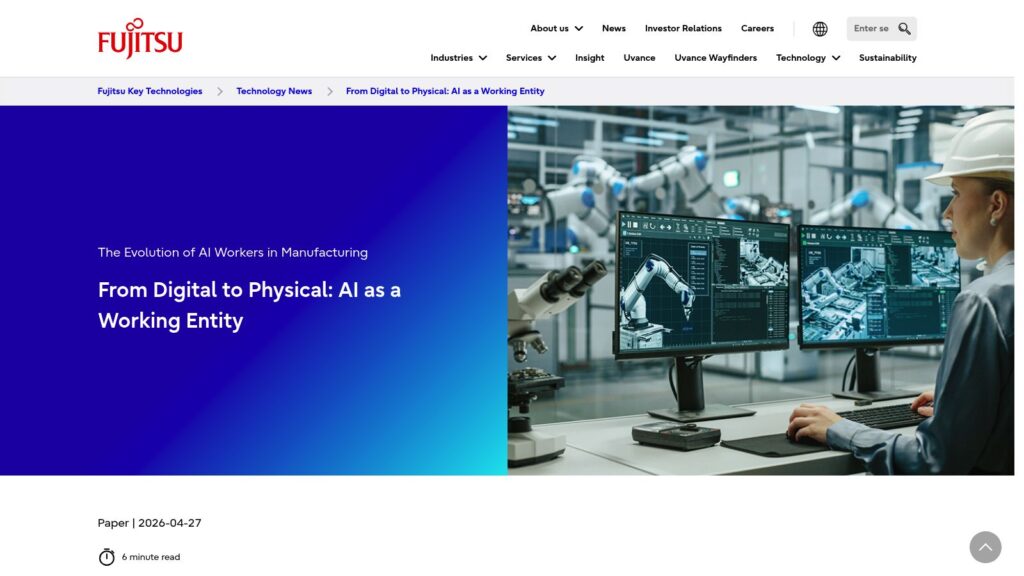
Fujitsu discusses the evolution of AI workers in manufacturing, highlighting their transition from simple automation tools to autonomous entities capable of independently executing tasks across the value chain, including design, production, and quality control. The article emphasizes the growing integration of both digital AI workers in white-collar roles and physical AI workers, such as humanoid robots on the shop floor, and stresses the need to redesign workflows and human–AI collaboration to maximize the potential of these AI workers.

https://global.fujitsu/en-global/technology/key-technologies/news/ta-Manufacturing_AI_worker-20260427

Want to Understand the Current State of AI? Check Out These Charts.

The 2026 AI Index from Stanford reveals that AI development is rapidly advancing, with top models outperforming human experts in many domains and adoption outpacing previous technologies like the internet. While the US and China lead in AI capabilities, the technology’s fast growth is challenging regulation, testing standards, and labor markets, with AI beginning to impact jobs and raising mixed public sentiments about its benefits and risks.

https://www.technologyreview.com/2026/04/13/1135675/want-to-understand-the-current-state-of-ai-check-out-these-charts/

How Can Tech Workforce and AI Strategies Impact Digital Readiness?

Deloitte’s system dynamics simulation explores how cutting technology workforce without proportionate investments in data and AI modernization can harm an enterprise’s digital capability and organizational readiness. The study found that workforce reductions may slow tech modernization and reduce change adoption capacity, while advancing data and AI maturity can improve performance; however, combining layoffs with AI investments often causes short-term disruptions before stability returns. This highlights the critical balance organizations must manage between tech talent and AI initiatives to sustain agility and growth.

https://www.deloitte.com/us/en/insights/topics/technology-management/tech-workforce-ai-strategies.html

This AI Expert Says the Job Apocalypse Isn’t Coming, Even if You’re a Coder – Here’s Why

Stanford professor Erik Brynjolfsson argues that AI will not cause a job apocalypse for coders or tech professionals, but rather transform roles by supplementing work and expanding the software profession. He emphasizes that human roles will shift toward defining the right problems and questions, managing AI-driven agents, and overseeing safe and productive AI use, which will empower a broader range of people to create software without traditional coding skills.

https://www.zdnet.com/article/ai-job-apocalypse-not-happening-for-coders/

Talent Reinventors: Value in the Age of AI

Accenture’s “Talent Reinventors” report highlights how organizations combining human talent with AI are achieving superior growth and workforce adaptability by reshaping work around shared goals powered by data and AI. The report identifies six key characteristics of these leaders—including clarity, intelligent teaming, talent mobility, co-learning, breakthrough leadership, and personalized experiences—that enable companies like Volkswagen, Microsoft, and Caterpillar to successfully integrate AI and people strategies, resulting in higher revenue, stronger cultures, and better employee experience in the rapidly evolving digital economy.

https://www.accenture.com/us-en/insights/consulting/talent-reinventors-delivering-value-people-age-ai?c=acn_glb_thefuture-readymediarelations_14261455&n=mrl_0226

America’s HR Leaders Say We’re Thinking About AI Agents All Wrong

Human resources leaders at major U.S. companies, including IBM and Microsoft, argue that AI agents should not be treated like human employees with names, job titles, or individual performance metrics, as this mindset undermines the technology’s full potential. They emphasize focusing on integrating AI into enterprise workflows for large-scale process improvement rather than managing AI as standalone “digital workers,” highlighting that accountability for AI-driven decisions must remain with humans.

https://www.wsj.com/cio-journal/americas-hr-leaders-say-were-thinking-about-ai-agents-all-wrong-7d8f1439

Tech Companies Are Blaming Massive Layoffs on AI. What’s Really Going On?

Recent tech industry layoffs attributed to artificial intelligence (AI) reflect a more complex reality than the companies suggest. While AI is beginning to impact certain jobs like programming and customer service, overall displacement remains limited, and many layoffs are influenced by factors such as corporate restructuring and investor pressures rather than AI-driven efficiency alone.

https://theconversation.com/tech-companies-are-blaming-massive-layoffs-on-ai-whats-really-going-on-278314

Why ATMs Didn’t Kill Bank Teller Jobs, but the iPhone Did

The article explains that automation does not automatically eliminate jobs, illustrated by the example of bank tellers after the introduction of ATMs. ATMs reduced the cost of operating branches, allowing banks to open more locations. As a result, the number of teller jobs initially remained stable, while their duties shifted toward customer service and sales. Job losses occurred later, with the rise of online and mobile banking, which changed how banking itself worked. The conclusion is that employment declines primarily when technology replaces an entire system, rather than when it merely automates individual tasks.

https://davidoks.blog/p/why-the-atm-didnt-kill-bank-teller

Layoffs, Cost-cutting Shatters IT Worker Confidence

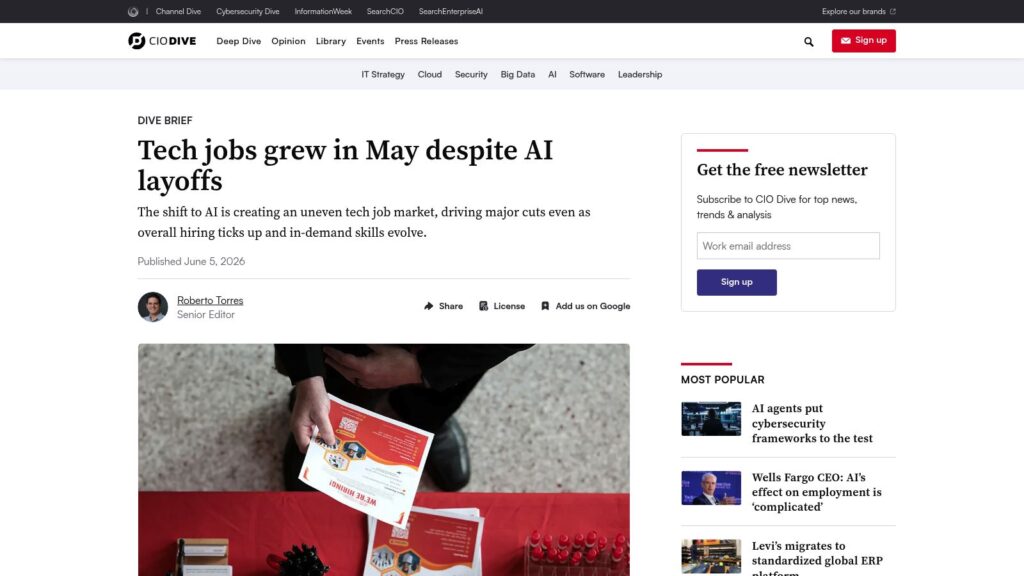
Tech worker confidence plummeted amid layoffs and stunted hiring, falling over seven percentage points year-over-year, per a Glassdoor report. Positive business outlooks were reported by fewer than half of tech employees. The soft job market has diminished worker leverage, highlighting the importance for CIOs to support employee engagement and career growth amid economic uncertainties.

https://www.ciodive.com/news/glassdoor-technology-hiring-sentiment-AI/814373/

Restaurants Say Tech Innovation Isn’t Taking Away Jobs

Tech Impact on Restaurants:

  • Restaurant sales to hit $1.55 trillion by 2026, creating over 100k jobs.
  • Many see tech as beneficial; 67% of quick-service operators highlight its positive impact on ordering/payment.
  • Tech minimally affects job elimination (6% claim it does).
  • 80% of operators consider tech a competitive advantage; 60% plan to invest in enhancing customer experience.
  • Younger diners favor tech solutions for speed and ease in ordering.
  • Tech divides sentiment: 41% see it improving hospitality, 38% believe it detracts.
  • Operators (65%) largely view tech positively for hospitality, indicating a need for balance between efficiency and human interaction.

https://www.qsrmagazine.com/story/restaurants-say-tech-innovation-isnt-taking-away-jobs/

The Human Work Behind Humanoid Robots Is Being Hidden

AI advancements in humanoid robots often hide the significant human labor involved. Companies, driven by hype, create unrealistic expectations about robot capabilities. As robots learn from human actions, workers are reduced to data gatherers, raising privacy concerns and reflecting gig-work dynamics. Transparency is lacking, and without it, the real limitations of robotic intelligence are obscured, leading to potential misunderstandings and risks, such as those seen in automotive technologies.

https://www.technologyreview.com/2026/02/23/1133508/the-human-work-behind-humanoid-robots-is-being-hidden/

Skills Are Evolving Too Quickly for Current Training Cycles, Report Says

IT skills are changing rapidly, with responsibilities shifting every 18 months. Companies view training as a perk rather than essential for operations, leading to skill gaps. Research suggests embedding learning into workflows to align skill development with business needs is crucial. Integrating training could also improve job retention, as many workers desire more training opportunities.

https://www.ciodive.com/news/learning-skills-evolving-training-cycles-it-info-tech/812628/

Japan to Mass-Produce Humanoid Robots by 2027

Japan plans to mass-produce humanoid robots by 2027 to address labor shortages. Two prototypes are under development: a 250 cm disaster response model and a human-sized research model. This effort involves collaboration among major Japanese companies and is part of a broader AI Robotics Strategy to enhance technological capabilities and workforce support, as Japan faces a declining working-age population. Despite challenges, the initiative aims to unify efforts in robotics as Japan seeks to regain its competitive edge in the field.

https://japan-forward.com/japan-to-mass-produce-humanoid-robots-by-2027/

Scroll to Top