business

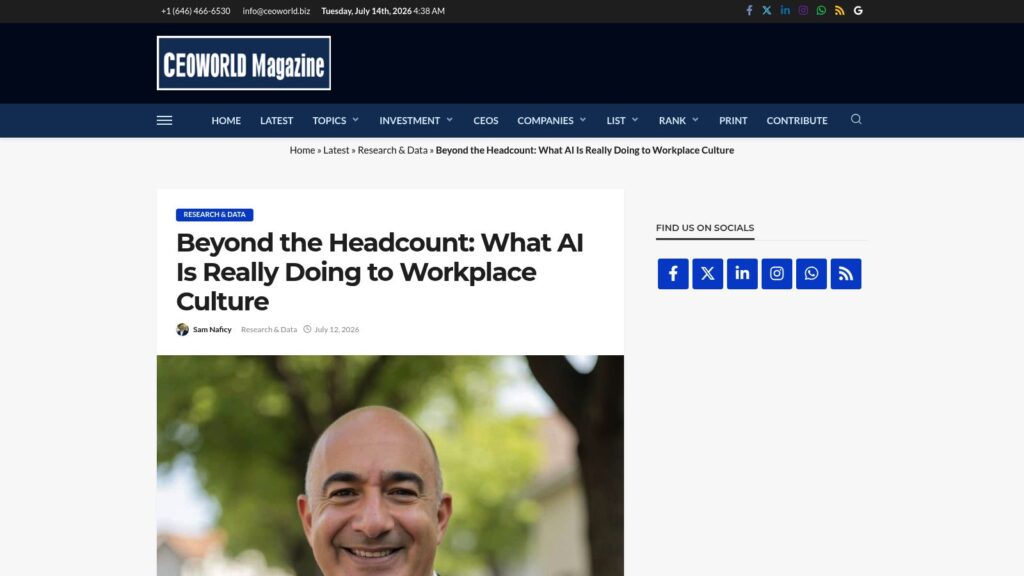
Beyond the Headcount: What AI Is Really Doing to Workplace Culture

AI-driven automation reshapes workplace culture by shifting communication patterns, thinning collaboration, and increasing employees’ cognitive load as remaining workers take on new responsibilities managing AI systems without additional support or compensation. Organizations often overlook these cultural impacts, focusing instead on headcount reductions and cost savings, while informal AI literacy roles emerge among socially connected employees who lack formal recognition, posing retention risks. Effective leadership requires acknowledging these changes, redefining roles and performance metrics, and investing in human-AI collaboration to sustain productivity and organizational cohesion.

https://ceoworld.biz/2026/07/12/beyond-the-headcount-what-ai-is-really-doing-to-workplace-culture/

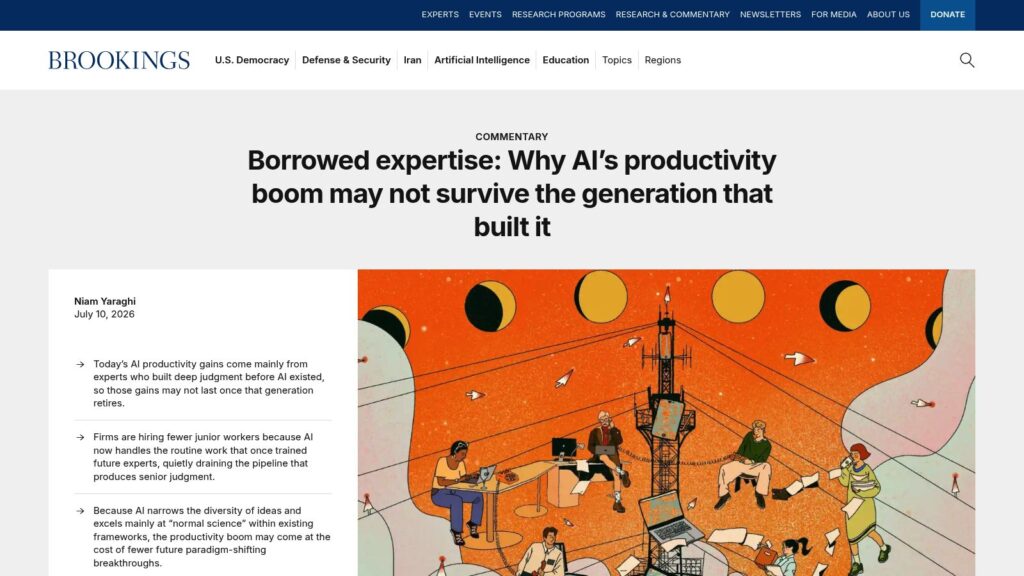
Borrowed Expertise: Why AI’s Productivity Boom May Not Survive the Generation That Built It

Generative AI’s current productivity gains rely heavily on experts whose judgment was developed before these tools existed, leveraging their deep domain knowledge to guide AI effectively. However, as firms reduce entry-level hiring due to AI’s automation of routine tasks, the developmental pipeline that cultivates future expert judgment is weakening, risking a long-term decline in innovation and expertise. This dynamic suggests that the current AI-driven productivity boom may not sustain as the generation that built it retires and is insufficiently replaced.

https://www.brookings.edu/articles/borrowed-expertise-why-ais-productivity-boom-may-not-survive-the-generation-that-built-it/

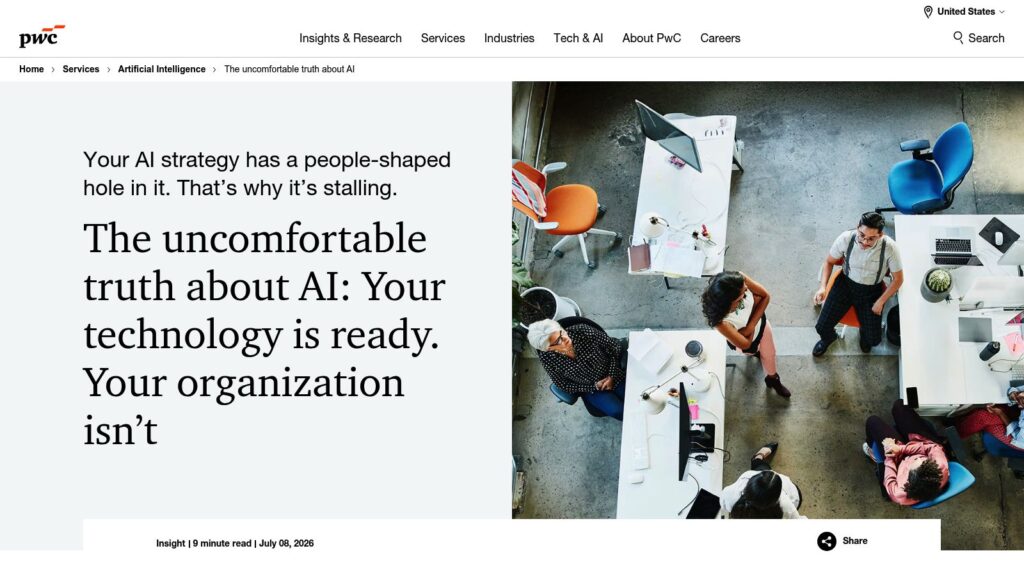
The Uncomfortable Truth About AI: Your Technology Is Ready. Your Organization Isn’t

PwC warns that while AI adoption can boost productivity and create new job opportunities, it will also lead to significant workforce disruptions, including job displacements and skill mismatches. Organizations must proactively invest in reskilling and upskilling initiatives to help employees adapt to changing roles and leverage AI effectively.

https://www.pwc.com/us/en/services/ai/uncomfortable-truth-about-ai-workforce-transformation.html

AI Creates a Workforce Dividend. Invest It for Growth.

The article highlights that CEOs often overlook the critical leadership role required to successfully integrate AI into their organizations. It emphasizes that beyond technology adoption, leaders must focus on workforce reskilling, culture change, and redesigning work practices to fully capture AI’s productivity and growth benefits. PwC underscores that proactive leadership in these areas is essential for realizing the long-term value of AI while managing workforce transformation effectively.

https://www.pwc.com/us/en/services/ai/ai-dividend-growth-redeployment.html

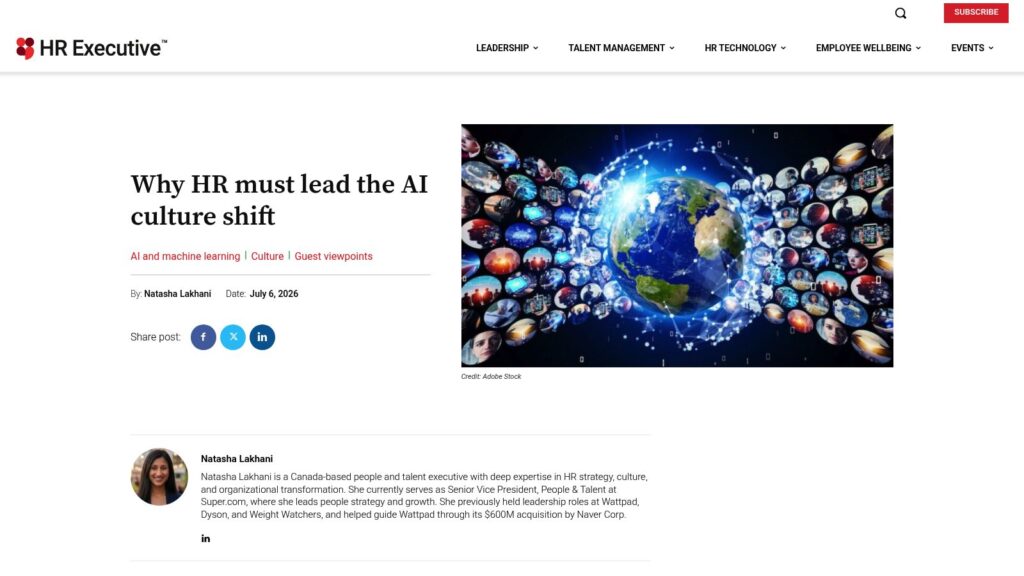
Why HR Must Lead the AI Culture Shift

HR must lead the AI culture shift by embedding AI into people operations to reduce administrative burdens and enable more strategic work such as retention, coaching, and leadership development. Rather than replacing human judgment, AI augments execution by automating time-consuming tasks like compensation analysis, performance reviews, and recruiting processes, allowing HR teams to focus on building trust and culture. Thoughtful AI adoption can help alleviate HR burnout and preserve the human aspects of leadership in the evolving workplace.

https://hrexecutive.com/why-hr-must-lead-the-ai-culture-shift/

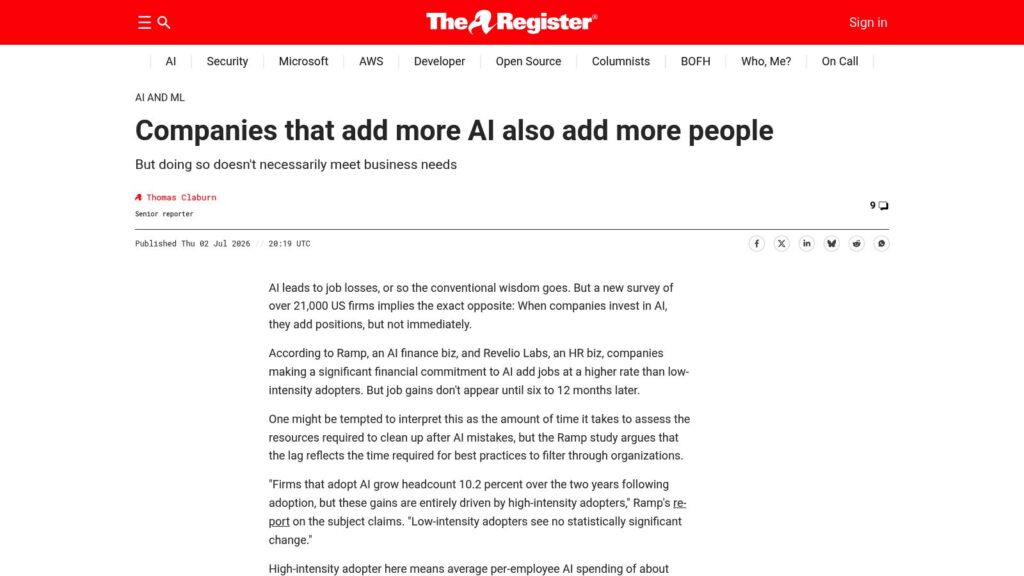
Companies That Add More AI Also Add More People

A survey of over 21,000 US firms by Ramp and Revelio Labs reveals that companies making significant financial investments in AI tend to add jobs at a higher rate than low-intensity adopters, with job growth appearing six to 12 months after AI adoption. High-intensity AI adopters grew headcount by 10.2 percent over two years, primarily by hiring entry-level workers with skills in AI usage, though overall labor market improvements remain uneven. This trend suggests that AI investment is associated with workforce expansion, especially in roles supporting AI deployment and management, despite ongoing concerns about costs, control, and trust in AI providers.

https://www.theregister.com/ai-and-ml/2026/07/02/companies-that-add-more-ai-also-add-more-people/5266134

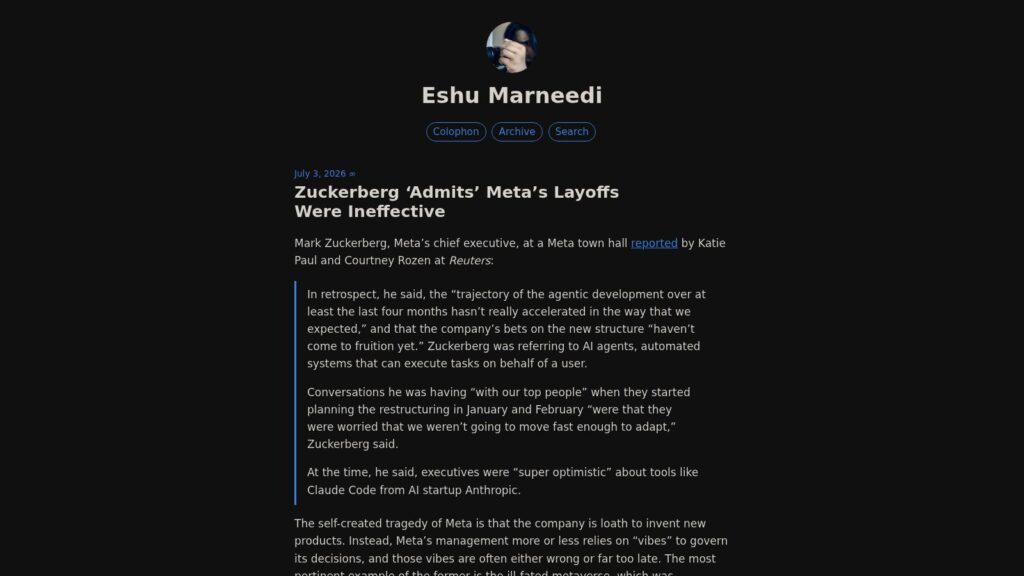
Zuckerberg ‘Admits’ Meta’s Layoffs Were Ineffective

Mark Zuckerberg acknowledged that Meta’s recent layoffs and restructuring around AI agent development have not yielded the expected acceleration in progress, revealing flaws in the company’s strategic bets. The article critiques Meta’s management style as overly reliant on intuition or “vibes,” leading to misdirected efforts like the metaverse push and misguided AI adoption strategies that have caused turmoil, layoffs, and organizational disorder without clear gains. This approach has left Meta struggling to effectively integrate AI developments and maintain coherent direction amid rapidly evolving technology trends.

https://eshumarneedi.com/2026/07/03/zuckerberg-admits-metas-layoffs-were.html

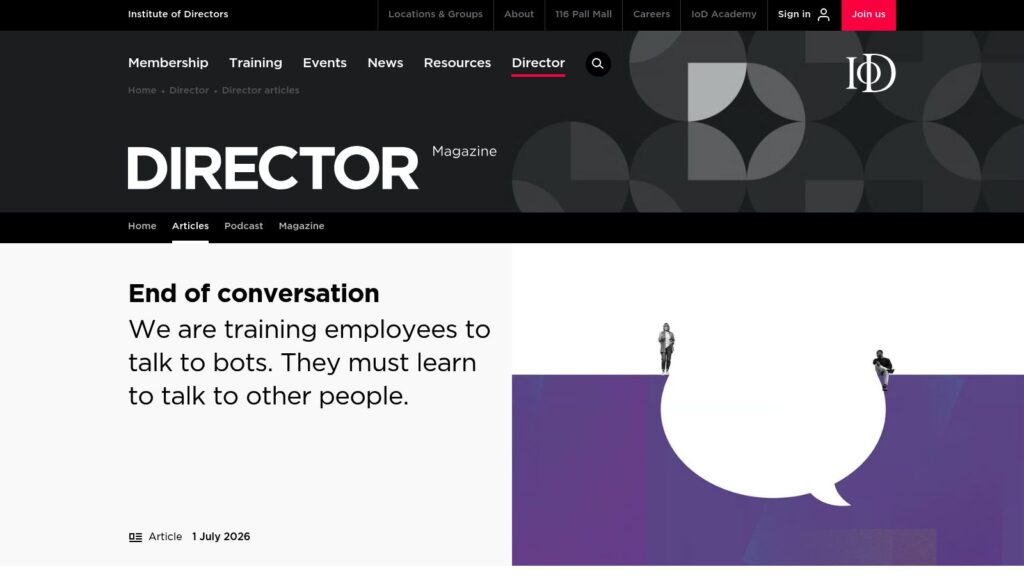
End of Conversation: We Are Training Employees to Talk to Bots. They Must Learn to Talk to Other People.

As generative AI becomes widespread in workplaces, businesses are investing heavily in training employees to communicate effectively with bots, but experts warn that preserving human-to-human conversation skills is crucial. Declining interpersonal communication, especially among younger generations who prefer texting and voice notes over calls, risks harming business relationships and causing communication breakdowns. To address this, companies should develop clear communication strategies that integrate AI as a support tool while prioritizing direct conversations, training employees in soft skills like active listening and empathy to maintain authentic human connections essential for organizational success.

https://www.iod.com/director/articles/end-of-conversation-we-are-training-employees-to-talk-to-bots-they-must-learn-to-talk-to-other-people/

AI Is Changing Work. It Might Also Be Limiting How Expertise Is Built

As organizations adopt AI to automate entry-level tasks, Deloitte research highlights a “broken skills ladder” where fewer entry-level hires lead to diminished opportunities for workers to develop expertise over time. This shift risks long-term shortages of proficient, experienced talent, emphasizing the need for public sector involvement to rebuild pathways that support skill development and expertise growth.

https://www.deloitte.com/us/en/insights/industry/government-public-sector-services/ai-future-of-work-reskilling.html

Computer Scientist on Why He Believes Mass Layoffs Due to AI Is a ‘Convenient Excuse’

Princeton computer scientist Sayash Kapoor argues that many corporate layoffs attributed to AI are actually driven by other factors like post-pandemic overhiring and shareholder pressure, making AI a “convenient excuse” rather than a primary cause. He believes AI will reshape job roles by automating certain tasks but not cause mass job losses, though the reduction in entry-level hiring could pose challenges for workforce development.

https://www.npr.org/2026/06/30/nx-s1-5864243/computer-scientist-on-why-he-believes-mass-layoffs-due-to-ai-is-a-convenient-excuse

The AI Jobs Debate Just Got Messier

A recent report by Ramp and Revelio Labs shows that companies heavily investing in AI have increased headcount by over 10%, including in entry-level roles, suggesting AI can contribute to firm expansion rather than just job displacement. While AI-related layoffs have impacted many workers, especially younger and entry-level employees, growth is strongest in tech-forward firms where AI lowers production costs and boosts output, potentially widening the gap between well-resourced companies and others. The findings challenge broad assumptions that AI universally eliminates jobs, highlighting its complex impact on workforce dynamics.

https://techcrunch.com/2026/06/29/the-ai-jobs-debate-just-got-messier/

Bosses Are Becoming Obsessed With AI, Using It to Make Every Decision, Barraging Their Employees With Nonsensical ChatGPT Directives, and Even Asking It Who to Fire

An increasing number of bosses are excessively relying on AI tools like ChatGPT to make every business decision, impose unrealistic directives, and even determine employee hirings or firings, creating toxic and unproductive workplaces. Employees report constant shifts in responsibilities and strategies based solely on AI interactions, diminished human input, and a disconnect from workplace realities, often leading to frustration, reduced morale, and resignations. This trend highlights the challenges organizations face in integrating AI without undermining human judgment and effective workforce management.

https://futurism.com/artificial-intelligence/bosses-obsessed-with-ai

Most Companies Are Already Failing at AI. They Just Don’t Know It Yet.

Many companies are wrongly assessing their progress with AI by relying on inadequate metrics, leading to widespread but unrecognized failure in effectively implementing AI initiatives. The article warns that the opportunity to correct course and achieve meaningful AI integration is shrinking faster than most organizations realize.

https://www.entrepreneur.com/business-news/most-companies-are-already-failing-at-ai-they-just-dont-know-it-yet

The Anatomy of an AI-Native Org

AI has drastically reduced the need for translation tasks that formed the broad middle layer of traditional software organizations, collapsing the “how” layer where most headcount existed. The resulting AI-native org features a small “why” group defining purpose, a larger “what” group focused on judgment and defining quality, and a smaller, highly skilled “how” group managing complex engineering work and building trust systems for AI agents that now handle most conversion tasks. This shift demands managers who contribute directly to outcomes and engineers who focus on defining correctness and maintaining high-level architectural control rather than routine translation work.

https://ajeygore.in/content/the-anatomy-of-an-ai-native-org

How AI Has Created a Braggy Culture of Layoffs

Tech CEOs increasingly boast about AI-driven layoffs as a strategy to signal to investors their commitment to cutting costs and boosting share prices, even at the expense of employee morale. This shift toward a more aggressive, performative language around workforce reductions reflects a power imbalance where executives prioritize market performance over employee wellbeing, contributing to a culture that normalizes and even celebrates job cuts enabled by automation.

https://newrepublic.com/article/211359/ceos-artificial-intelligence-tech-layoffs

Scroll to Top