psychology

Why Is Everyone In Tech So Sad?

The article explores the growing sense of disillusionment among knowledge workers in the tech industry as AI increasingly automates their tasks, challenging the meaningfulness of their careers. It highlights how this shift may prompt a broader loss of faith in knowledge work itself, raising questions about the future role and well-being of professionals in an AI-driven economy.

https://www.noemamag.com/why-is-everyone-in-tech-so-sad/

When People Think AI Did the Creative Work, Task Meaning and Effort Decline

A study by researchers from the United States and the Netherlands found that when people believe AI created a creative output, they perceive the related task as less meaningful and are less willing to put in effort, such as contributing their own ideas. This decline in task meaning and motivation occurs despite the quality of the AI-generated work remaining constant, highlighting a challenge for organizations adopting AI: preserving human engagement and a sense of ownership in AI-assisted workflows to fully realize productivity gains.

https://www.brookings.edu/articles/when-people-think-ai-did-the-creative-work-task-meaning-and-effort-decline/

Is AI Creating a Culture of Avoidance?

AI communication tools help reduce interpersonal friction by smoothing difficult interactions, but experts warn they may also erode empathy and human intuition, especially among younger users still developing social skills. Increased reliance on AI for social exchanges can create a culture of avoidance, diminishing people’s ability to practice real-world empathy and weakening trust and mutual connection. Researchers emphasize the importance of using AI to augment rather than replace human relationships to preserve essential social and cognitive skills.

https://cacm.acm.org/news/is-ai-creating-a-culture-of-avoidance/

What Nobody Wants to Talk About in AI Disruption, and a Silver Lining

The article compares AI disruption in the workplace to a forced-rotation culture that compels employees to continually update their skills and adapt proactively. It emphasizes that fear of obsolescence is natural, but individuals who actively manage their career trajectory with discipline and integrate mind, body, spirit, and emotion are better equipped to navigate change. The author encourages leaders to acknowledge their fears, move beyond purely cognitive responses, and take ownership of their development to remain relevant and resilient amid rapid AI-driven transformations.

https://www.psychologytoday.com/us/blog/mental-health-in-the-workplace/202607/what-nobody-wants-to-talk-about-in-ai-disruption-and-a

AI Job Grief: The Unnamed Psychological Crisis Hitting Tech Workers

AI-driven job displacement is causing a unique form of psychological grief among tech workers that extends beyond typical fear or anxiety, as it threatens their professional identity and sense of self. This grief is often disenfranchised, lacking social acknowledgment or institutional support, which complicates emotional processing and recovery, especially as AI continues to evolve rapidly, leaving no stable endpoint for acceptance. The resulting emotional distress manifests in symptoms like anxiety and depression and affects workforce behavior, including sabotage of AI implementations, while existing models of grief and institutional responses fail to adequately address this ongoing crisis.

https://jackmaguire.org/blog/ai-job-grief/

The Gervais Principle, Or The Office According to “The Office”

The Gervais Principle, derived from The Office, posits that organizations function as hierarchical constructs where Sociopaths exploit over-performing Losers, promoting them to middle management (Clueless) while grooming under-performers for Sociopath roles. The principle critiques existing management theories, asserting that organizations are inherently pathological and thrive on a Darwinian dynamic. Sociopaths, the most cunning, manipulate the structure for personal gain, while Clueless individuals maintain false loyalty despite the organization’s exploitation. In contrast, Losers adapt by slacking off or seeking fulfillment outside work. This system reveals the tragic absurdity of workplace dynamics, exemplified through characters like Michael Scott and Ryan.

https://www.ribbonfarm.com/2009/10/07/the-gervais-principle-or-the-office-according-to-the-office/

It Turns Out That Constantly Telling Workers They’re About to Be Replaced by AI Has Grim Psychological Effects

AI automation fears cause significant mental health issues, termed AI Replacement Dysfunction (AIRD). Symptoms include anxiety, insomnia, and loss of identity, affecting workers even without other disorders. Researchers stress the need for awareness in mental health practices as job displacement concerns grow, particularly among those fearing AI’s impact on employment.

https://futurism.com/artificial-intelligence/ai-effects-workers-psychological

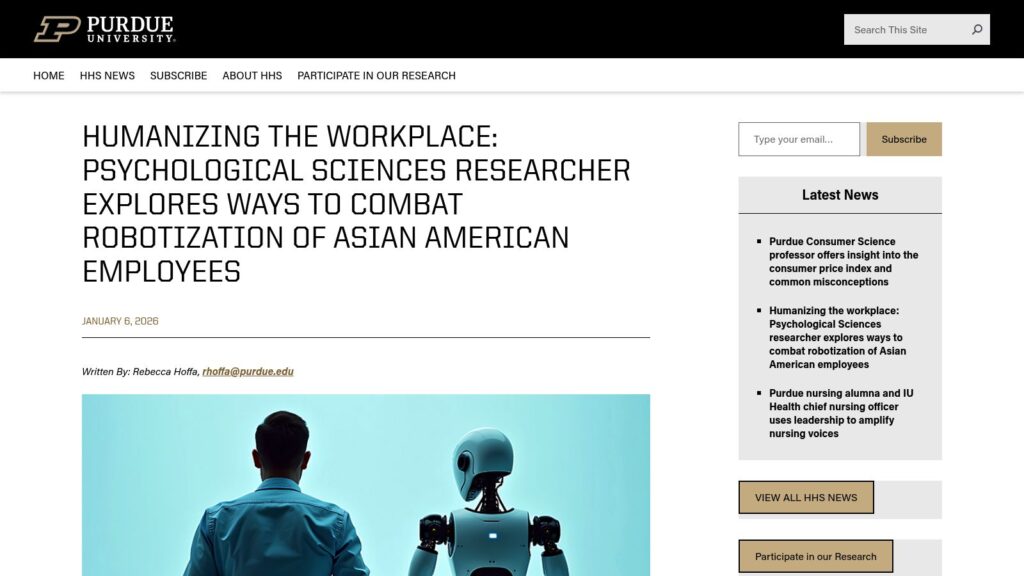
Humanizing the Workplace: Psychological Sciences Researcher Explores Ways to Combat Robotization of Asian American Employees

Research by Franki Kung at Purdue reveals U.S. Asians face mechanistic dehumanization at work, impacting employee satisfaction. Kung advocates for humanizing workplace practices that respect individuality, enhancing both employee well-being and organizational success. His work aims to create environments where employees feel valued and understood, addressing broader implications for all workers.

https://www.purdue.edu/hhs/news/2026/01/humanizing-the-workplace-psychological-sciences-researcher-explores-ways-to-combat-robotization-of-asian-american-employees/

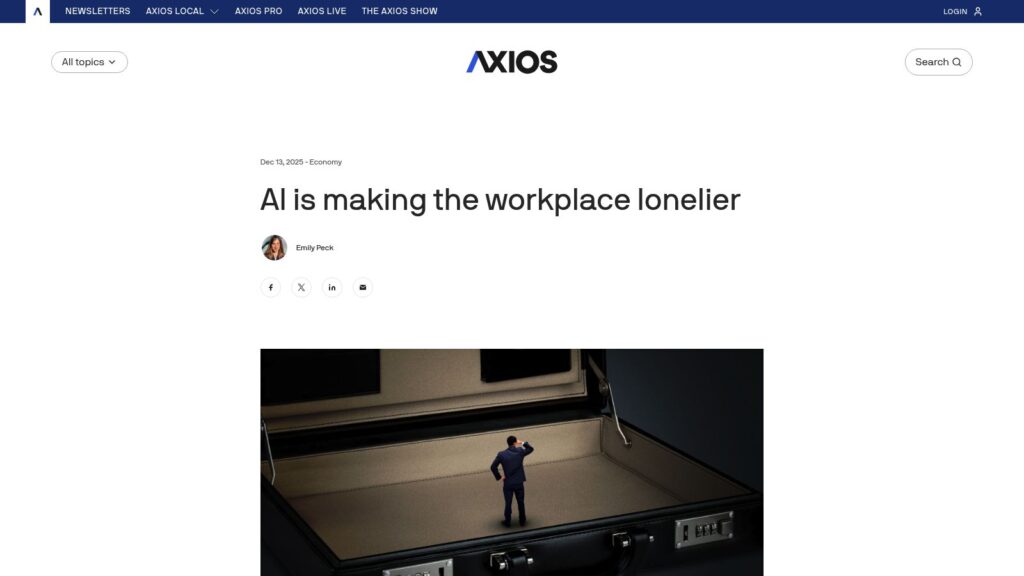
AI Is Making the Workplace Lonelier

AI is increasing workplace loneliness as employees favor chatbots over human interaction for tasks like mentorship and brainstorming. While productivity rises, this trend results in fewer connections and collaboration, leading to potential emotional detachment among workers. Although AI is seen as a supplement to conversation, concerns grow that reliance on bots undermines human connection and creativity, potentially fracturing organizations.

https://www.axios.com/2025/12/13/ai-anthropic-chatbot-remote-work-jobs

Scroll to Top