growth

AI Creates a Workforce Dividend. Invest It for Growth.
The article highlights that CEOs often overlook the critical leadership role required to successfully integrate AI into their organizations. It emphasizes that beyond technology adoption, leaders must focus on workforce reskilling, culture change, and redesigning work practices to fully capture AI’s productivity and growth benefits. PwC underscores that proactive leadership in these areas is essential for realizing the long-term value of AI while managing workforce transformation effectively.

https://www.pwc.com/us/en/services/ai/ai-dividend-growth-redeployment.html
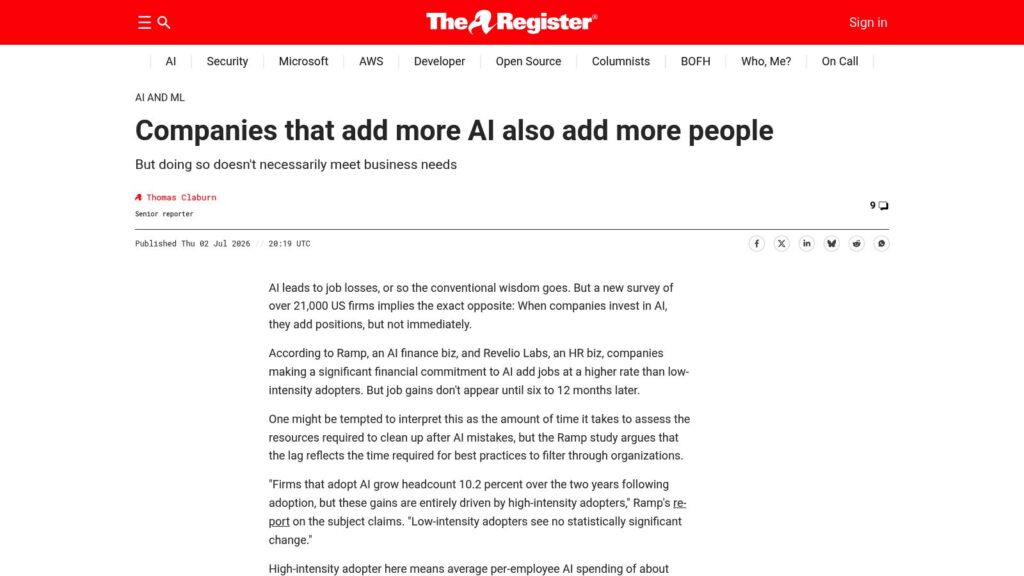
Companies That Add More AI Also Add More People

A survey of over 21,000 US firms by Ramp and Revelio Labs reveals that companies making significant financial investments in AI tend to add jobs at a higher rate than low-intensity adopters, with job growth appearing six to 12 months after AI adoption. High-intensity AI adopters grew headcount by 10.2 percent over two years, primarily by hiring entry-level workers with skills in AI usage, though overall labor market improvements remain uneven. This trend suggests that AI investment is associated with workforce expansion, especially in roles supporting AI deployment and management, despite ongoing concerns about costs, control, and trust in AI providers.

https://www.theregister.com/ai-and-ml/2026/07/02/companies-that-add-more-ai-also-add-more-people/5266134

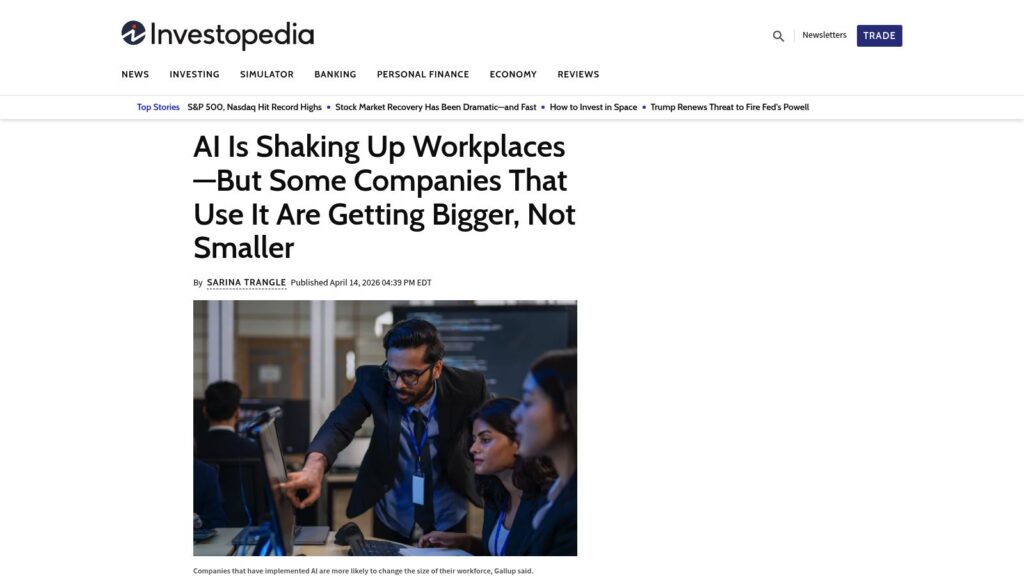
AI Is Shaking Up Workplaces—But Some Companies That Use It Are Getting Bigger, Not Smaller

A Gallup survey reveals that smaller U.S. companies adopting AI tend to expand their workforces, while larger firms are more likely to reduce staff, though AI use signals potential layoffs across all sizes. Despite worker concerns about AI eliminating jobs, many credit the technology with boosting productivity, even as companies continue to explore its operational impact.

https://www.investopedia.com/ai-is-shaking-up-workplaces-but-some-companies-that-use-it-are-getting-bigger-not-smaller-11949806

Why AI Is a Massive Job-Creation Technology, Despite What You Think

Josh Bersin argues that, contrary to popular belief, AI is a massive job-creation technology rather than a job-eliminator, as it transforms and enriches roles rather than replacing them outright. Using examples from software engineering and healthcare, he shows that while AI automates routine tasks, job openings and salaries are increasing due to new, more complex roles requiring human skills such as problem-solving and communication, highlighting how AI amplifies human work and value creation.

https://joshbersin.com/2026/03/why-ai-is-a-massive-job-creation-technology-despite-what-you-think/

5 Workforce Metrics That Reveal If Your Business Growth Is Actually Sustainable

The article emphasizes the importance of monitoring workforce metrics, particularly time and pay data, for business founders aiming for sustainable growth. Key indicators such as overtime, absenteeism, true employee costs beyond base pay, pay accuracy, and turnover rates reveal whether a company’s growth is manageable and financially sound.

https://www.entrepreneur.com/growing-a-business/5-workforce-metrics-every-growing-business-needs-to-track/502987

The 2026 Global Intelligence Crisis

2026 Global Intelligence Crisis Summary:
In 2026, the U.S. faces a 4.28% unemployment rate and rising software engineer job postings. Despite AI capital expenditure growth, current data shows no imminent labor displacement risk. AI adoption follows a slow, cost-sensitive S-curve, suggesting it will complement rather than replace labor. Productivity improvements usually lead to economic growth, increasing real income rather than creating demand shocks. Historical patterns indicate that technological advancements have not eliminated jobs but transformed them. The chance of significant economic disruption from AI hinges on its adoption pace and regulatory responses.

https://www.citadelsecurities.com/news-and-insights/2026-global-intelligence-crisis/

Professional AI Adoption Could Unlock up to $4.1 Trillion Capacity for US

LinkedIn’s report reveals that adopting AI could boost the U.S. economy by $4.1 trillion, enhancing efficiency in sectors like manufacturing and education. However, U.S. AI adoption lags behind countries like India, with only 28% of working-age Americans utilizing AI tools. The report suggests upskilling employees and government support for AI programs to optimize benefits, highlighting that many businesses currently see limited impact from AI.

https://www.socialmediatoday.com/news/professional-ai-adoption-could-unlock-up-to-41-trillion-capacity-for-us/812915/

KPMG 2026 Perspectives: Local Insights From Boston

KPMG’s 2026 report on Boston businesses shows a strategic shift towards AI adoption and workforce upskilling amidst economic uncertainty. Leaders emphasize efficiency, with 98% providing AI training and 91% focusing on internal upskilling to reduce hiring needs. Confidence in growth remains high (up to 94%), but there are concerns over integration of AI, cybersecurity, and market conditions. While hiring and expansion plans have slightly decreased, 93% intend to increase AI use, expecting transformative impacts on operations. Additionally, Boston’s talent quality and educational resources are seen as competitive advantages, with a substantial number aiming for acquisitions in 2026 despite tariff impacts affecting sales.

https://kpmg.com/us/en/media/news/boston-perspectives.html

Growth in 2026 Won’t Happen Without Businesses Prioritizing Worker Trust and Skills

Businesses must prioritize employee trust and skills for growth in 2026. Research indicates that while employees are optimistic about AI’s potential, many companies are not effectively leveraging AI to boost productivity. High-performing organizations that invest in upskilling and employee collaboration achieve better results, demonstrating that human-centric approaches are vital for successful AI integration and organizational growth.

https://www.unleash.ai/artificial-intelligence/growth-in-2026-wont-happen-without-businesses-prioritizing-worker-trust-and-skills/

Scroll to Top