ai

Here’s Why Your AI Rollout Is Failing
Many businesses struggle with AI adoption; only 14% of workers use Generative AI daily. The major barrier isn’t technology but a skills gap—63% of employers cite workforce skills as a key issue for AI transformation. Most employees lack the advanced skills necessary for AI, with 69% unable to perform even basic tasks. Quick workshops aren’t a solution; organizations need systematic training to develop foundational skills and build trust in AI tools. Companies that invest in training show significantly better AI integration outcomes, emphasizing that solving the training problem, not the technology issue, is crucial for success.

https://www.fastcompany.com/91467341/heres-why-your-ai-rollout-is-failing
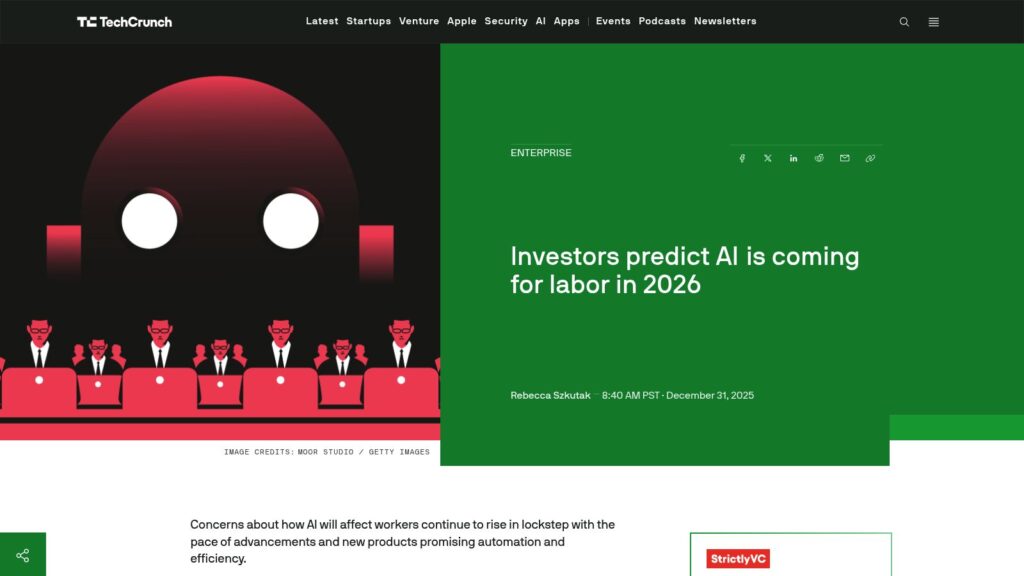
Investors Predict AI Is Coming for Labor in 2026

Investors foresee significant labor impact from AI by 2026, with concerns about automation replacing jobs. A study indicates 11.7% of jobs may be automated; layoffs are already being attributed to AI in many companies. Experts suggest a shift in budgets from labor to AI will exacerbate job cuts, although there’s ambiguity regarding productivity and future workforce roles. AI is anticipated to evolve from enhancing efficiency to automating tasks, leading some to view it as a scapegoat for corporate downsizing.

https://techcrunch.com/2025/12/31/investors-predict-ai-is-coming-for-labor-in-2026/

Key HR Technology Trends for 2026 — and How to Plan

Agentic AI is transforming HR technology, driving automation and insights. Organizations must align people, data, and technology to leverage AI’s potential, prioritizing strong governance and HR-IT collaboration. By 2028, 33% of enterprise software applications will include agentic AI, highlighting its growing importance in streamlining processes and enhancing decision-making.

https://www.adp.com/spark/articles/2025/12/key-hr-technology-trends-for-2026-and-how-to-plan.aspx

These Companies Say AI Is Key to Their Four-day Workweeks

Some companies are adopting a four-day workweek, citing AI’s ability to automate time-consuming tasks and improve efficiency. This trend is particularly prevalent among remote and hybrid companies, where AI tools are used for coding, marketing, and data analysis. While challenges exist, such as educating teams about AI and ensuring data confidentiality, the potential for increased productivity and employee satisfaction is driving this shift.

https://www.washingtonpost.com/business/2025/12/31/ai-four-day-workweek/

A Tale of Two Workforces: Who’s Using AI and Who’s Getting Left Behind

AI adoption at work varies by country, with 70% in Ireland using it versus 18% in Japan. Employer support drives adoption, but 16-40% of workers feel disengaged from AI and its training, often older and in manual jobs. AI users report significant time savings, averaging over an hour daily, leading to increased engagement and productivity. Disengaged workers lack awareness and training opportunities, highlighting the need for employer support and targeted outreach to improve AI integration in the workplace.

https://www.hiringlab.org/2025/12/29/two-workforces-whos-using-ai-and-whos-getting-left-behind/

Utilities Turn to Physical AI to Accelerate Grid Modernization

Utilities are using robotics and AI to address workforce shortages, enhance operational efficiency, and improve inspection cycles without needing extensive manpower. Integrating robotics into existing ERP systems offers significant benefits such as increased task velocity, better data reliability, and improved safety. This approach helps meet rising demands while optimizing the workforce, reducing risk, and enhancing grid resilience.

https://erp.today/utilities-turn-to-physical-ai-to-accelerate-grid-modernization/

Manufacturing’s Future Is High Tech

Manufacturing is evolving into a high-tech industry driven by AI, automation, and sustainability, requiring new skills and perceptions. Experts advocate for educational reforms to align with modern needs, emphasizing hands-on training and career visibility to attract talent. The sector faces a talent shortage, demanding a workforce adept in technology and soft skills. By 2035, successful manufacturing will hinge on innovation, adaptability, and purpose-driven careers, reinforcing manufacturing’s role in economic strength.

https://roboticsandautomationnews.com/2025/12/30/opinion-manufacturings-future-is-high-tech-and-the-workforce-must-adapt/97952/

Joseph Michelli Discusses AI Trends Reshaping Workforce and Customer Experience

Michelli discusses AI’s impact on workforce and customer experience. As tech evolves, 38% feel left behind; companies must adopt thoughtful offboarding to maintain reputations. Internal communication should be careful not to disclose personal details. Customer satisfaction declines with AI; many prefer human interaction. Automation should enhance human-centered design while respecting privacy. Leaders need ongoing engagement with staff and customers for improved satisfaction and learning.

https://www.cbtnews.com/joseph-michelli-discusses-ai-trends-reshaping-workforce-and-customer-experience/

Tech Trends 2026: How AI, Data and Security Are Reshaping Manufacturing

By 2026, manufacturers will increasingly adopt AI and automation to optimize operations, with over 40% upgrading production scheduling systems to AI. This shift will involve software-defined factories, AI-driven design, and federated data architectures, requiring manufacturers to address challenges like data unification and security concerns. Additionally, AI will reshape workforces through human-robot collaboration and personalized training, and enhance cybersecurity through AI-powered defenses.

https://biztechmagazine.com/article/2025/12/tech-trends-2026-how-ai-data-and-security-are-reshaping-manufacturing

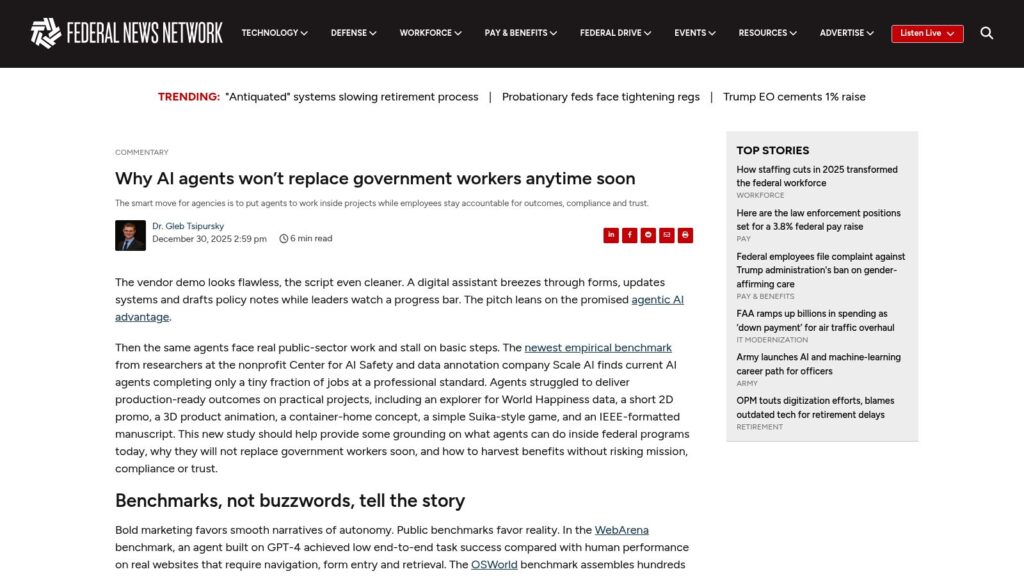
Why AI Agents Won’t Replace Government Workers Anytime Soon

AI agents can’t replace government workers soon; they lag in completing complex tasks essential for public-sector work. Current AI technology struggles with nuance, compliance, and multitasking, as shown by benchmarks proving low task success rates. Instead, AI should complement human efforts, enhancing productivity by assisting with specific tasks under human oversight. This ensures quality, accountability, and adherence to compliance standards unique to government operations.

https://federalnewsnetwork.com/commentary/2025/12/why-ai-agents-wont-replace-government-workers-anytime-soon/

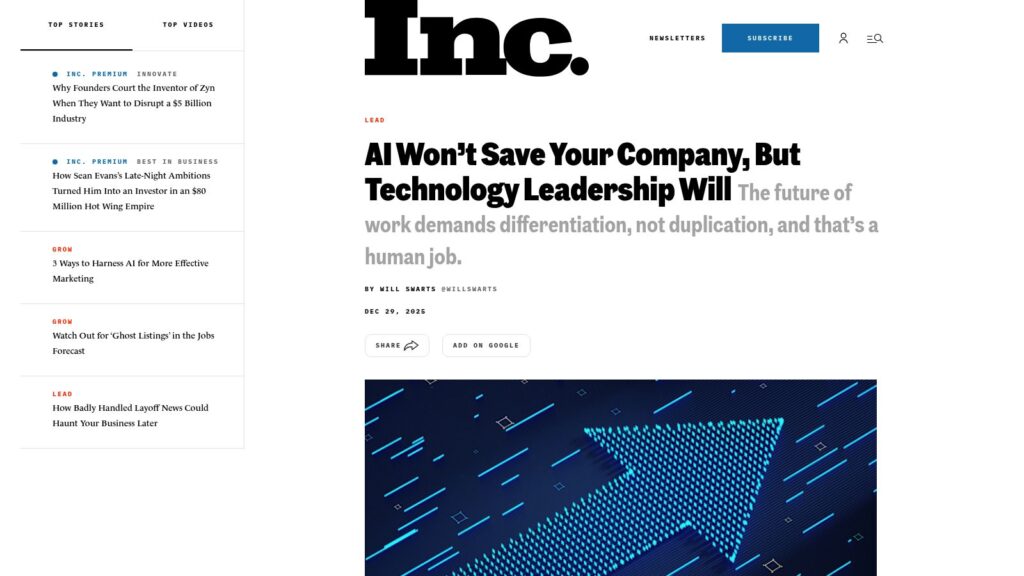
AI Won’t Save Your Company, But Technology Leadership Will

AI’s rise in the workplace necessitates genuine differentiation over mere application. Companies must transition from superficial “AI-loving” to innovative use, as market consolidation looms. Many will face job loss, particularly early-career workers, while experienced staff can enhance productivity with AI. Leadership’s role is crucial in bridging the skill gap, fostering ethical AI use, and guiding employee adaptation.

https://www.inc.com/will-swarts/ai-wont-save-your-company-but-technology-leadership-will/91280923

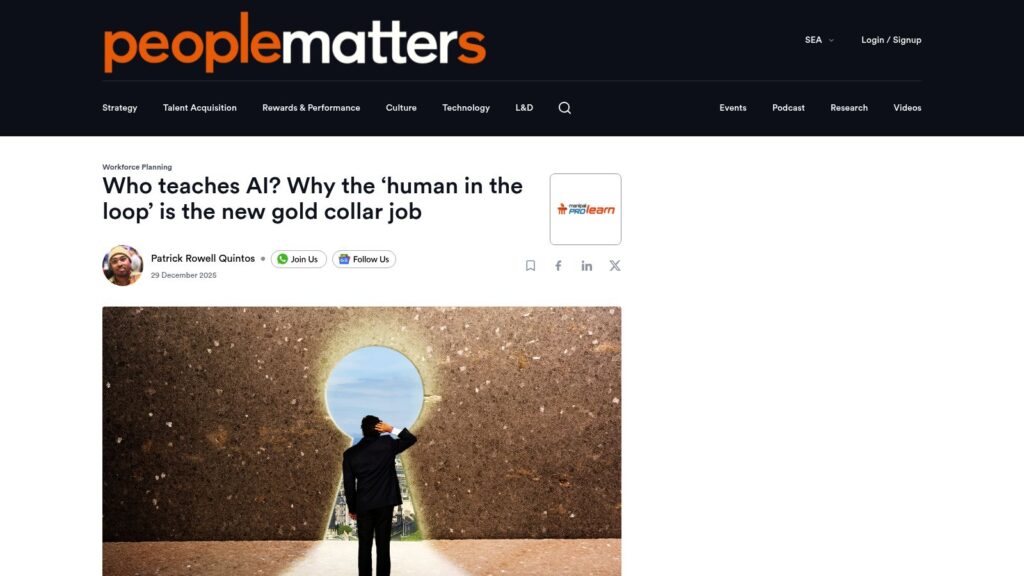
Who Teaches AI? Why the ‘human in the Loop’ Is the New Gold Collar Job

AI’s future relies on ‘human-in-the-loop’ (HITL) systems, where skilled professionals manage AI’s outputs to prevent errors. This shift creates “gold collar” workers who ensure AI accuracy, countering costly mistakes from AI hallucinations, which cost enterprises $67.4 billion in 2024. Professionals in high-demand fields, like medicine and finance, serve as crucial overseers, shifting from execution to management of AI systems. As AI evolves, companies prioritize enhanced training for staff, adopting robust frameworks to bridge the skills gap and maintain oversight, making human judgment essential in the AI era.

https://sea.peoplemattersglobal.com/article/workforce-planning/who-teaches-ai-why-the-human-in-the-loop-is-the-new-gold-collar-job-47857

AI Was Behind Over 50,000 Layoffs in 2025 — Here Are the Top Firms to Cite It for Job Cuts

In 2025, AI was linked to nearly 55,000 layoffs in the U.S., contributing to a total of 1.17 million job cuts, the highest since 2020. Major companies like Amazon and Microsoft cited AI as a key factor in their layoffs, part of broader cost-cutting efforts amid economic challenges. Critics suggest companies may be using AI as a scapegoat for overhiring during the pandemic.

https://www.cnbc.com/2025/12/21/ai-job-cuts-amazon-microsoft-and-more-cite-ai-for-2025-layoffs.html

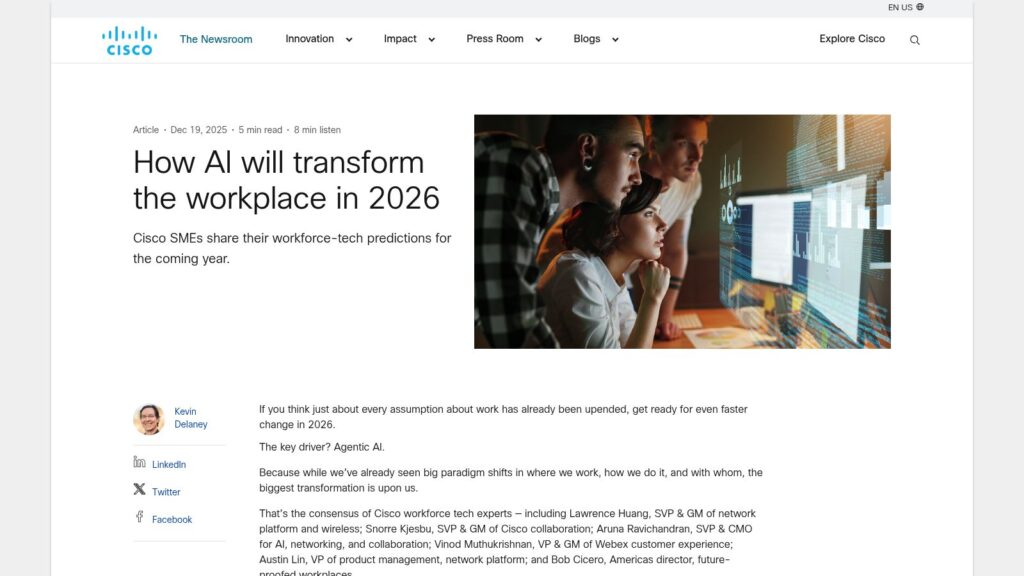
How AI Will Transform the Workplace in 2026

AI will transform workplaces in 2026 through ‘Connected Intelligence,’ integrating people, AI, and data. Key changes include:

  1. Collaboration: Human-to-AI and AI-to-AI interactions will enhance teamwork.
  2. Infrastructure: Networks will evolve to support increased AI traffic and threats.
  3. Simplified IT: AI will streamline network management, enabling focus on strategy.
  4. Customer Experience: AI will redefine interactions between brands and customers, emphasizing hybrid teamwork.
  5. Security & Leadership: Organizations will prioritize trust and adaptive security as they manage human and AI workers.

The future emphasizes collaboration, simplified management, and trust.

https://newsroom.cisco.com/c/r/newsroom/en/us/a/y2025/m12/how-ai-will-transform-the-workplace-in-2026.html

Scroll to Top