Amazon’s Layoffs and Leaked AI Plans Beg the Question: Is the Era of Robot-driven Unemployment Upon Us?

Amazon’s layoffs and AI plans raise concerns about robot-driven unemployment. Though Amazon claims robots extend human capacity, internal documents suggest plans to automate 75% of operations, potentially affecting 600,000 jobs. While corporate layoffs occur (14,000 jobs cut), the company continues investing in AI and training. Automation could reshape job roles, but fears about job scarcity persist, creating a complex future for workers. The mixed impact of robots on warehouse employment highlights the need for a balance between efficiency and workforce sustainability.

https://fortune.com/2025/11/25/amazon-layoffs-artificial-intelligence-robots-unemployment-automation/

Agents, Robots, and Us: Skill Partnerships in the Age of AI

AI is reshaping workforce dynamics, creating partnerships among individuals, agents, and robots. While automation could theoretically streamline 57% of US work hours, this does not predict job loss. Skills remain relevant but will evolve. Key findings reveal a rise in demand for AI fluency and an estimated potential economic boost of $2.9 trillion in the US by 2030, dependent on effective collaboration between humans and machines. Organizations must adapt workflows around AI integration, emphasizing human skills that complement technology.

https://www.mckinsey.com/mgi/our-research/agents-robots-and-us-skill-partnerships-in-the-age-of-ai

Robots and AI Are Already Remaking the Chinese Economy

China is rapidly transforming its economy with robots and AI to enhance manufacturing efficiency as a response to rising costs and international competition. Companies like Midea are implementing AI systems that manage production and logistics, significantly speeding up processes and reducing labor needs. China’s aggressive robot deployment—295,000 installed last year—far exceeds that of the U.S. These advancements aim to secure China’s role as a global manufacturing hub despite a shrinking workforce and rising wages. The government sees this adoption of AI as crucial for maintaining economic strength and competitiveness against U.S. initiatives to bring jobs back domestically.

https://www.wsj.com/tech/ai/ai-robots-china-manufacturing-89ae1b42?st=wTHV3o

The Incredible Shrinking Shelf Life of IT Skills

IT skills’ relevance is declining rapidly due to accelerated technological innovation, necessitating continuous upskilling among IT professionals. The half-life of skills has decreased from decades to as little as two years, with skills like FinOps currently in demand but possibly becoming obsolete as AI advancements take over. Organizations must foster a culture of adaptability and continuous learning to keep pace with changing requirements. Hiring or developing employees with a growth mindset and enabling time for skill development is essential for navigating this skill instability landscape.

https://www.cio.com/article/4093446/the-incredible-shrinking-shelf-life-of-it-skills.html

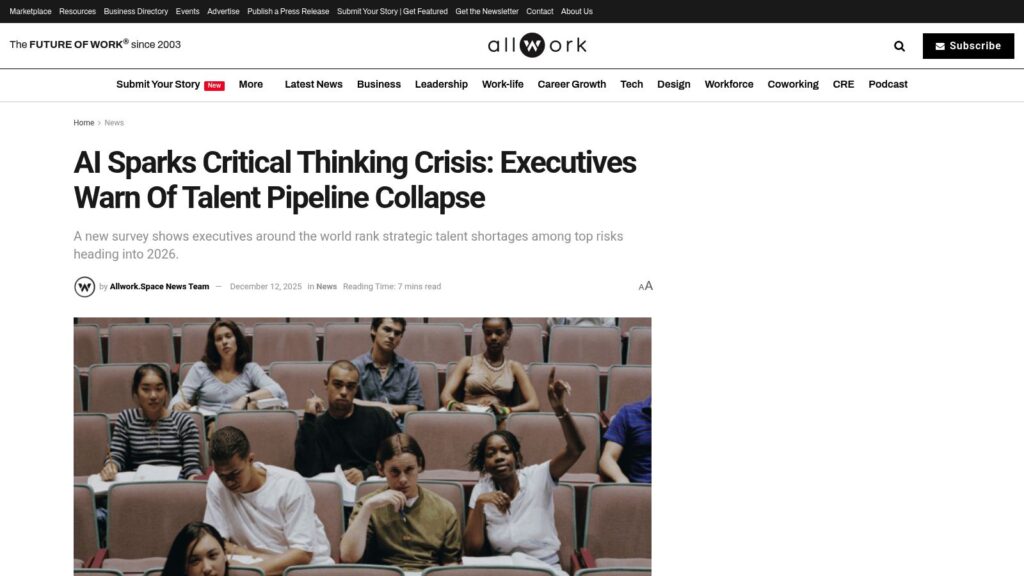
AI Is Killing Many Entry-Level Jobs

AI is displacing entry-level jobs, particularly for recent graduates, as employers increasingly automate processes. While hiring projections remain bleak, some companies still prioritize entry-level roles for future growth. A report suggests up to 20% entry-level unemployment might occur due to automation. Typical sectors like software, clerical, and customer service jobs are hit hardest, prompting advice for young workers to seek opportunities at small companies and acquire skills in AI technologies.

https://www.eweek.com/news/ai-kills-entry-level-jobs/

American Workers Are Leading the AI Revolution Despite Questions Around New Career Paths

The insight reveals a “bottom-up” AI adoption among U.S. workers: 87% use AI weekly, yet job security concerns rise. Employees seek more AI training and better integration of productivity gains. Gen Z fears job loss to AI, prompting the need for new career development paths. Diverse workplace experiences highlight the need for flexible models to retain talent and promote equity.

https://kpmg.com/us/en/media/news/american-workers-leading-ai-revolution.html

Agentic AI: The Autonomous Force Redefining Work and Power Structures

Agentic AI represents a shift from traditional chatbots to autonomous systems capable of independent decision-making, driven by companies like Microsoft and Amazon. These systems promise to enhance productivity across industries, potentially unlocking trillions in value, while raising ethical and workforce concerns due to their capacity to automate complex tasks and eliminate entry-level jobs. As enterprise platforms evolve to integrate agentic AI, businesses must adapt to its implications on work structures and the need for workforce reskilling.

https://www.webpronews.com/agentic-ai-the-autonomous-force-redefining-work-and-power-structures/

How to Scale Distributed Product Teams From 10 to 100+

TLDR: Scaling distributed product teams from 10 to 100+ in 2025 demands a mindset shift and effective organizational structures. Key stages include establishing squad structures, implementing decision frameworks, fostering autonomy with tribes and chapters, and introducing communication processes. Hire effectively with structured interviews and prioritize cultural diversity. Maintain culture through documented values and engagement practices. Watch out for pitfalls like rapid hiring and ignoring technical debt. Focus on metrics like velocity and engagement to ensure healthy scaling. Successful scaling is about creating systems that enable team multiplication, not just adding personnel.

https://intelligentfuturetech.com/blog/scaling-distributed-product-teams-2025/

‘AI Will Leave a Lot of White Collar People Behind’ and It’s Time to Shift to This Industry, According to Fortune 500 CEO

Ford CEO Jim Farley warns AI may displace many white-collar jobs, advocating for a shift to trade skills. Research shows manual labor positions, like roofing, are less likely to be replaced by AI. Despite declining views on the necessity of college, degree-holders still earn significantly more than those without degrees.

https://www.investopedia.com/ai-will-leave-a-lot-of-white-collar-people-behind-and-it-s-time-to-shift-to-this-industry-according-to-fortune-500-ceo-11853838

AI Is Changing Jobs. Who Benefits?

AI is reshaping job landscapes, with companies hiring fewer juniors and pressuring experienced workers to do more. Gains mainly benefit shareholders, AI firms, and skilled senior workers, leaving entry-level positions scarce and mid-career workers undercompensated. The future could see a divided economy or new job creation, but without policy changes, benefits may concentrate among the few.

https://www.vincentschmalbach.com/ai-is-changing-jobs-who-benefits/

Microsoft Teases Agents That Become ‘independent Users’

Microsoft introduces “agentic users,” AI agents acting as independent workforce members, capable of attending meetings, editing documents, and collaborating with humans. These agents will require a specific A365 license and be available in the M365 Agent Store. Concerns about management and potential rogue behavior have been raised, with their debut anticipated during Microsoft’s Ignite conference.

https://www.theregister.com/2025/11/10/microsoft_agentic_users_a365/

The Great Decoupling of Labor and Capital

Tech companies are increasingly decoupling revenue growth from employee headcount, evident in their historical milestones. For instance, Apple achieved its initial $100 billion in revenue with 60k employees but needed only 17k for the next $100 billion. Similarly, Alphabet, Microsoft, and Meta show reduced employee requirements for revenue growth. Even Amazon, affected by pandemic-driven overhiring, added $200 billion in revenue with only 36k more employees. Overall, nearly $1 trillion in incremental revenue across several companies involved only 100k new hires, highlighting a significant trend before generative AI’s impact. This decoupling raises questions about the future workforce dynamics and potential implications for investments and the broader economy.

https://www.mbi-deepdives.com/the-great-decoupling-of-labor-and-capital/

The Rise of ‘vibe Working’

“Vibe working” is a trend where generative AI is used to simplify tasks in the workplace, focusing on a casual, free-flowing approach. It has gained traction, with companies hiring for roles like “Vibe Growth Manager” and implementing tools like Microsoft’s “vibe working.” However, while it emphasizes creativity and ease, experts warn it may underplay the need for skill and hard work. The trend, popular among Gen Z, reflects a shift towards less formal workplaces. Yet, over-reliance on AI can lead to subpar results, highlighting the need for a balance between creativity and expertise.

https://www.businessinsider.com/rise-of-vibe-working-coding-microsoft-openai-2025-10

How to Futureproof Your IT Team in the AI Era

AI disrupts IT roles, causing entry-level positions to vanish. CIOs must adjust by prioritizing skills for future needs, emphasizing strategic problem-solving and collaboration. Traditional IT structures are evolving into cross-functional teams that demand higher-level problem-solving skills from new hires. Training should focus on non-technical skills and AI literacy, while organizations must proactively build continuous training programs to fill growing skill gaps. Emerging roles in AI and cybersecurity are expanding, urging IT leaders to restructure teams and foster a culture of innovation and adaptability.

https://www.cio.com/article/4062363/how-to-futureproof-your-it-team-in-the-ai-era.html

Scroll to Top