ai

500,000 Tech Workers Have Been Laid Off Since ChatGPT Was Released

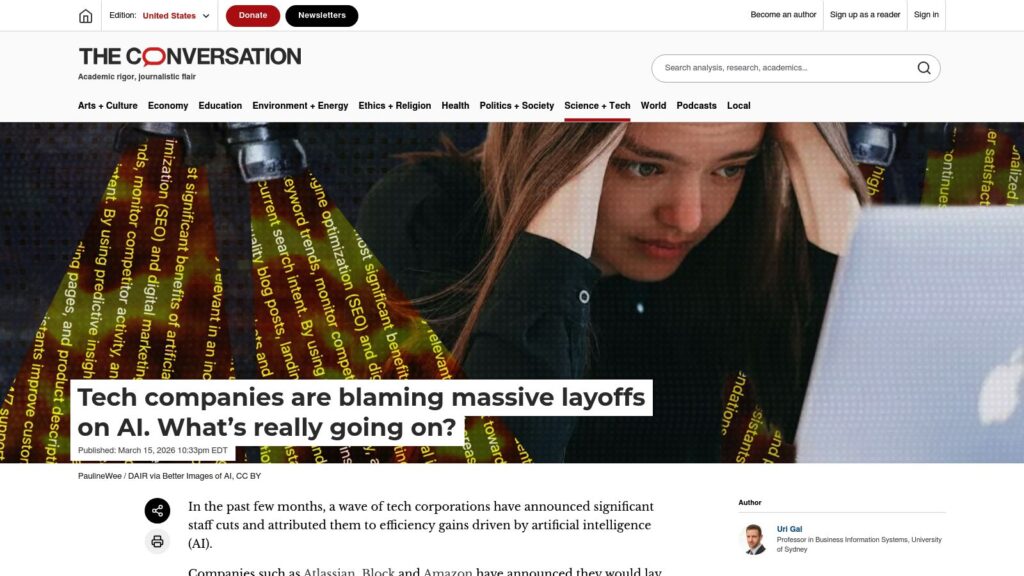
500,000 tech workers laid off since ChatGPT’s late 2022 release, not solely due to AI but as a pretext for cuts by executives. This reflects broader issues in the tech industry, where workers suffer due to bosses’ desires for profit, using AI as an excuse for layoffs rather than as a replacement. The ongoing layoffs cause fear and lower morale, pressuring remaining staff into compliance. Understanding these dynamics is crucial, as AI and automation often conceal deeper political and social motivations behind workforce reductions. Future resilience may arise from displaced talent forming new companies or industries.

https://www.anildash.com/2026/01/06/500k-tech-workers-laid-off/

How Generative and Agentic AI Are Transforming Manufacturing: Solving Workforce Challenges and Driving Efficiency

Generative and Agentic AI enhance manufacturing efficiency, addressing workforce challenges. AI improves productivity and automates processes, offering significant ROI across various applications. AEM encourages embracing AI for organizational success.

https://www.aem.org/news/how-generative-and-agentic-ai-are-transforming-manufacturing-solving-workforce-challenges-and-drivin

The AI Revolution Is Here. Will the Economy Survive the Transition?

AI revolution is underway; experts debate its economic impact. Participants include Michael Burry, who critiques AI’s hype and spending surge post-ChatGPT, and Jack Clark from Anthropic, focusing on AI’s rapid capability growth via Transformers. They discuss AI’s past, current productivity issues, and uncertainty in sector competition. Despite AI’s advancements, widespread job displacement remains limited. Future market dynamics hinge on whether AI can create new spending without cannibalizing existing sectors. The discussion highlights the cyclical nature of AI investments, potential stranded assets, and the challenge of measuring true productivity gains. Overall, skepticism pervades about whether AI will yield significant economic value.

https://post.substack.com/p/the-ai-revolution-is-here-will-the

LSU Research Insights: Shaping the Future of Work With AI That Elevates People

LSU explores AI’s impact on workplaces, focusing on human resource development (HRD). Research emphasizes ethical AI use, employee collaboration, and continuous learning. Key challenges include AI literacy and change management. Future research should address AI’s effects on well-being and competence development. Exciting prospects include personalized learning and organizational analytics. HRD is vital in balancing technology with human needs, promoting collaboration across disciplines.

https://www.lsu.edu/blog/2026/01/ri-hr-ai-park.php

McKinsey Boss Says There Are 3 Skills AI Models Can’t Do That Young Professionals Should Focus On

McKinsey’s Bob Sternfels highlights three essential human skills that AI can’t replicate: the ability to aspire, judgment, and true creativity. He stresses the importance of these skills for young professionals as AI changes talent requirements, suggesting that education background may become less significant compared to practical skills demonstrated in portfolios.

https://www.businessinsider.com/mckinsey-boss-shares-human-skills-ai-models-cant-do-2026-1

Workers Rank AI Among Top Trends Shaping Their Workplace

Workers rank AI and generative AI as top workplace trends, with AI as the leading concern. According to The Adecco Group’s report, based on 37,500 workers and 2,000 executives, salary and work-life balance are primary reasons for job retention. AI training struggles persist, as many feel undertrained. The report emphasizes the demand for stability and growth opportunities in employment.

https://www.staffingindustry.com/news/global-daily-news/workers-rank-ai-among-top-trends-shaping-their-workplace

Can AI Do Your Job? See the Results From Hundreds of Tests.

A study comparing AI systems and human workers on real tasks shows AI is far from replacing jobs. Despite impressive capabilities, the best AI only completed 2.5% of projects successfully, failing mostly due to lack of long-term memory and poor visual understanding. AI produced subpar work for projects like floor plans and dashboards, highlighting its limitations. Although AI may reduce dependence on human workers, the study suggests it won’t fully automate jobs soon.

https://www.washingtonpost.com/technology/interactive/2026/ai-jobs-automation/

Four Ways AI and Talent Trends Could Reshape Jobs by 2030

AI advancements may reshape jobs by 2030 through four scenarios: 1) Supercharged Progress – rapid AI development boosts productivity but causes job displacement; 2) The Age of Displacement – swift automation outpaces workforce adaptation, leading to high unemployment; 3) Co-Pilot Economy – gradual AI integration fosters collaboration and new opportunities; 4) Stalled Progress – slow tech advance with skill shortages results in uneven productivity gains. Businesses must adopt flexible strategies to navigate these uncertainties and invest in human-AI collaboration.

https://www.weforum.org/stories/2026/01/four-ways-ai-impact-job-markets/

AI Layoffs Are Looking More and More Like Corporate Fiction That’s Masking a Darker Reality, Oxford Economics Suggests

Oxford Economics suggests that AI layoffs are often used as a cover for routine headcount reductions, rather than a result of automation. Companies may be attributing job cuts to AI to present themselves as innovative and to appease investors, rather than admitting to business failures. Despite headlines, data show that AI-related job losses account for only a small share of total reported job losses.

https://finance.yahoo.com/news/ai-layoffs-looking-more-more-210954693.html

Companies Are Blaming AI for Layoffs. The Real Reason Will Piss You Off.

Companies falsely blame AI for layoffs; a study shows 95% of investments yield no ROI. Instead, firms are cutting jobs to rectify overhiring from COVID-19. Young workers face increased job losses, particularly in entry-level positions. To safeguard your career, document your achievements, learn AI tools for productivity, and recognize the difference between actual AI displacement and opportunistic layoffs labeled as “AI-driven.”

https://medium.com/@mattlar.jari/companies-are-blaming-ai-for-layoffs-the-real-reason-will-piss-you-off-149639ce47cf

How to Build an AI-Augmented Workforce: The CIO’s Guide

CIOs are shifting to AI-augmented workforces, enhancing human capabilities instead of replacing jobs. AI improves decision-making, reduces mundane tasks, and fosters innovation. Best practices for implementation include prioritizing augmentation, investing in training, and redesigning workflows. Challenges include employee resistance, skills gaps, and data integration issues. Examples across industries illustrate AI’s transformative role in customer support, finance, product development, and HR. Future trends involve personalized AI assistants, embedded generative AI tools, and an increased focus on human judgment, redefining roles and skills necessary for an AI-driven workplace.

https://www.techtarget.com/searchenterpriseai/tip/How-to-build-an-AI-augmented-workforce-The-CIOs-guide

8 Skills You Need To Manage The New AI Agent Workforce

The workforce of the future is being shaped by AI agents, autonomous digital workers that handle complex tasks. To manage this new workforce, professionals need to develop skills in strategic thinking, AI literacy, responsible AI implementation, agentic workflow design, human communication, change management, data governance, and continuous learning. These skills will enable organizations to leverage AI agents effectively while empowering human workers to focus on creative and strategic tasks.

https://bernardmarr.com/8-skills-you-need-to-manage-the-new-ai-agent-workforce/

10 HR Trends That Matter Most As AI Transforms Organizations

AI is becoming a strategic imperative for organizations, reshaping how they compete and innovate. As AI transforms work, companies are prioritizing AI fluency, revamping hiring processes, and addressing employee concerns about job security. While some entry-level jobs are decreasing, new roles are emerging, and organizations are shifting from AI adoption to AI transformation, embedding AI into core business operations.

https://www.forbes.com/sites/jeannemeister/2026/01/06/10-hr-trends-that-matter-most-as-ai-transforms-organizations/

The ‘Godfather of SaaS’ Says He Replaced Most of His Sales Team With AI Agents: ‘We’re Done With Hiring Humans’

SaaStr founder Jason Lemkin replaced most of his sales team with AI agents, aiming for enhanced productivity and efficiency after two high-paid human sales reps quit. His company now employs 20 AI agents, which autonomously handle tasks previously managed by humans, and plans to train them based on top human sales practices. While concerns about data security remain, Lemkin believes AI agents can outperform human workers in scalability and effectiveness.

https://www.businessinsider.com/godfather-of-saas-jason-lemkin-replace-humans-ai-agents-sales-2026-1

AI Is Collapsing The Corporate Pyramid — Experts Say This New Shape Is The Future Of Work

AI is disrupting traditional corporate structures, reducing entry-level positions by 30% and middle management roles, prompting a shift towards flatter, more adaptive organizations. Experts suggest a pentagon-shaped workforce to maintain human judgment and adaptability, ensuring long-term resilience amid AI advancements.

https://allwork.space/2026/01/ai-is-collapsing-the-corporate-pyramid-experts-say-this-new-shape-is-the-future-of-work/

Scroll to Top