business

10 HR Trends That Matter Most As AI Transforms Organizations

AI is becoming a strategic imperative for organizations, reshaping how they compete and innovate. As AI transforms work, companies are prioritizing AI fluency, revamping hiring processes, and addressing employee concerns about job security. While some entry-level jobs are decreasing, new roles are emerging, and organizations are shifting from AI adoption to AI transformation, embedding AI into core business operations.

https://www.forbes.com/sites/jeannemeister/2026/01/06/10-hr-trends-that-matter-most-as-ai-transforms-organizations/

AI Is Collapsing The Corporate Pyramid — Experts Say This New Shape Is The Future Of Work

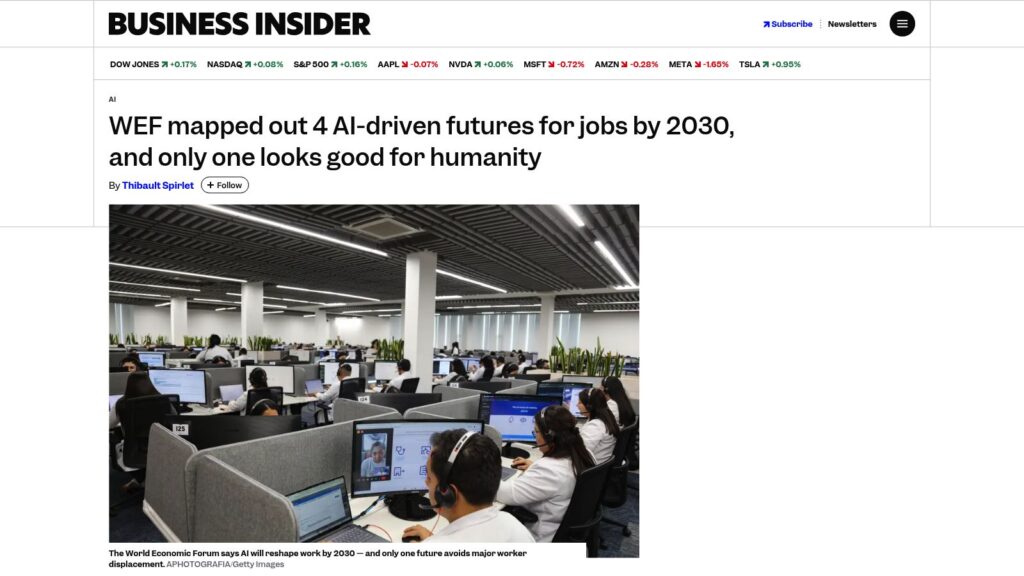
AI is disrupting traditional corporate structures, reducing entry-level positions by 30% and middle management roles, prompting a shift towards flatter, more adaptive organizations. Experts suggest a pentagon-shaped workforce to maintain human judgment and adaptability, ensuring long-term resilience amid AI advancements.

https://allwork.space/2026/01/ai-is-collapsing-the-corporate-pyramid-experts-say-this-new-shape-is-the-future-of-work/

Welcome Back to the Office. You Won’t Get Anything Done

Return-to-office (RTO) mandates are not about productivity but about control. Despite studies showing that hybrid work does not impact productivity, many companies are implementing RTO mandates, citing productivity and company culture as reasons. However, the real motivation behind these mandates is likely to exert control over employees and reduce staff size without paying severance.

https://thewalrus.ca/return-to-office-mandates/

Boston Dynamics Is Training an AI-powered Humanoid Robot to Do Factory Work

Boston Dynamics is advancing AI-powered humanoid robots, notably its Atlas model, to perform factory tasks, demonstrating significant progress in robotics. The company employs innovative training techniques like demonstration and machine learning, enabling Atlas to execute complex movements. Although Atlas can perform some tasks autonomously, routine jobs remain challenging. The humanoid robotics market is projected to grow significantly, with Boston Dynamics leading, amidst competition from global firms, particularly in China. Concerns over job displacement exist, though officials indicate these robots are not yet autonomous enough to fully replace humans.

https://www.cbsnews.com/news/boston-dynamics-training-ai-humanoids-to-perform-human-jobs-60-minutes/

Why Didn’t AI “Join the Workforce” in 2025?

AI agents were predicted to “join the workforce” in 2025, promising significant advancements in productivity. However, this did not materialize; products like ChatGPT Agent underperformed, revealing limitations in AI capabilities. Experts suggest anticipation exceeding reality’s technological progress, calling for a focus on current AI applications rather than future speculations. The discussion emphasizes reevaluating the understanding of AI’s role and output in 2026, shifting from predictions to present capabilities.

https://calnewport.com/why-didnt-ai-join-the-workforce-in-2025/

Know the Top 10 Applications of Robotics in 2026

Robotics is rapidly advancing, influencing many industries by 2026. Key applications include:

  1. Manufacturing: Smart factories with collaborative robots enhance productivity.
  2. Healthcare: Precision robots improve surgical outcomes and patient care.
  3. Logistics: Automation boosts efficiency in warehousing and supply chains.
  4. Agriculture: Robotics enhances crop management and yields.
  5. Retail: AI-powered robots improve customer service and inventory management.
  6. Construction: Robotics facilitates safety and efficiency in building tasks.
  7. Defense: Intelligent robots assist in surveillance and safety.
  8. Space Exploration: Robots perform complex tasks with minimal human input.
  9. Education: Robotics integration aids STEM learning.
  10. Home Automation: Smart robots assist with daily tasks and enhance living quality.

Overall, robotics will reshape work, enhance productivity, and drive economic growth while promoting collaborative human-robot interaction.

https://www.jaroeducation.com/blog/applications-of-robotics

AI Won’t Save Bad Managers, It Will Expose Them

AI exposes bad managers by eliminating their safety net; poor guidance leads to failure. Effective management, not just technology, is crucial for AI success. Clear communication and responsibility are vital as AI cannot compensate for weak leadership. Companies must focus on training managers to leverage AI effectively, ensuring human oversight, and recognizing when tasks should remain human-led to avoid amplifying flaws.

https://nationalcioreview.com/articles-insights/ai-wont-save-bad-managers-it-will-expose-them/

A Future Without Work? What Elon Musk, Bill Gates, and Others in AI Are Saying About the Future.

AI may eliminate work, leading to a future of universal wealth, as envisioned by Elon Musk (“universal high income”), Bill Gates (shorter workweeks), and Sam Altman (shared AI profits). Innovators like Jensen Huang and Dario Amodei foresee varying impacts, questioning the societal structure and fulfillment in such a world.

https://www.businessinsider.com/elon-musk-ai-universal-high-income-ubi-2026-1#jensen-huang-4

6 Workplace Trends Shaping 2026

AI will integrate with workplaces in 2026, affecting roles and productivity. Six trends identified: AI as a team member, enhancing middle management, focus on skills over job roles, human-centric cultures for engagement, personalized return-to-office policies, and building a fluid talent pool. Organizations must adapt to thrive by embracing change and prioritizing ethical practices.

https://www.prsa.org/article/6-workplace-trends-shaping-2026-jan26

AI Changed Work Forever in 2025

By 2050, AI will transform work, enabling individuals to manage AI agents instead of human employees. A significant 79% of companies are utilizing AI, which enhances productivity but raises concerns about human jobs. Execution tasks will increasingly be handled by AI, shifting human roles towards asking the right questions and evaluating results as “Chief Question Officers.” This change could spark innovation, but the societal impact of AI deployment remains uncertain, posing crucial questions about control and empowerment.

https://time.com/7342494/ai-changed-work-forever/

Tokyo Venture Allows Housebound People to ‘work While Teleporting’

Tokyo’s Dawn Avatar Robot Cafe, created by Ory Yoshifuji, allows housebound individuals to operate robots for tours and service, promoting social engagement and employment. Initially a reaction to his own isolation, the venture now employs over 100 “pilots,” enabling disabled participants to feel more connected and productive. The cafe has expanded into tourism, offering personalized tours, while facing challenges like internet connectivity in crowded areas. Ory aims for broader implementation of this model to combat loneliness and enhance inclusion through technology.

https://www.abc.net.au/news/2025-12-31/tokyo-robot-tourism-business-cafe-housebound-workers/106177054

Joseph Michelli Discusses AI Trends Reshaping Workforce and Customer Experience

Michelli discusses AI’s impact on workforce and customer experience. As tech evolves, 38% feel left behind; companies must adopt thoughtful offboarding to maintain reputations. Internal communication should be careful not to disclose personal details. Customer satisfaction declines with AI; many prefer human interaction. Automation should enhance human-centered design while respecting privacy. Leaders need ongoing engagement with staff and customers for improved satisfaction and learning.

https://www.cbtnews.com/joseph-michelli-discusses-ai-trends-reshaping-workforce-and-customer-experience/

Tech Trends 2026: How AI, Data and Security Are Reshaping Manufacturing

By 2026, manufacturers will increasingly adopt AI and automation to optimize operations, with over 40% upgrading production scheduling systems to AI. This shift will involve software-defined factories, AI-driven design, and federated data architectures, requiring manufacturers to address challenges like data unification and security concerns. Additionally, AI will reshape workforces through human-robot collaboration and personalized training, and enhance cybersecurity through AI-powered defenses.

https://biztechmagazine.com/article/2025/12/tech-trends-2026-how-ai-data-and-security-are-reshaping-manufacturing

AI Won’t Save Your Company, But Technology Leadership Will

AI’s rise in the workplace necessitates genuine differentiation over mere application. Companies must transition from superficial “AI-loving” to innovative use, as market consolidation looms. Many will face job loss, particularly early-career workers, while experienced staff can enhance productivity with AI. Leadership’s role is crucial in bridging the skill gap, fostering ethical AI use, and guiding employee adaptation.

https://www.inc.com/will-swarts/ai-wont-save-your-company-but-technology-leadership-will/91280923

The HBR Charts That Help Explain 2025

The year 2025 saw a wobbly economy, breakthroughs and disappointments with AI, and a disconnect between consumer sentiment and economic indicators. Charts help explain these trends, including the increasing use of generative AI for personal purposes, the impact of AI-generated “workslop” on workplace productivity, and the importance of cultivating joy in busy lives. Additionally, charts highlight the need for businesses to monitor specific economic indicators and provide guidance on effective leadership and coaching.

https://hbr.org/2025/12/the-hbr-charts-that-help-explain-2025

Scroll to Top