business

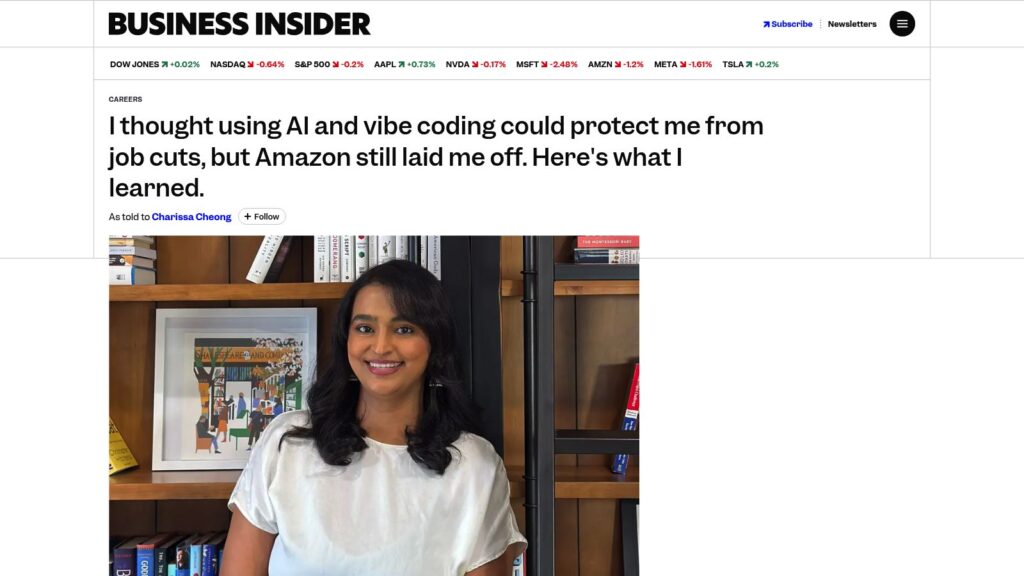
I Was Laid Off by Amazon. Using AI and Vibe Coding Didn’t Save My Job — but I Learned an Important Lesson.

Tejal Rives, an Amazon product marketer who upskilled in AI and vibe coding to try to protect her job during tech layoffs, was nonetheless laid off in October 2025 as part of a 14,000-person reduction. Although disappointed, she found value in learning prompt engineering, an important AI skill, and now focuses on her career coaching business while advising professionals to reskill in AI to adapt to the changing workforce.

https://www.businessinsider.com/laid-off-amazon-use-ai-protect-job-vibe-coding-lesson-2026-3

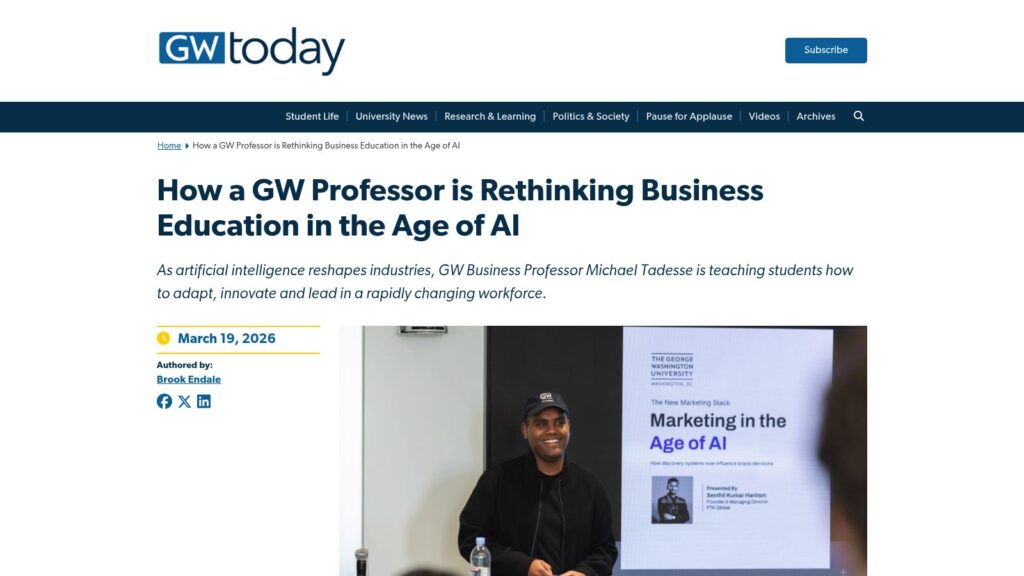
How a GW Professor Is Rethinking Business Education in the Age of AI

George Washington University Business Professor Michael Tadesse is reshaping business education to prepare students for a workforce transformed by artificial intelligence (AI). By integrating real-world projects, industry expert insights, and emerging AI tools into his curriculum, Tadesse aims to equip students with an innovation mindset and practical skills that enable them to adapt, lead, and innovate in rapidly evolving job markets.

https://gwtoday.gwu.edu/how-gw-professor-rethinking-business-education-age-ai

Why I’m Not Worried About Running Out of Work in the Age of AI

In the article “Why I’m Not Worried About Running Out of Work in the Age of AI,” Dave Kellogg argues that despite concerns about AI-driven job displacement, there will always be more work to do because technology frequently creates new opportunities rather than eliminating all jobs. He compares current AI disruption to past industrial changes, noting that knowledge workers possess transferable skills that make transitioning easier, and emphasizes that learning to work with AI as a tool is critical for future job security and business success.

https://kellblog.com/2026/03/19/why-im-not-worried-about-running-out-of-work-in-the-age-of-ai/

Larry Fink Warns Leaders on AI’s Workforce Impact

BlackRock CEO Larry Fink warns that artificial intelligence is rapidly disrupting the workforce, potentially causing high unemployment among new college graduates due to shifts in demand for skills and roles. In response, BlackRock has launched a US$100 million Future Builders Initiative to connect workers with skilled trades training, addressing the growing need for skilled labor to support infrastructure modernization and AI-related industries.

https://businesschief.com/news/larry-fink-warns-leaders-on-ais-workforce-impact

Facebook Co-Founder Chris Hughes Warns AI Could Harm Workers—Even If It Doesn’t Entirely Replace Them

Facebook co-founder Chris Hughes warned that while AI may not fully replace human jobs, it could still cause significant disruption for workers and challenges in transitioning to new employment. Speaking at a panel with economists and technologists, Hughes emphasized that AI will have a meaningful impact on the labor market and urged policymakers to address the potential harm to workers rather than assuming AI will render human work obsolete.

https://www.adweek.com/media/facebook-co-founder-chris-hughes-ai-harm-workers/

Half of Companies Are Cutting Compensation To Fund AI Investments

A 2026 survey by ResumeBuilder.com reveals that 54% of U.S. companies have reduced employee compensation—including bonuses, raises, and base pay—or conducted layoffs to fund investments in artificial intelligence. Driven by competitive pressures and investor demands, many firms prioritize AI spending over employee satisfaction, with 94% expecting to reduce headcount and accepting higher turnover as they continue shifting budgets toward AI growth.

https://www.resumebuilder.com/half-of-companies-are-cutting-compensation-to-fund-ai-investments/

Why Hasn’t AI Made Work Easier?

Cal Newport discusses how, despite promises, AI has not made work easier but rather intensified activity in many tasks without increasing high-value, focused work. Citing a study by ActivTrak, he highlights that AI usage leads to more time spent on emails and messaging but a decline in deep, uninterrupted concentration, mirroring past patterns seen with technologies like email and mobile computing.

https://calnewport.com/why-hasnt-ai-made-work-easier/

MetLife Study Finds AI Acceleration Is Creating New Concerns in Today’s Workplace

MetLife’s 2026 Employee Benefit Trends Study reveals that while AI adoption is enhancing workplace efficiency, 61% of employees are concerned about ethical risks and job security related to AI. The study highlights a growing need for employers to provide clarity, skill development, and supportive benefits to help employees adapt and maintain well-being amid rapid technological change.

https://www.metlife.com/about-us/newsroom/2026/march/metlife-study-finds-ai-acceleration-is-creating-new-concerns-in-todays-workplace/

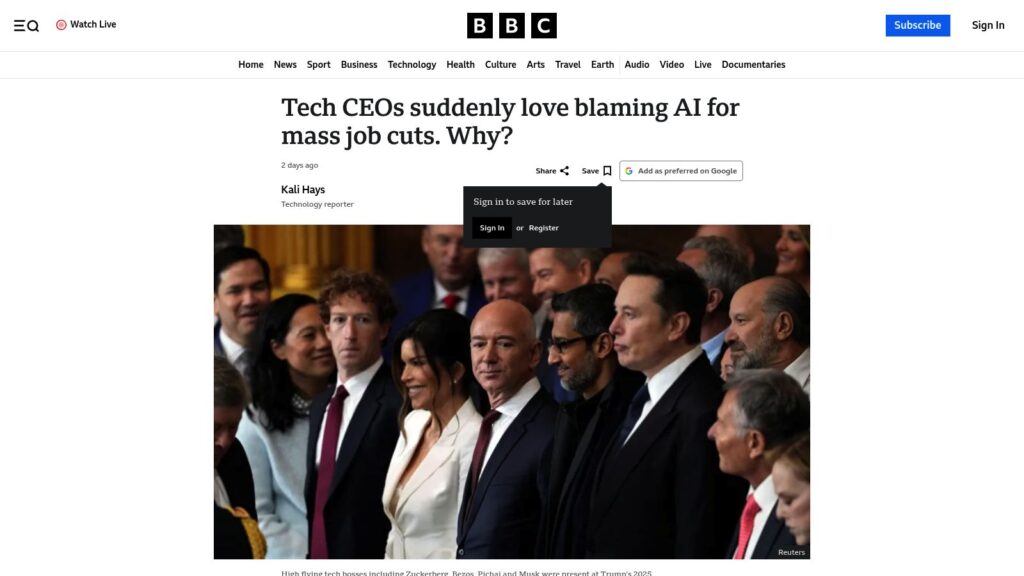
Tech Companies Are Blaming Massive Layoffs on AI. What’s Really Going On?

Recent tech industry layoffs attributed to artificial intelligence (AI) reflect a more complex reality than the companies suggest. While AI is beginning to impact certain jobs like programming and customer service, overall displacement remains limited, and many layoffs are influenced by factors such as corporate restructuring and investor pressures rather than AI-driven efficiency alone.

https://theconversation.com/tech-companies-are-blaming-massive-layoffs-on-ai-whats-really-going-on-278314

The Return-to-the-office Trend Backfires

Research shows that remote-first work models, characterized by flexibility and trust, lead to higher productivity, engagement, and growth compared to mandate-driven return-to-office policies. These models enable organizations to attract a wider talent pool, improve employee well-being, and sustain trust. While return-to-office mandates may seem like a solution for collaboration and innovation, they often lead to decreased employee satisfaction and talent attrition.

https://thehill.com/opinion/technology/5775420-remote-first-productivity-growth/

Why ATMs Didn’t Kill Bank Teller Jobs, but the iPhone Did

The article explains that automation does not automatically eliminate jobs, illustrated by the example of bank tellers after the introduction of ATMs. ATMs reduced the cost of operating branches, allowing banks to open more locations. As a result, the number of teller jobs initially remained stable, while their duties shifted toward customer service and sales. Job losses occurred later, with the rise of online and mobile banking, which changed how banking itself worked. The conclusion is that employment declines primarily when technology replaces an entire system, rather than when it merely automates individual tasks.

https://davidoks.blog/p/why-the-atm-didnt-kill-bank-teller

The AI Lab Next Door

New America introduces a revamped vision that highlights collaboration between local colleges and communities to harness AI for public value. Key points include the convergence of incentives for cooperative relationships, increased investments in university AI capabilities, and the urgency for local leaders to engage colleges to address civic needs. Despite progress, challenges like cultural clashes and decentralized operations hinder large-scale partnerships. The brief calls for strategic partnerships that are problem-focused, economically beneficial, accountable, and aimed at strengthening democratic institutions amid the rapid evolution of AI.

https://www.newamerica.org/insights/the-ai-lab-next-door/

Push to Replace Workers With AI Faces Backlash — Even From Management

Survey shows employees, including managers, prefer human collaboration over AI, citing limitations in AI’s creativity and judgment. Many believe replacing workers with AI leads to legal risk and disrupts talent pipelines. Despite claims of AI-driven job displacement, experts suggest a cautious approach emphasizing human roles alongside AI innovations.

https://www.cio.com/article/4138743/push-to-replace-workers-with-ai-faces-backlash-even-from-management.html

Current and Former Block Workers Say AI Can’t Do Their Jobs After Jack Dorsey’s Mass Layoffs: ‘You Can’t Really AI That’

Block CEO Jack Dorsey laid off 4,000 employees, claiming AI productivity justified the cuts. Workers argue AI can’t replace critical aspects of their roles, expressing skepticism about AI’s capabilities and frustrations over being required to develop tools that could replace them. There’s a growing sentiment of job insecurity and dissatisfaction among remaining employees, fearing increased workloads and customer dissatisfaction with AI-driven support. Overall, many believe current AI tools can’t fully substitute human expertise in the company’s operations.

https://www.theguardian.com/technology/2026/mar/08/block-ai-layoffs-jack-dorsey

Scroll to Top