career

How Data and AI Are Reshaping Every Career

AI reshapes careers through “job churn,” where roles evolve due to task automation, augmentation, and redesign. As industries transform, workers face new expectations around data and technology, making skills adaptation essential. Approximately 40% of global employment is exposed to AI, with 78 million new jobs expected by 2030 amidst significant displacement. Key impacts include changing responsibilities across sectors such as finance, retail, and marketing, emphasizing the need for continuous skill development to maintain job relevance.

https://www.snowflake.com/en/blog/how-data-ai-reshaping-careers/

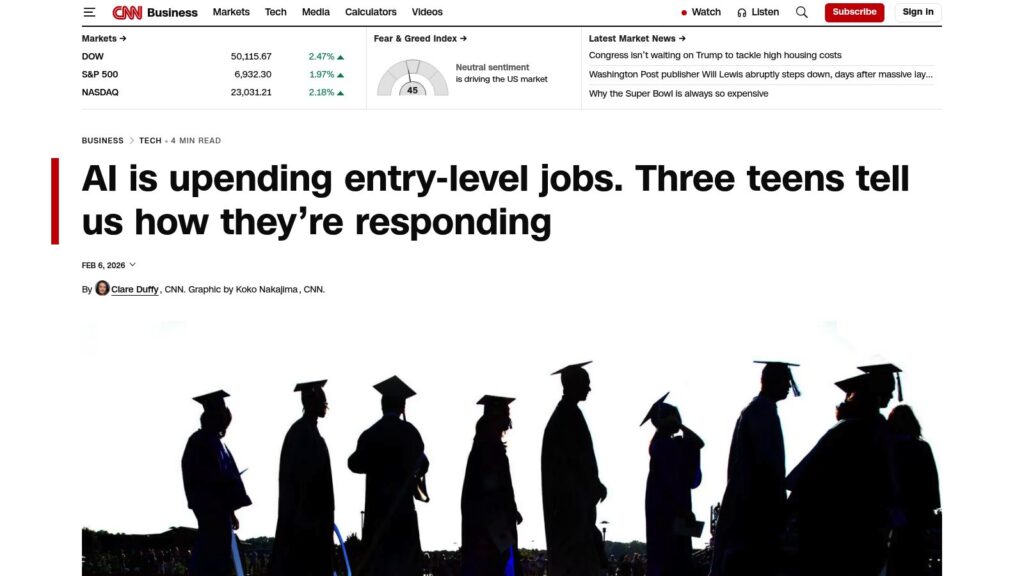
AI Is Upending Entry-level Jobs. Three Teens Tell Us How They’re Responding

AI is transforming the job market for high school students, with many entry-level positions at risk of obsolescence. Teens are adapting by exploring hands-on careers and gaining AI skills. Education is evolving as schools grapple with AI’s role in learning. Experts suggest students should focus on developing skills applicable across fields to secure future employment amidst these changes.

https://edition.cnn.com/2026/02/06/tech/ai-entry-level-jobs-teens

Your Job Isn’t Disappearing. It’s Shrinking Around You in Real Time

AI isn’t replacing jobs; it’s devaluing expertise. Traditional adaptation methods like mastering AI or doubling down on existing skills fail because the economic model prioritizes immediate cost reduction over long-term workforce transformation. Roles are evolving rapidly, leaving many feeling lost. To thrive, focus on orchestrating capabilities with AI to achieve what wasn’t possible before, and redefine your value based on new possibilities rather than trying to defend current tasks. Embrace the shift from being a specialist to becoming a strategic orchestrator of AI-enhanced work.

https://newsletter.jantegze.com/p/your-job-isnt-disappearing-its-shrinking

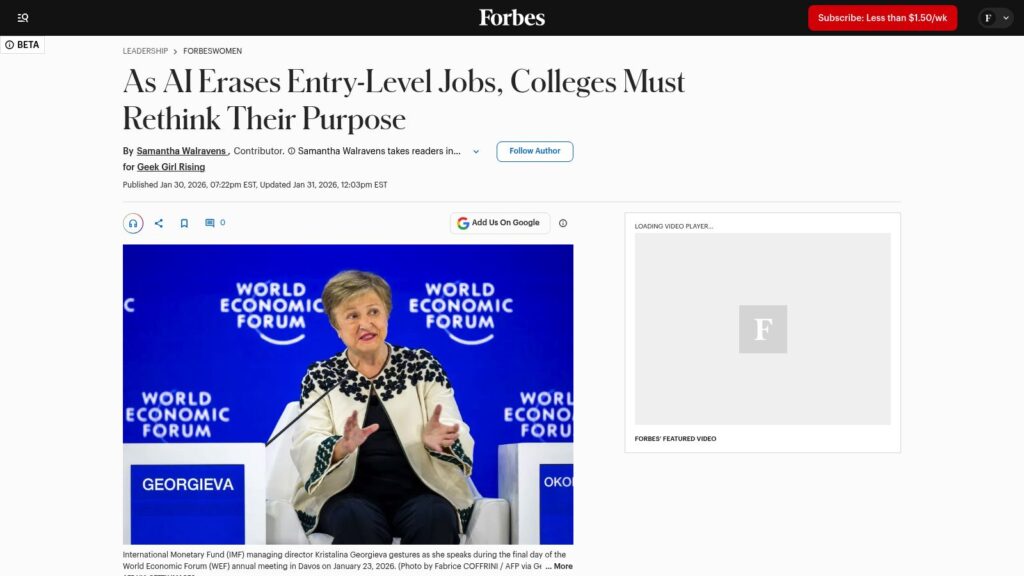
As AI Erases Entry-Level Jobs, Colleges Must Rethink Their Purpose

AI is replacing entry-level jobs, disrupting the traditional path from education to experience. As a result, human judgment, the ability to connect decisions and anticipate risks, is becoming the most valuable job skill. Colleges must adapt by aligning education with real-world work and emphasizing experience and responsibility to prepare students for an AI-driven workforce.

https://www.forbes.com/sites/geekgirlrising/2026/01/30/as-ai-erases-entry-level-jobs-colleges-must-rethink-their-purpose/

Mind the Skills Gap: Communication

Communication Skills Gap: LSE emphasizes developing communication skills, crucial for career success. Employers report that graduates lack essential communication abilities. Faculty and alumni suggest practice through societies, mock interviews, and board-style presentations. Workshops and networking events are offered to enhance interpersonal skills. Communication is framed as a “muscle,” needing constant enhancement for effective workplace engagement.

https://blogs.lse.ac.uk/management/2026/01/27/mind-the-skills-gap-communication/

AI Is Turning Side Hustles Into Second Careers — And Exposing a Policy Vacuum At Work

AI enables employees to pursue side hustles, transforming them into second careers while still working full-time. This trend challenges traditional job loyalty and requires companies to rethink engagement policies as more workers seek autonomy and diverse income streams. Organizations must adapt to this reality to avoid alienating talent and recognize the potential benefits of side hustles, which can enhance skills and innovation.

https://allwork.space/2026/01/ai-is-turning-side-hustles-into-second-careers-and-exposing-a-policy-vacuum-at-work/

McKinsey Boss Says There Are 3 Skills AI Models Can’t Do That Young Professionals Should Focus On

McKinsey’s Bob Sternfels highlights three essential human skills that AI can’t replicate: the ability to aspire, judgment, and true creativity. He stresses the importance of these skills for young professionals as AI changes talent requirements, suggesting that education background may become less significant compared to practical skills demonstrated in portfolios.

https://www.businessinsider.com/mckinsey-boss-shares-human-skills-ai-models-cant-do-2026-1

Will AI Take My Job in 2026? What the Data Actually Says

AI won’t fully replace jobs by 2026; it will reshape tasks, leading to 92 million job displacements but creating 170 million new ones (net gain of 78 million). Many roles will shift, with significant automation in customer service and admin. Workers should focus on tasks rather than titles, as automation will particularly target routine, rules-based tasks. Industries like finance and tech face high exposure, while healthcare and education may rely more on AI as an assistive tool. Adapting to these changes and gaining AI skills will be crucial for maintaining job security.

https://www.nucamp.co/blog/will-ai-take-my-job-in-2026-what-the-data-actually-says

Worried About AI Taking Your Job? Experts Say That’s Only Half the Story

AI is rapidly transforming the job market in Australia, creating both anxiety about job losses and potential opportunities. Experts note that while some roles may be automated, particularly in clerical and entry-level positions, others could emerge or expand. Research indicates an increase in entry-level jobs amidst AI integration. Predicting future impacts is complex, but a shift is expected toward industries where human skills are still essential. Workers who adapt and learn to utilize AI effectively may find themselves in higher demand, while those resistant to change may struggle. The government’s National AI Plan seeks to ensure a balanced approach to AI development, promoting growth without compromising job security.

https://www.sbs.com.au/news/article/australians-are-worried-about-losing-their-job-to-ai-heres-whats-really-happening/9n1syo7k7

Manufacturing’s Future Is High Tech

Manufacturing is evolving into a high-tech industry driven by AI, automation, and sustainability, requiring new skills and perceptions. Experts advocate for educational reforms to align with modern needs, emphasizing hands-on training and career visibility to attract talent. The sector faces a talent shortage, demanding a workforce adept in technology and soft skills. By 2035, successful manufacturing will hinge on innovation, adaptability, and purpose-driven careers, reinforcing manufacturing’s role in economic strength.

https://roboticsandautomationnews.com/2025/12/30/opinion-manufacturings-future-is-high-tech-and-the-workforce-must-adapt/97952/

The Scariest Word This Year for Workers From DC to Silicon Valley

In 2025, “efficiency” has become the defining buzzword in the job market, prompting widespread layoffs and hiring freezes across sectors from tech to government. Companies are streamlining operations to cut costs amid economic challenges, creating job insecurity for workers as they face tough competition in the job market. CEOs advocate for reduced bureaucracy and increased productivity, but many employees find their job prospects dwindling, struggling to adapt to evolving expectations. The trend raises concerns about long-term job stability, even as businesses increasingly adopt AI.

https://www.businessinsider.com/layoffs-ai-and-doge-efficiency-tech-federal-workforce-job-market-2025-12

AI Shifts Expectations for Entry Level Jobs

AI’s rise affects early-career engineers, as entry-level jobs decline due to automation. Predictions show significant job cuts, particularly in programming, while roles like AI engineer are growing. Recent grads must adapt to higher expectations and develop skills in AI usage, as proficiency becomes essential. Employers seek experiential learning over theoretical knowledge, prompting educational shifts towards apprenticeships. Overall, AI augments rather than replaces jobs, requiring a balance of hard skills and critical thinking for success in the evolving job market.

https://spectrum.ieee.org/ai-effect-entry-level-jobs

Beyond the Inflection Point: The New Forces Shaping the Transformation of Work

Rapid workplace changes, influenced by demographic shifts, deglobalization, and AI, necessitate proactive leadership and a reevaluation of skills and employment structures. There’s a significant skills scarcity as multiple generations work, yet roles remain unfilled despite automation. AI transforms job requirements, necessitating continuous reskilling. Entry-level job prospects for Gen Z decline due to automation, economic changes, and an oversupply of graduates, highlighting a mismatch between education and job market demands. Stronger connections between education and the labor market are essential to ensure students are prepared for evolving roles, promoting inclusive growth through proactive leadership and effective policy.

https://www.weforum.org/stories/2025/12/work-transformation-skills-agility-growth/

‘Godfather of AI’ Geoffrey Hinton Says Computer Science Degrees ‘will Remain Valuable’ — and Students Should Learn to Code

“Godfather of AI” Geoffrey Hinton asserts that computer science (CS) degrees remain valuable beyond just coding skills, emphasizing critical thinking and systems understanding. Despite AI advancements, he suggests students should learn to code, likening it to the intellectual benefits of learning Latin. Hinton advises focusing on foundational skills like math and statistics, which will always be relevant in tech fields.

https://www.businessinsider.com/godfather-ai-geoffrey-hinton-cs-degrees-valuable-learn-to-code-2025-12

Scroll to Top