leadership

2026 AI Trends

In 2026, organizations will increasingly integrate AI into their business strategies, focusing on how to use AI effectively rather than just deploying it. This will lead to the rise of AI-native departments in HR, procurement, and customer operations, where AI handles routine tasks, and humans focus on higher-value activities. Additionally, there will be a reduction in middle management roles as AI takes over routine tasks, and organizations will prioritize leaders who can effectively manage hybrid teams of humans and AI.
https://www.imd.org/ibyimd/artificial-intelligence/2026-ai-trends-what-leaders-need-to-know-to-stay-competitive/

Managers Are Unprepared to Lead a Human-agent Hybrid Workforce

Managers struggle to lead hybrid teams with AI agents, which complicates traditional management roles. As AI adoption rises, employees shift from execution to orchestration, requiring new leadership strategies. Leaders must balance agent skills with domain expertise, maintain collaboration, and pivot career development towards strategic thinking. Managers face identity challenges as technical skills become accessible, and they must adapt their approach to leadership amidst evolving work dynamics. Successful navigation of this transition is crucial for organizational efficiency and culture.

https://digiday.com/sponsored/managers-are-unprepared-to-lead-a-human-agent-hybrid-workforce/

Board Oversight Of AI-Driven Workforce Displacement

Boards must reassess oversight roles in response to AI-driven workforce changes, notably layoffs. Legal obligations exist mainly around financial disclosures and WARN Act compliance, but fiduciary responsibilities are emerging that emphasize the importance of human capital and company culture. Governing bodies are encouraged to consider AI’s impact on employees, aligning technology adoption with long-term corporate strategy rather than short-term cost-cutting. Ethical considerations also mandate directors to prioritize worker welfare and align with corporate values, while fostering management accountability in AI deployment decisions.

https://corpgov.law.harvard.edu/2025/12/18/board-oversight-of-ai-driven-workforce-displacement/

Fear of Losing Your Job Is No Way to Get Employees on Board With AI

Companies pushing AI adoption through fear are using the wrong motivator. Fear-driven mandates create performative compliance that limits growth, while open communication and collaboration unlock AI’s potential. Effective leadership redirects attention outward, fostering trust, creativity, and problem-solving, rather than inward fear and rigidity.

https://www.morningstar.com/news/marketwatch/20251218179/fear-of-losing-your-job-is-no-way-to-get-employees-on-board-with-ai

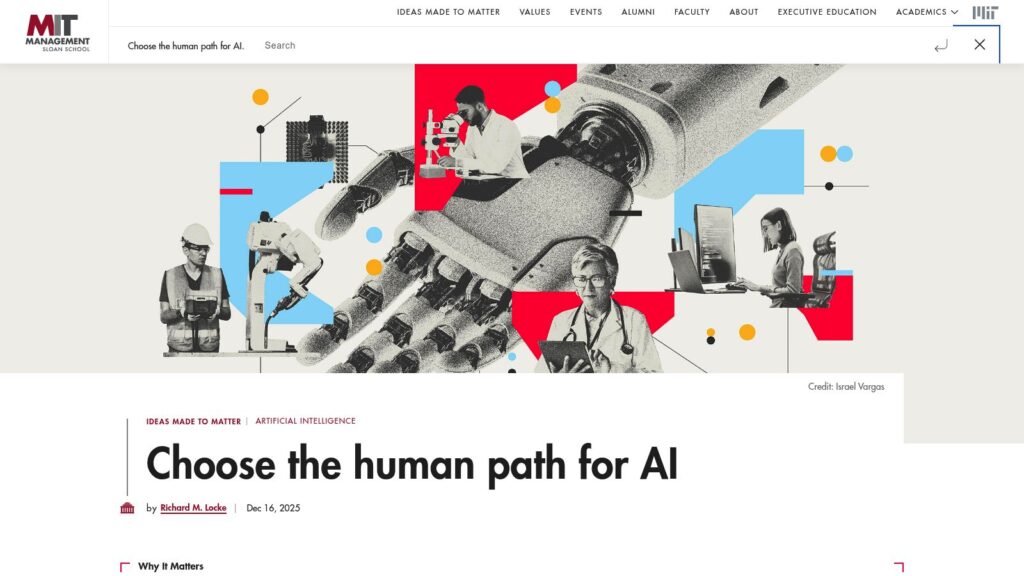
Choose the Human Path for AI

Mitigation of AI’s impact requires prioritizing human enhancement over job elimination. The future of work can leverage AI to empower rather than replace workers, as highlighted by historical management theories and MIT research. Emphasizing human capabilities (empathy, creativity, etc.) is vital for effective AI integration. Educational frameworks are evolving, such as MIT’s Universal AI, to enhance understanding and application of AI. Deliberate choices in AI development can lead to collaborative prosperity rather than widespread job loss.

https://mitsloan.mit.edu/ideas-made-to-matter/choose-human-path-ai

The Top Interviews From UNLEASH in 2025: Google, McDonald’s, SAP, HUGO BOSS, Moderna, and More!

UNLEASH’s 2025 highlights include top interviews with HR leaders from diverse industries, emphasizing strategic integration of HR with technology, leadership rethinking amid rapid changes, and collaboration between executives for effective people strategies. Key insights stress HR’s critical role in guiding organizational transformations, AI adoption, employee engagement, and maintaining a healthy work culture.

https://www.unleash.ai/strategy-and-leadership/the-top-interviews-from-unleash-in-2025-google-mcdonalds-sap-hugo-boss-moderna-and-more/

Why Curiosity, Not Coding, Is the Top Trait CEOs Need for the Future

Curiosity over coding: In an AI-driven workplace, curiosity and digital engagement are more important for leaders and employees than pure technical skills.

Digitally engaged employees: They are curious, proactive learners who experiment, seek development, accept mistakes, and become GenAI superusers.

AI value unlocked by people: These superusers teach others, improve processes, and move organizations beyond basic AI usage to real productivity gains.

Shaping the 2030 workforce: Their behavior is writing the roadmap for how AI will transform work over the next several years.

CEO responsibility: Leaders must model continuous learning and create environments that foster curiosity and digital engagement, not just hire for it.

https://www.inc.com/joe-galvin/why-curiosity-not-coding-is-the-top-trait-ceos-need-for-the-future-of-work/91278344

Agents of Change: New Organizational Roles in the Age of AI

AI adoption is quickly reshaping work, shifting AI from background automation to an active role as a digital teammate. Organizations are creating new roles and structures to integrate AI, focusing on blending human ingenuity with digital efficiency. Key roles address strategy, operations, oversight, and ethics. Most large companies plan to restructure in response, with formal governance and continuous upskilling now essential.

https://kpmg.com/us/en/articles/2025/agents-change-new-organizational-roles-ai.html

How to Build Forward-thinking Cybersecurity Teams for Tomorrow

Microsoft’s security strategy emphasizes the need for adaptive, innovative teams in the evolving landscape of AI-powered cyber threats. Traditional cybersecurity roles must evolve beyond technical expertise to include critical thinking and diverse skill sets. Organizations should rethink recruitment practices, onboarding processes, and continuous training to build resilient teams equipped to tackle sophisticated threats. Emphasizing cognitive diversity and collaboration will enhance defenses against AI-driven attacks, as the next major cyber breach could stem from inadequate talent adaptation to this new era. Future-proofing cybersecurity talent is crucial for organizational success.

https://www.microsoft.com/en-us/security/blog/2025/12/02/how-to-build-forward-thinking-cybersecurity-teams-for-tomorrow/

AI Is Taking the Lead: Now Managers Must Make People More Valuable, Not Replaceable

AI’s integration demands leaders emphasize human value over replaceability. Employees use AI to enhance productivity and prefer its logical approach in management. However, they still value human leaders for emotional intelligence, urging a balance of AI for fairness and humans for inspiration.

https://www.hcamag.com/us/specialization/hr-technology/ai-is-taking-the-lead-now-managers-must-make-people-more-valuable-not-replaceable/558323

Scroll to Top