Klarna Tried to Replace Its Workforce With AI

Klarna’s attempt to replace workers with AI led to decreased customer satisfaction, revealing that simply automating tasks doesn’t improve service quality. Successful companies now focus on hybrid models where AI supports human workers rather than replacing them, enhancing efficiency by removing obstacles. This shift emphasizes collaboration between AI and people, highlighting the importance of understanding the unique strengths of humans in the workforce for better outcomes.

https://www.fastcompany.com/91468582/klarna-tried-to-replace-its-workforce-with-ai

How AI Is Transforming Workplace Planning

AI is revolutionizing workforce planning by enhancing real-time talent analysis and strategic alignment with business goals. It supports skills-based hiring, predictive analytics for attrition and internal mobility, and scenario modeling for workforce needs. Organizations can leverage AI for effective skills mapping, continuous learning, and internal mobility, while ensuring ethical use in hiring decisions. By integrating AI thoughtfully, businesses can transform workforce planning into a dynamic process that enhances capabilities and career development opportunities.

https://www.peoplemanagement.co.uk/article/1944800/ai-transforming-workplace-planning

A Shorter Workweek Can Prevent AI-driven Mass Unemployment

AI-driven layoffs are increasing as firms pursue short-term profits without planning for a sustainable future, risking mass unemployment. To address this, a shorter workweek could balance labor supply and demand, maintaining employment and economic stability. Public policy is essential to implement gradual reductions in work hours, ensuring workers benefit from technological advancements without sacrificing job security.

https://thehill.com/opinion/technology/5681660-shorter-workweek-ai-economy/

Allianz Taps Anthropic to Empower Workforce and Automate Operations

Allianz partners with Anthropic to integrate AI into insurance operations, focusing on employee empowerment, automation, and compliance. Key initiatives include providing access to AI models, developing agents for insurance workflows, and establishing AI audit trails. This aims to enhance efficiency while ensuring transparency and regulatory adherence, amid workforce restructuring and training programs for skill development.

https://nationalcioreview.com/articles-insights/extra-bytes/allianz-taps-anthropic-to-empower-workforce-and-automate-operations/

The AI Question Every Job Candidate on Interview Should Be Prepared to Answer

Job candidates need to be ready to address how they add unique value beyond AI in their work. Companies are shifting focus from simply doing jobs to enhancing productivity through AI collaboration. While AI adoption is leading to layoffs, many firms still hire, looking for AI-savvy employees. Workers must adapt by upskilling but should trust that AI won’t solely replace human roles. Historical patterns suggest AI’s impact will unfold gradually, requiring companies to adjust their workforce strategies amidst the technological transition.

https://www.cnbc.com/2026/01/10/jobs-careers-ai.html

From AI Screening to the Uberization of Talent: 4 Trends HR Needs to Prepare For in 2026

TLDR: HR faces pressure with tight budgets and high expectations; AI is reshaping work, yet only 17% have fully embedded it. Key trends for 2026:
1. AI reduces admin burdens (e.g., screening, scheduling).
2. Flexibility becomes a workforce standard.
3. Talent “Uberization” leads to faster, skill-based hiring.
4. HR must leverage real-time data and improve processes. Action steps: apply AI to admin tasks, reassess job structures, build talent pools, invest in flexibility tools, and communicate clearly with teams.

https://hrdailyadvisor.com/2026/01/09/from-ai-screening-to-the-uberization-of-talent-4-trends-hr-needs-to-prepare-for-in-2026/

WEF Mapped Out 4 AI-driven Futures for Jobs by 2030, and Only One Looks Good for Humanity

WEF’s report outlines 4 AI-driven job scenarios by 2030, with only the “Co-Pilot Economy” minimizing worker displacement through skill augmentation. Other scenarios suggest varying levels of disruption, with rapid AI advancements outpacing adaptation leading to job loss. The future of work will depend on policy decisions and investment in skills, as experts express differing views on AI’s impact on employment.

https://www.businessinsider.com/wef-sees-4-ai-futures-for-jobs-by-2030-only-one-limits-disruption-2026-1

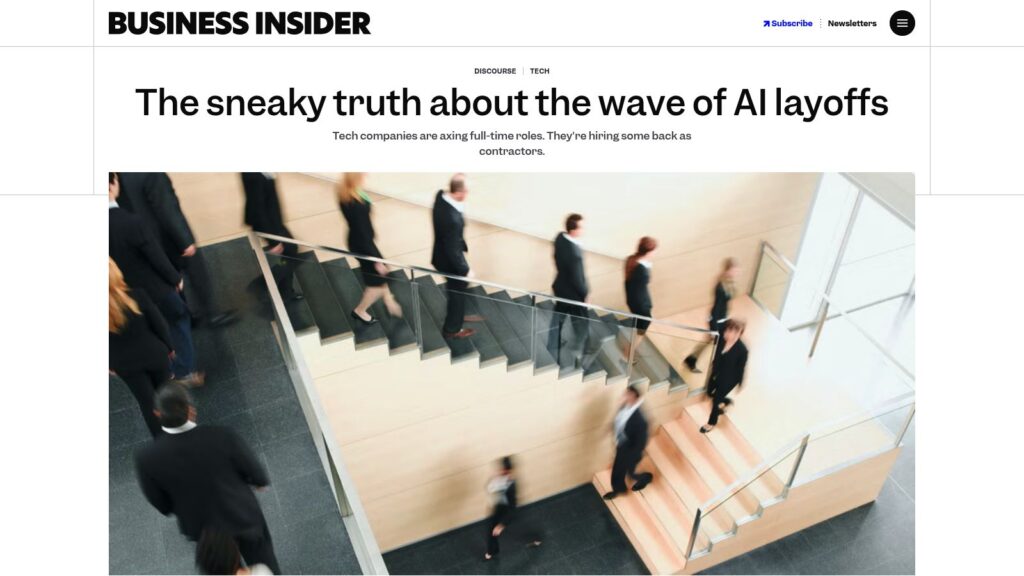
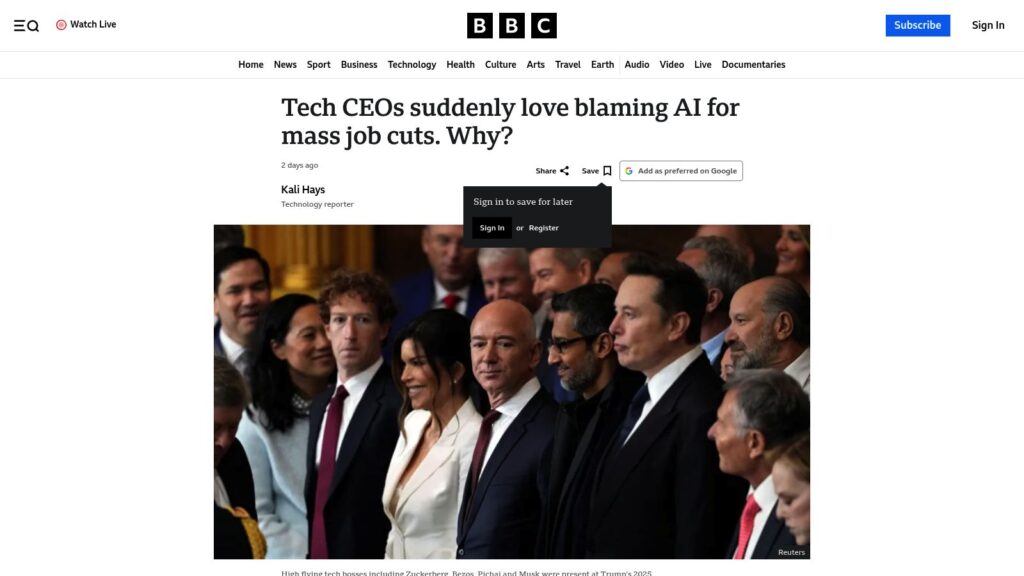
500,000 Tech Workers Have Been Laid Off Since ChatGPT Was Released

500,000 tech workers laid off since ChatGPT’s late 2022 release, not solely due to AI but as a pretext for cuts by executives. This reflects broader issues in the tech industry, where workers suffer due to bosses’ desires for profit, using AI as an excuse for layoffs rather than as a replacement. The ongoing layoffs cause fear and lower morale, pressuring remaining staff into compliance. Understanding these dynamics is crucial, as AI and automation often conceal deeper political and social motivations behind workforce reductions. Future resilience may arise from displaced talent forming new companies or industries.

https://www.anildash.com/2026/01/06/500k-tech-workers-laid-off/

How Generative and Agentic AI Are Transforming Manufacturing: Solving Workforce Challenges and Driving Efficiency

Generative and Agentic AI enhance manufacturing efficiency, addressing workforce challenges. AI improves productivity and automates processes, offering significant ROI across various applications. AEM encourages embracing AI for organizational success.

https://www.aem.org/news/how-generative-and-agentic-ai-are-transforming-manufacturing-solving-workforce-challenges-and-drivin

The US Leads the World in Robots (Once You Count Correctly)

US ranked low in robots per 10K manufacturing workers (304), lagging behind South Korea, China, Japan, and Germany. However, including Teslas with FSD capability elevates the US to the top, as these vehicles are highly sophisticated. This redefines Tesla’s humanoid robot division, Optimus, as a natural extension of its core technology.

https://marginalrevolution.com/marginalrevolution/2026/01/the-us-leads-the-world-in-robots-once-you-count-correctly.html?utm_source=rss

The AI Revolution Is Here. Will the Economy Survive the Transition?

AI revolution is underway; experts debate its economic impact. Participants include Michael Burry, who critiques AI’s hype and spending surge post-ChatGPT, and Jack Clark from Anthropic, focusing on AI’s rapid capability growth via Transformers. They discuss AI’s past, current productivity issues, and uncertainty in sector competition. Despite AI’s advancements, widespread job displacement remains limited. Future market dynamics hinge on whether AI can create new spending without cannibalizing existing sectors. The discussion highlights the cyclical nature of AI investments, potential stranded assets, and the challenge of measuring true productivity gains. Overall, skepticism pervades about whether AI will yield significant economic value.

https://post.substack.com/p/the-ai-revolution-is-here-will-the

Amazon Flags ‘Low-Time’ and ‘Zero Badgers’ as It Cracks Down on RTO

Amazon has introduced a manager dashboard to monitor employee office attendance, categorizing staff into “Low-Time Badgers,” “Zero Badgers,” and “Unassigned Building Badgers.” This aims to enforce return-to-office policies, increasing surveillance of white-collar workers. The dashboard tracks how often employees are in the office, the duration of their visits, and their locations, with the intention of promoting in-person collaboration. Similar practices are being adopted by other companies to track compliance with office attendance rules.

https://www.businessinsider.com/amazon-flags-employees-rto-office-2026-1

LSU Research Insights: Shaping the Future of Work With AI That Elevates People

LSU explores AI’s impact on workplaces, focusing on human resource development (HRD). Research emphasizes ethical AI use, employee collaboration, and continuous learning. Key challenges include AI literacy and change management. Future research should address AI’s effects on well-being and competence development. Exciting prospects include personalized learning and organizational analytics. HRD is vital in balancing technology with human needs, promoting collaboration across disciplines.

https://www.lsu.edu/blog/2026/01/ri-hr-ai-park.php

McKinsey Boss Says There Are 3 Skills AI Models Can’t Do That Young Professionals Should Focus On

McKinsey’s Bob Sternfels highlights three essential human skills that AI can’t replicate: the ability to aspire, judgment, and true creativity. He stresses the importance of these skills for young professionals as AI changes talent requirements, suggesting that education background may become less significant compared to practical skills demonstrated in portfolios.

https://www.businessinsider.com/mckinsey-boss-shares-human-skills-ai-models-cant-do-2026-1

Scroll to Top