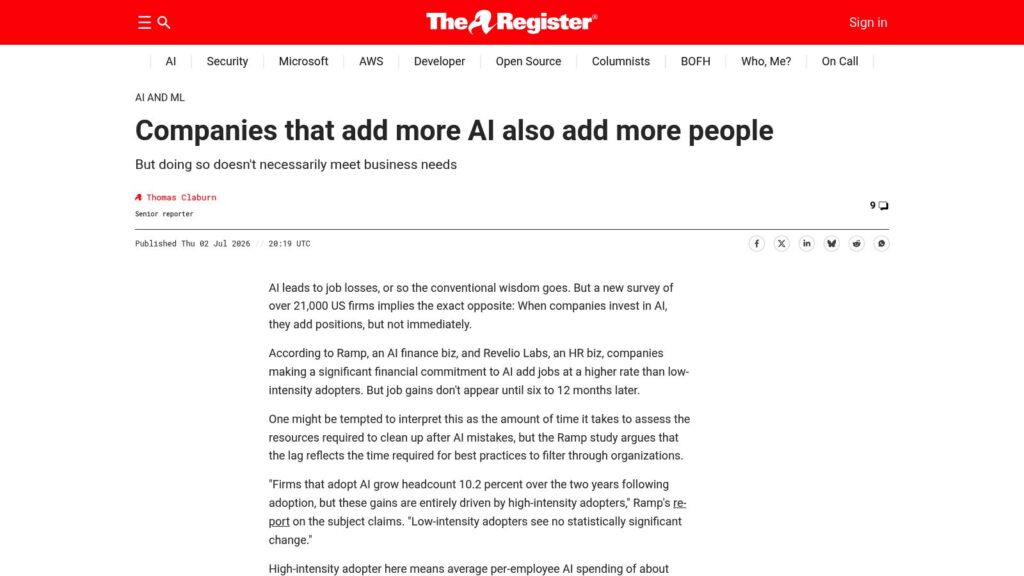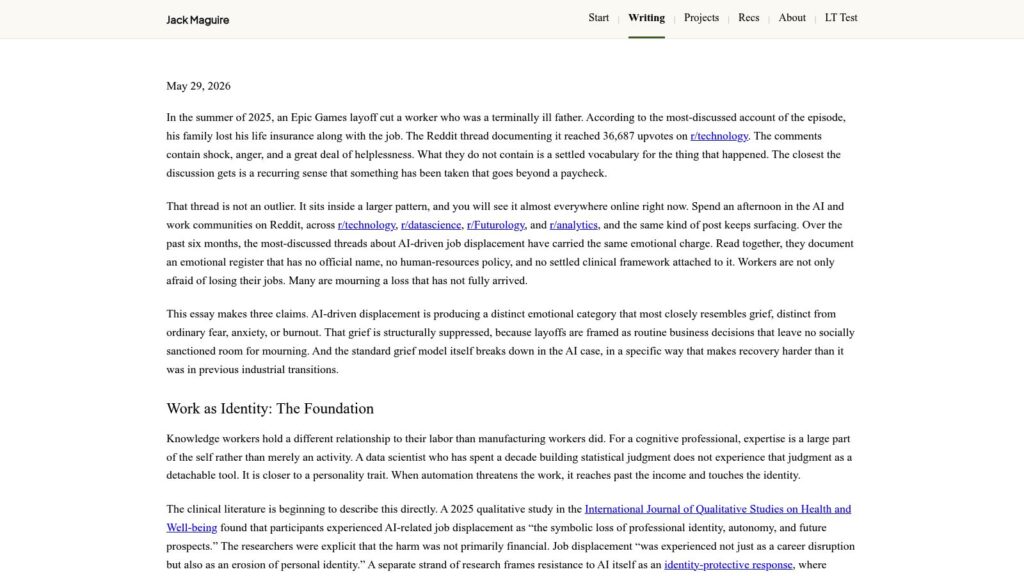
Is AI Coming for Our Jobs?

AI unlikely to cause permanent mass unemployment, says Vivek Chibber. Automation may worsen inequality without class struggle and state intervention. Past technological changes show job displacement often leads to new opportunities due to economic growth. While AI could broadly impact various tasks, similar historical patterns suggest overall job loss isn’t inevitable. Fundamental capitalist profit motives drive technology use, potentially harming labor experiences, but rethinking technology implementation can prioritize human welfare. The individual trauma of job loss persists amid broader economic trends, highlighting the need for supportive social structures.

https://jacobin.com/2026/02/ai-technology-productivity-growth-job-loss

JPMorgan CEO: AI Has ‘displaced People … and We Offer Them Other Jobs’

JPMorgan CEO Jamie Dimon admits AI has displaced workers but asserts they are offered other jobs through active redeployment. The bank’s workforce remains stable, with growth in client-facing roles and tech functions while reducing operational support. JPMorgan prioritizes using AI to enhance employee productivity. In contrast, a Deloitte report reveals that most companies are focusing on educating rather than restructuring their workforce in response to AI. Dimon highlights the need for proactive planning to address potential future job displacements due to technological advances.

https://hrexecutive.com/jpmorgan-ceo-we-have-displaced-people-from-ai-and-we-offer-them-other-jobs/

Block Lays Off 4,000 Workers Citing AI. But How Much Does AI Actually Have to Do With It?

Block’s CEO Jack Dorsey announced layoffs of 4,000 employees (40% of workforce), attributing this to AI advancements. However, experts suggest overhiring during the pandemic contributed significantly to these cuts. While Block’s shares rose post-announcement, analysts believe the layoffs are a mix of AI efficiency and necessary organizational adjustments, rather than solely due to AI’s impact. Other tech companies like Salesforce and Amazon have also made significant layoffs, linking them partially to reallocating resources to AI. Despite industry cuts, job opportunities in tech still exist, particularly in medium-sized companies.

https://www.cbc.ca/news/business/block-layoffs-ai-9.7108981

Can Advanced AI Lead to Negative Economic Growth?

The essay explores the potential for negative economic growth due to advanced AI automation. It argues that if automation displaces most workers and reduces their income, thereby decreasing demand for goods and services, the economy could shrink despite increased production capacity. The author examines two scenarios: one in which satiated preferences and income redistribution from workers to capital owners lead to a demand collapse, and another in which automation reduces savings and the capital stock, affecting future generations.

https://aleximas.substack.com/p/will-advanced-ai-lead-to-negative

The Eternal Promise: a History of Attempts to Eliminate Programmers

Software simplification trends in history reveal a persistent cycle of attempts to reduce the need for programmers since the 1960s. Each generation, from COBOL to AI tools, promised democratization of software creation but ultimately created demand for specialized skills. Tools (like no-code platforms and large language models) improved efficiency but did not eliminate complex programming challenges. Understanding software principles remains crucial as human judgment is essential in navigating the complexities of development. The future will likely see evolving roles for developers rather than their obsolescence, reinforcing the enduring value of deep understanding in software engineering.

https://www.ivanturkovic.com/2026/01/22/history-software-simplification-cobol-ai-hype/

Accenture: You’re Promoted or Fired on Using the AI

Accenture’s CEO announced the company is firing staff not fully adopting AI tools, citing a need for “reinventors” skilled in generative AI. Despite extensive layoffs in 2025 due to poor consulting sales, the company insists on promoting senior staff based on their use of AI tools, which some employees view as ineffective. Critics highlight the absurdity of relying on flawed AI while attempting to position the company as a top consultant in AI.

https://pivot-to-ai.com/2026/02/25/accenture-youre-promoted-or-fired-on-using-the-ai/

The 2026 Global Intelligence Crisis

2026 Global Intelligence Crisis Summary:
In 2026, the U.S. faces a 4.28% unemployment rate and rising software engineer job postings. Despite AI capital expenditure growth, current data shows no imminent labor displacement risk. AI adoption follows a slow, cost-sensitive S-curve, suggesting it will complement rather than replace labor. Productivity improvements usually lead to economic growth, increasing real income rather than creating demand shocks. Historical patterns indicate that technological advancements have not eliminated jobs but transformed them. The chance of significant economic disruption from AI hinges on its adoption pace and regulatory responses.

https://www.citadelsecurities.com/news-and-insights/2026-global-intelligence-crisis/

Jack Dorsey’s Block Cuts Thousands of Roles as It Embraces AI

Block, co-founded by Jack Dorsey, is laying off nearly half its workforce due to AI’s impact on business operations, reducing staff from 10,000 to under 6,000. Dorsey predicts AI will drive similar changes across companies soon. This follows tech industry-wide layoffs, including Amazon and Meta, as firms shift focus to AI investments. Block anticipates up to $500 million in restructuring costs but reported strong product demand, positively affecting its stock.

https://www.bbc.com/news/articles/cq570d12y9do

Delivery Robots Have His Old Job — and Now They’ve Created a New One for Him

AI delivery robots are replacing drivers, creating a new job: robot wrangler. These workers help robots navigate obstacles, provide maintenance, and ensure they operate effectively. Charlie Snodgrass, a former gig driver, is among the first to take on this role, checking and managing multiple robots daily as companies like Serve Robotics expand their fleets. Demand for such positions is rising as robots become more integrated into urban infrastructure.

https://www.latimes.com/business/story/2026-02-25/theres-job-that-ai-isnt-eliminating-robot-wrangler

New Report: 80% of Executives View Agentic AI as Critical to Company Survival by 2027

80% of executives view agentic AI as vital for company survival by 2027, according to a Cisco report. While excitement around AI grows, gaps in infrastructure and skills pose challenges. Companies must invest in robust networks to support AI transformations, with expectations of new job categories emerging. Early adopters of agentic AI see significant ROI, signaling the technology as a necessary investment for future success.

https://blogs.cisco.com/news/new-report-80-of-executives-view-agentic-ai-as-critical-to-company-survival-by-2027

Column: Robots Are Heading Into the Kitchen. Should We Welcome Them?

Robotic cooking machines like Robby and Al Dente are revolutionizing kitchens, preparing dishes like fried rice consistently. These machines still require human input but can enhance efficiency in restaurant operations. Robby, made by Next Robot, can cook large quantities while maintaining quality and is already used in various locations, including schools and restaurants. The technology aims to replicate complex cooking techniques, addressing issues of inconsistency in food preparation, with ongoing developments improving their functionality. Chefs see these machines as tools to streamline operations rather than replacements.

https://www.latimes.com/food/story/2026-02-23/robot-cooking-machinery-woks-future-los-angeles-restaurants-dining

AI Robots May Outnumber Workers in a Few Decades as Firms Ramp up Investment

AI robots may outnumber human workers in decades due to increased corporate investment and profitability focus. Former Citi executive predicts AI robots’ rapid growth, estimating 1.3 billion by 2035 and 4 billion by 2050. Robots often pay for themselves rapidly, making them more cost-effective than humans. McKinsey reports the workforce will soon balance between humans and AI agents. AI’s impact on jobs will be significant, creating concerns over worker displacement while also promising high-tech job opportunities.

https://www.cnbc.com/2026/02/23/ai-robots-outnumber-workers-agents-few-decades-citi.html

Professional AI Adoption Could Unlock up to $4.1 Trillion Capacity for US

LinkedIn’s report reveals that adopting AI could boost the U.S. economy by $4.1 trillion, enhancing efficiency in sectors like manufacturing and education. However, U.S. AI adoption lags behind countries like India, with only 28% of working-age Americans utilizing AI tools. The report suggests upskilling employees and government support for AI programs to optimize benefits, highlighting that many businesses currently see limited impact from AI.

https://www.socialmediatoday.com/news/professional-ai-adoption-could-unlock-up-to-41-trillion-capacity-for-us/812915/

The Human Work Behind Humanoid Robots Is Being Hidden

AI advancements in humanoid robots often hide the significant human labor involved. Companies, driven by hype, create unrealistic expectations about robot capabilities. As robots learn from human actions, workers are reduced to data gatherers, raising privacy concerns and reflecting gig-work dynamics. Transparency is lacking, and without it, the real limitations of robotic intelligence are obscured, leading to potential misunderstandings and risks, such as those seen in automotive technologies.

https://www.technologyreview.com/2026/02/23/1133508/the-human-work-behind-humanoid-robots-is-being-hidden/

Scroll to Top