business

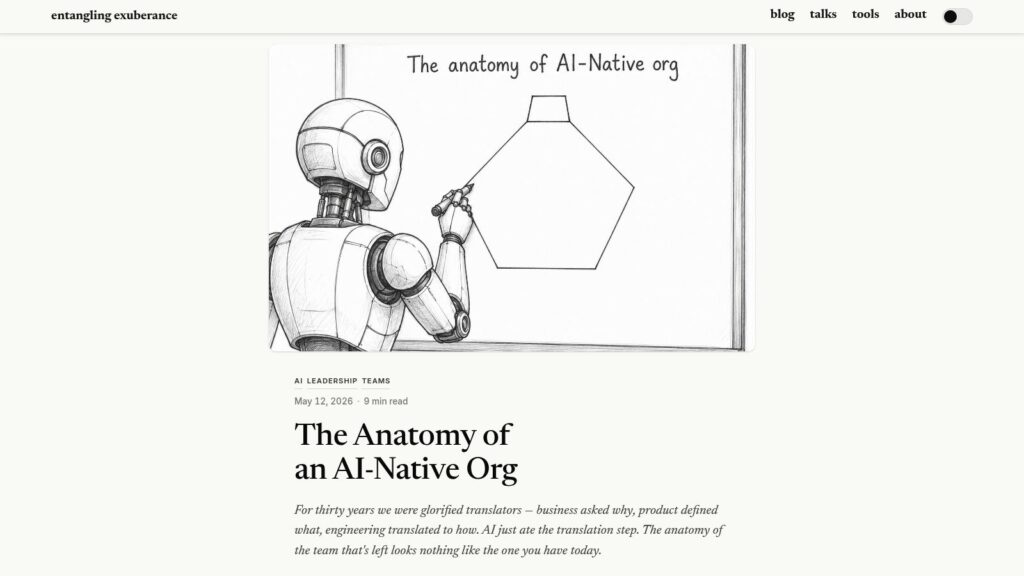
The Anatomy of an AI-Native Org

AI has drastically reduced the need for translation tasks that formed the broad middle layer of traditional software organizations, collapsing the “how” layer where most headcount existed. The resulting AI-native org features a small “why” group defining purpose, a larger “what” group focused on judgment and defining quality, and a smaller, highly skilled “how” group managing complex engineering work and building trust systems for AI agents that now handle most conversion tasks. This shift demands managers who contribute directly to outcomes and engineers who focus on defining correctness and maintaining high-level architectural control rather than routine translation work.

https://ajeygore.in/content/the-anatomy-of-an-ai-native-org

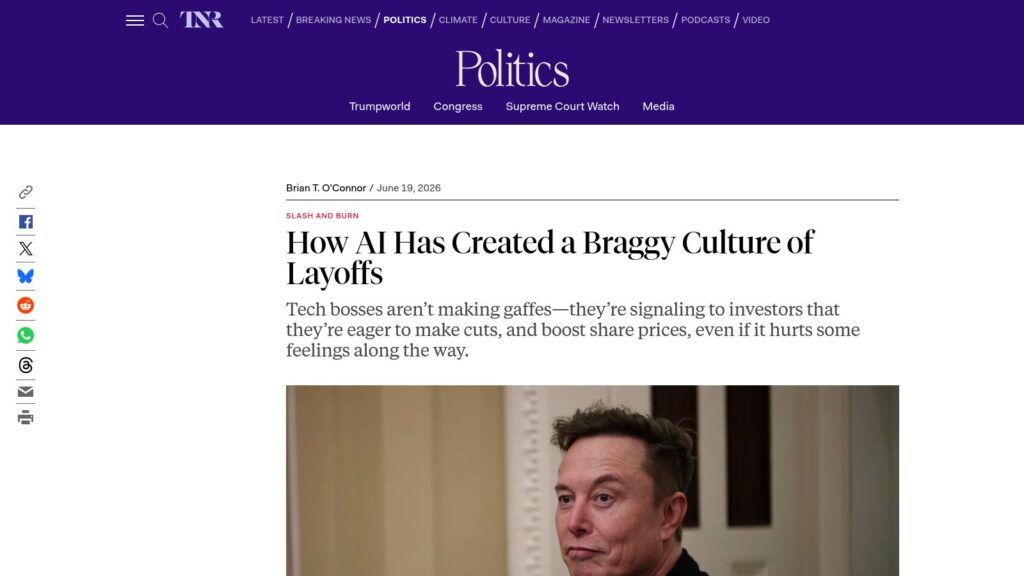
How AI Has Created a Braggy Culture of Layoffs

Tech CEOs increasingly boast about AI-driven layoffs as a strategy to signal to investors their commitment to cutting costs and boosting share prices, even at the expense of employee morale. This shift toward a more aggressive, performative language around workforce reductions reflects a power imbalance where executives prioritize market performance over employee wellbeing, contributing to a culture that normalizes and even celebrates job cuts enabled by automation.

https://newrepublic.com/article/211359/ceos-artificial-intelligence-tech-layoffs

History Will Judge Today’s CEOs on How They Handled AI

The article reflects on how history will evaluate today’s CEOs based on their management of artificial intelligence, highlighting AI as a potentially transformative technology for humanity. It emphasizes the significant test leaders face in guiding their workforce through the disruptions caused by AI, drawing historical parallels to past industrial labor challenges.

https://www.afr.com/work-and-careers/management/history-will-judge-today-s-ceos-on-how-they-handled-ai-20260615-p606xm

CEOs Who Think AI Replaces Their Employees Are Just Bad CEOs

The article argues that CEOs who believe AI can simply replace their employees misunderstand the technology and the nature of work, labeling them ineffective. It highlights that while AI tools can enhance productivity when workers willingly adopt them, building reliable, scalable, and compliant products requires nuanced human expertise beyond what AI prototypes alone can provide. The piece stresses that successful AI integration depends on CEOs appreciating both AI’s capabilities and its limitations, rather than using AI as an excuse for widespread layoffs.

https://www.techdirt.com/2026/06/09/ceos-who-think-ai-replaces-their-employees-are-just-bad-ceos/

The CIO’s Guide to Skills-Based Workforce Planning

CIOs face a critical challenge where having sufficient IT staff does not guarantee the right skills to drive digital transformation, particularly in areas like AI, cloud, and cybersecurity. Skills-based workforce planning addresses this by focusing on employees’ capabilities rather than job titles, enabling organizations to dynamically align talent with evolving business priorities, improve agility, and close critical skills gaps through continuous visibility, learning, and flexible deployment of both human and AI-assisted resources.

https://www.techtarget.com/searchcio/tip/The-CIOs-guide-to-skills-based-workforce-planning

The 5 Faces of Human Readiness for AI Adoption – and How to Work with Them

The article discusses the contrasting perspectives between executives eager to adopt AI and employees who often feel threatened by it, identifying five distinct employee attitudes toward AI adoption: enthusiasts, curious, cautious, skeptics, and opposed. It emphasizes that successful AI integration requires addressing these varied human responses through cultural change, focusing on human-AI collaboration, and directly tackling employee concerns to ensure meaningful and accepted AI use in the workplace.

https://www.weforum.org/stories/2026/06/ai-workplace-adoption-readiness/

Public Have More Fear Than Hope on AI and Future of Work, Study Finds

A study by King’s College London finds that a majority of the UK public fear the economic impacts of AI, with seven in ten worried about job losses and over half believing AI will eliminate more jobs than it creates, particularly affecting entry-level roles and young people. While employers and some groups show more optimism about AI’s potential benefits and productivity gains, most people express concern about AI’s societal effects and support government intervention, regulation, and retraining programs to prepare for the AI-driven changes in the workforce.

https://www.kcl.ac.uk/news/one-in-five-britons-think-ai-will-create-civil-unrest-study-finds

Appearing Productive in The Workplace

The article discusses how generative AI in the workplace allows novices to produce work that appears expert without the necessary understanding, leading to significant risks when people impersonate expertise outside their training. It highlights the decoupling of output quality from actual competence, resulting in flawed work accepted due to management’s eagerness for apparent productivity, and warns that the lack of human judgment in reviewing AI-generated work undermines quality control and professional development.

https://nooneshappy.com/article/appearing-productive-in-the-workplace/

‘On the Precipice’: Is Your Organization Close to a Culture Collapse?

A Cambridge University study warns that corporate culture in complex organizations is fragile and can collapse suddenly from small disruptions like leadership changes, causing productivity to drop to zero. Heidi Hauver of Ranovus emphasizes transparent communication, psychological safety with accountability, and intentional investment in people as key practices to build cultural resilience and navigate organizational shocks effectively.

https://www.hrreporter.com/focus-areas/culture-and-engagement/on-the-precipice-is-your-organization-close-to-a-culture-collapse/394402

The Real Job Destruction From AI Is Hitting Before Careers Can Start

Yale’s Jeffrey Sonnenfeld and colleagues highlight that while AI’s impact on overall U.S. unemployment appears limited, it is significantly reducing entry-level job opportunities for recent college graduates, making it harder for them to start careers and gain essential experience. This subtle labor market shift is driven by the rise of agentic AI systems that automate workflows and routine tasks, prompting companies to slow hiring rather than lay off current employees, which could undermine future workforce development and career progression.

https://insights.som.yale.edu/insights/the-real-job-destruction-from-ai-is-hitting-before-careers-can-start

Anthropic Executive, One Year Ago: Fully AI Employees Are a Year Away

A year ago, Anthropic predicted that AI-powered virtual employees with autonomous roles and corporate accounts would soon be integrated into companies, but this expectation has not materialized. John Gruber critiques this prediction as more of a marketing ploy than a realistic forecast, noting that the actual use of AI in companies differs significantly and that such hype has negatively impacted public perception of AI.

https://daringfireball.net/linked/2026/05/04/anthropic-prediction-fully-ai-employees

Remote Work Doesn’t Break Company Culture. Poor Measurement Does

Akamai Technologies demonstrates that remote work does not inherently damage company culture; rather, poor measurement does. By conducting regular culture diagnostics and defining clear productivity metrics, Akamai strategically measures and improves its culture in a remote-first environment, emphasizing leadership, clear expectations, and deliberate communication to sustain engagement and trust regardless of physical location.

https://hrexecutive.com/remote-work-doesnt-break-company-culture-poor-measurement-does/

Apollo’s Top Economist Says AI Is About to Spark a Massive Job Market Boom

Apollo’s top economist, Torsten Sløk, believes AI will spark a job-market boom. He argues AI could increase employment rather than reduce it, applying the concept of Jevons paradox, where greater efficiency lowers costs and expands demand. As AI makes services like legal and financial work cheaper, more people and businesses can use them, which may lead companies to grow and hire more workers. The main point is that AI-driven productivity gains could expand industries and create jobs, challenging predictions of widespread unemployment.

https://www.businessinsider.com/ai-job-market-labor-unemployment-jevons-paradox-apollo-torsten-slok-2026-4

A Robot Economy: Who Gets Rich, Who Gets Left Behind

The article discusses the rising impact of humanoid robots on the economy, highlighting that robots leased at $300 per month are already significantly cheaper than human labor and operate continuously without costs like benefits or turnover. While this technological shift promises increased corporate profits and an “age of abundance” with cheaper goods, it risks exacerbating economic inequality, as the benefits primarily accrue to capital owners, deepening the existing K-shaped economy where wealth concentrates at the top and many workers face stagnation or displacement.

https://seekingalpha.com/article/4897346-robot-economy-who-gets-rich-who-gets-left-behind

Accenture Deploys Microsoft 365 Copilot to All 743,000 Employees

Microsoft is deploying its Microsoft 365 Copilot AI assistant to all 743,000 employees at Accenture, marking the largest enterprise rollout of the tool to date. This extensive adoption, showing 89% monthly active usage in pilot cohorts and significant productivity gains, provides Microsoft with a key case study for scaling AI adoption within large organizations amid slower-than-expected enterprise AI uptake.

https://thenextweb.com/news/accenture-deploys-microsoft-365-copilot-to-all-743000-employees

Scroll to Top