business

Why CEOs’ AI Hype Isn’t Landing With Employees

CEOs struggle to communicate AI benefits amid employee skepticism and unclear implementation, hindering productivity gains. Despite high investments, a study shows 95% of businesses see no AI return, with communication gaps and fears of job loss fueling resistance. Executives are urged to build trust and focus on AI training to bridge the divide, as poor messaging risks backlash in political spheres.

https://www.axios.com/2026/02/05/ai-adoption-messaging-gap

Beyond the Robots: What CES 2026 Really Means for Digital Workplace Leaders

CES 2026 showcased AI’s transformative impact on frontline work and digital employee experiences (DEX). Key takeaways highlight AI’s role in improving operations, safety, and business outcomes, as seen in examples from Siemens and Google. AI is now central to digital experiences, facilitating personalized, adaptive workplaces, while wearables emerged as a powerful yet risky technology. Despite advancements, the practical implementation of these solutions varies, emphasizing the need for careful problem identification and a balanced approach to technology integration.

https://www.cdotrends.com/story/4879/beyond-robots-what-ces-2026-really-means-digital-workplace-leaders

The Dangers of “Vibe Reporting” About AI

Cal Newport critiques “vibe reporting” in AI news, highlighting how sensationalist articles, like one from Quartz on Amazon layoffs, imply AI causation without providing supporting details. In contrast, a CNBC article clarifies that layoffs result from management restructuring, not AI. Newport warns this reporting style misleads public perception and hinders understanding of real issues related to AI’s impact. He emphasizes the need for fact-based reporting to foster constructive dialogue.

https://calnewport.com/the-dangers-of-vibe-reporting-about-ai/

Marc Andreessen Says the Real Crisis Isn’t AI Job Losses — It’s What Would Have Happened Without AI

Marc Andreessen argues fears about AI causing job losses misidentify the real crisis: economic stagnation without AI. He believes AI counters workforce decline due to low birth rates, reshapes tasks rather than jobs, and increases the value of remaining workers. Andreessen anticipates AI will spur productivity, raising living standards despite potential job changes, ultimately preventing a more severe economic decline.

https://www.businessinsider.com/marc-andreessen-says-ai-wont-kill-jobs-may-save-economy-2026-1

How CEOs Bringing AI Agents to Work Are Preparing Customers and Employees

CEOs are integrating AI agents in the workplace to enhance customer service and employee productivity, but challenges include addressing worker fears of job loss and measuring effectiveness. Successful implementations treat AI as an enhancement, not a replacement. Companies like Walmart are leveraging AI for shopping assistance, while others emphasize AI’s role in workflow without job displacement. As concerns grow about AI-led layoffs, companies are encouraged to position AI as collaborative tools within the workforce, ultimately reshaping job roles and productivity.

https://www.cnbc.com/2026/01/29/how-ceos-bringing-ai-agents-to-work-are-preparing-customers-employees.html

Growth in 2026 Won’t Happen Without Businesses Prioritizing Worker Trust and Skills

Businesses must prioritize employee trust and skills for growth in 2026. Research indicates that while employees are optimistic about AI’s potential, many companies are not effectively leveraging AI to boost productivity. High-performing organizations that invest in upskilling and employee collaboration achieve better results, demonstrating that human-centric approaches are vital for successful AI integration and organizational growth.

https://www.unleash.ai/artificial-intelligence/growth-in-2026-wont-happen-without-businesses-prioritizing-worker-trust-and-skills/

Stop Managing Your AI ‘workforce’

AI adoption requires rethinking workflow architecture rather than framing agents as digital co-workers. Historical insights from Toyota show that integrating new capabilities necessitates reorganizing production systems to fully utilize their potential. As AI capabilities evolve, human roles will shift, necessitating dynamic management of human skill value and capability sensing. Leaders must view agentic systems as strategic investments, reframing their approach to organizational structure and competitive advantage.

https://www.kyndryl.com/us/en/institute/2026/01/ai-workforce

Mind the Skills Gap: Communication

Communication Skills Gap: LSE emphasizes developing communication skills, crucial for career success. Employers report that graduates lack essential communication abilities. Faculty and alumni suggest practice through societies, mock interviews, and board-style presentations. Workshops and networking events are offered to enhance interpersonal skills. Communication is framed as a “muscle,” needing constant enhancement for effective workplace engagement.

https://blogs.lse.ac.uk/management/2026/01/27/mind-the-skills-gap-communication/

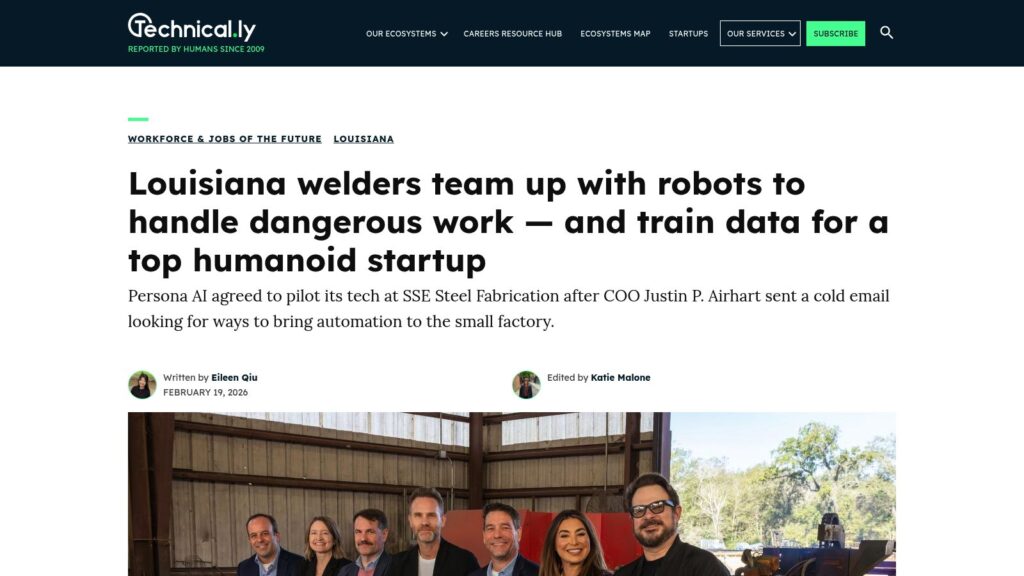
Louisiana Partners With Persona AI For Humanoid Robotics Pilot

Louisiana has partnered with Persona AI to pilot humanoid robotics in heavy industry, specifically at SSE Steel’s fabrication facility. The initiative aims to gather data for humanoid systems working alongside skilled tradespeople, enhancing operational efficiency and safety. This collaboration is part of a broader effort to modernize the state’s industrial capabilities through innovative technologies, ultimately creating high-skill jobs and improving competitiveness in key sectors.

https://businessfacilities.com/louisiana-partners-with-persona-ai-for-humanoid-robotics-pilot/

Hyundai Motor Workers Should Upskill to Coexist With Robots: ILO Director

ILO director advises Hyundai workers to upskill for coexistence with robots; union’s anti-robot stance deemed unrealistic. Emphasizes skilled workers needed to maintain robots despite fears of job loss. Calls for creating sustainable job cycles while supporting youth entrepreneurship.

https://www.koreatimes.co.kr/amp/business/companies/20260127/hyundai-motor-workers-should-adapt-to-coexist-with-robots-ilo-director

Frequent Use of AI in the Workplace Continued to Rise in Q4

AI workplace use rose gradually in Q4 2025; daily use increased from 10% to 12%, with 26% using it frequently. Total users remained flat, with 49% never using AI. Adoption varies by industry and role; highest in tech and finance, lowest in retail and manufacturing. Leaders use AI more than others (69% vs. 40%). AI growth concentrated in remote-capable roles. Overall, leaders reported higher AI use than other employees, necessitating clear applications for effective integration.

https://www.gallup.com/workplace/701195/frequent-workplace-continued-rise.aspx

‘Jobs, Jobs, Jobs’ the AI Mantra in Davos as Fears Take Back Seat

Davos 2026 saw business leaders optimistic about AI creating new jobs despite fears of job losses and industry disruptions. Executives highlighted AI’s potential to improve productivity and efficiency, with some expressing concern that it might be used to justify layoffs. While tech giants viewed AI as a means for job growth in sectors like energy and infrastructure, union leaders warned of its threat to workers. Bill Gates emphasized the need for society to adapt to AI’s impact, suggesting solutions like taxing AI activities to assist displaced workers.

https://www.reuters.com/business/davos/jobs-jobs-jobs-ai-mantra-fears-take-back-seat-davos-2026-01-23/

Invest in the Workforce for the AI Age: a Blueprint for Scale, Skills and Responsible Growth

Investing in workforce skills is crucial in the AI era for maximizing value creation. Successful transformation requires alignment of workforce, operating models, and governance to drive business outcomes. A new social contract for learning is essential, where organizations offer clear skills pathways and support continuous learning. Roles must evolve, emphasizing human judgment over repetitive tasks. Companies should adopt disciplined AI missions, focus on collaborative ecosystems, and ensure responsible AI deployment to foster trust and inclusivity. Leaders must integrate strategy with skills development to achieve sustainable growth and productivity.

https://www.weforum.org/stories/2026/01/ai-roadmap-transforming/

Human Behaviour and Workforce Adoption Will Determine the Value From AI

AI’s value hinges on human adoption and workforce readiness, not just technology. Organizations must shift to skills-based structures and continuous learning to boost productivity. Demographic challenges necessitate tech adoption, especially AI, to sustain economic growth. Work organization is evolving to focus on skills and flexibility, driven by automation and employee expectations for adaptability. Despite increased AI use, workforce confidence remains low, indicating that organizational readiness is key for maximizing outcomes. Continuous retooling and learning are critical in a volatile landscape. Ultimately, the synergy between human capabilities and AI defines future success.

https://www.weforum.org/stories/2026/01/human-behaviour-workforce-adoption-value-derived-from-ai/

Robots Expected to Become ‘allies’ in Closing Labour Gaps

Robots are increasingly seen as allies in workplaces, aiding in closing labor gaps and enhancing efficiency, as per the International Federation of Robotics. This shift is prompted by heightened demands for skilled labor and the desire to alleviate employee workloads. The global market for industrial robots is soaring, reflecting widespread adoption. However, concerns persist regarding potential job displacement. Successful integration of robotics hinges on collaboration between employers and employees.

https://www.hcamag.com/us/specialization/hr-technology/robots-expected-to-become-allies-in-closing-labour-gaps/561837

Scroll to Top