trends

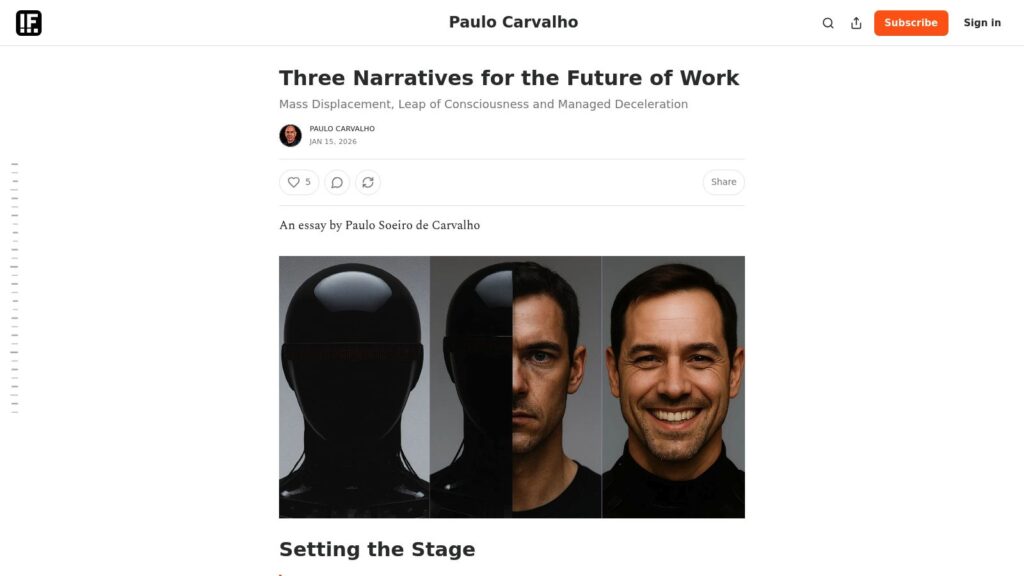
Three Narratives for the Future of Work

TLDR: Future of work narratives include: 1) Mass Displacement – automation outpaces job creation, risking widespread unemployment and social instability; 2) Leap of Consciousness – technological advancement disrupts jobs but creates new roles requiring human skills, hinging on timely workforce reskilling; 3) Managed Deceleration – external factors like regulation slow tech adoption, allowing time for societal adjustment. Key focus: adaptation capacity is vital for navigating these futures.

https://ifforesight.substack.com/p/three-narratives-for-the-future-of

Who Uses AI in Europe

EU invests in AI adoption, but usage remains uneven. 64% of Europeans see AI literacy as crucial by 2030. AI use has increased 12.3% since 2021, with 32.7% of Europeans using AI tools. Adoption varies by country, with generative AI in education low at 9.8%. Denmark leads in AI business adoption (42.03%), while Hungary lags behind (1.31%). The EU should focus on sector-specific AI deployment and measurable KPIs for effective support.

https://eutechloop.com/who-uses-ai-in-europe-and-where-its-still-taboo/

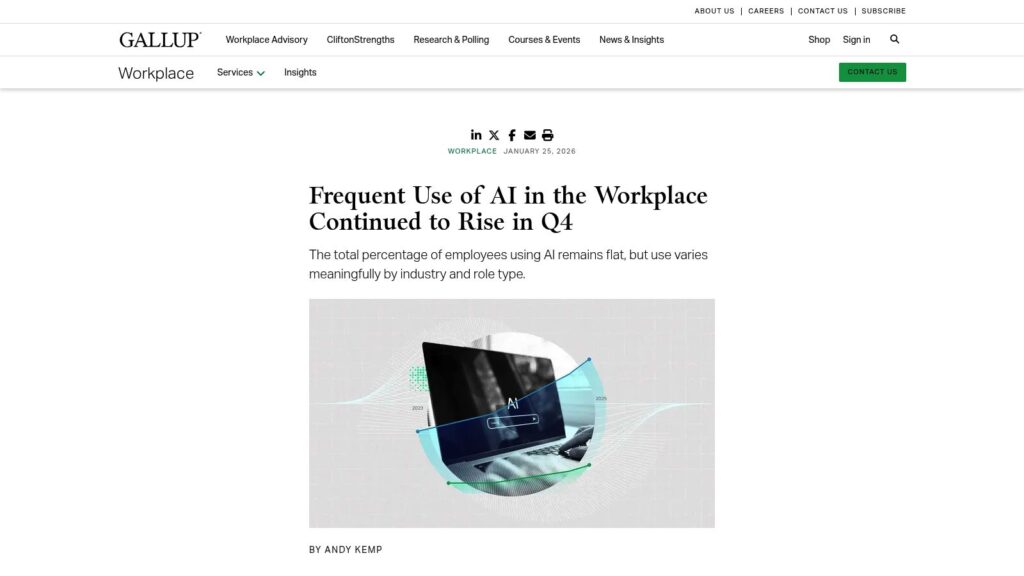
Frequent Use of AI in the Workplace Continued to Rise in Q4

AI workplace use rose gradually in Q4 2025; daily use increased from 10% to 12%, with 26% using it frequently. Total users remained flat, with 49% never using AI. Adoption varies by industry and role; highest in tech and finance, lowest in retail and manufacturing. Leaders use AI more than others (69% vs. 40%). AI growth concentrated in remote-capable roles. Overall, leaders reported higher AI use than other employees, necessitating clear applications for effective integration.

https://www.gallup.com/workplace/701195/frequent-workplace-continued-rise.aspx

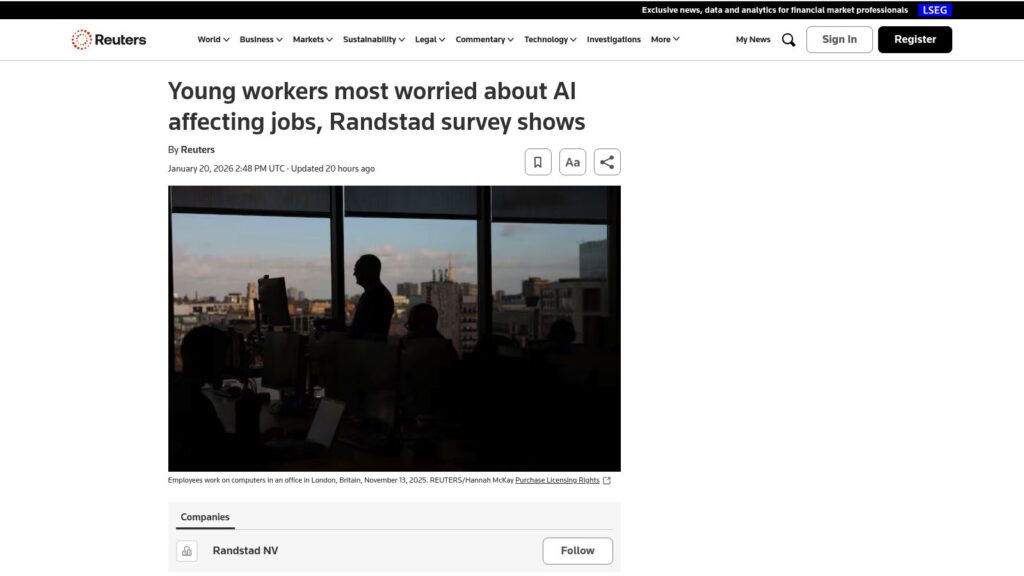
Young Workers Most Worried About AI Affecting Jobs, Randstad Survey Shows

Young workers fear AI’s job impact, per Randstad survey. 80% believe AI will affect work, especially Gen Z. Job postings needing “AI skills” rose 1,587%. Nearly half of workers worry AI benefits companies over employees. 95% of employers expect growth, only 51% of workers share this optimism.

https://www.reuters.com/technology/young-workers-most-worried-about-ai-affecting-jobs-randstad-survey-shows-2026-01-19/

The Economics of Skills: AI, Human Augmentation, and the Future Workforce

TLDR: HR faces challenges from digital transformation, requiring skills orchestration over cost. Talent is shifting from Global North to decentralized hubs in the South/East. Effective Digital Capacity (EDC) metrics are essential as 40% of tech skills will be obsolete by 2027. Emerging Tier-2 cities increase competitiveness, while talent gaps grow, particularly in cybersecurity. AI transforms job roles, fostering human-machine collaboration. Companies must adapt from wage models to skill-based compensation and move towards a polycentric talent strategy to remain relevant by 2030.

https://draup.com/talent/data-books/economics-of-skills-ai-augmentation

7 Challenges IT Leaders Will Face in 2026

Challenges for CIOs in 2026 include talent shortages, AI integration, governance, cybersecurity threats, and balancing costs while ensuring agile operations. Key strategies involve investing in training, fostering a culture of continuous learning, aligning technology with business objectives, and implementing robust governance frameworks for AI.

https://www.cio.com/article/4114004/7-challenges-it-leaders-will-face-in-2026.html

From AI Screening to the Uberization of Talent: 4 Trends HR Needs to Prepare For in 2026

TLDR: HR faces pressure with tight budgets and high expectations; AI is reshaping work, yet only 17% have fully embedded it. Key trends for 2026:
1. AI reduces admin burdens (e.g., screening, scheduling).
2. Flexibility becomes a workforce standard.
3. Talent “Uberization” leads to faster, skill-based hiring.
4. HR must leverage real-time data and improve processes. Action steps: apply AI to admin tasks, reassess job structures, build talent pools, invest in flexibility tools, and communicate clearly with teams.

https://hrdailyadvisor.com/2026/01/09/from-ai-screening-to-the-uberization-of-talent-4-trends-hr-needs-to-prepare-for-in-2026/

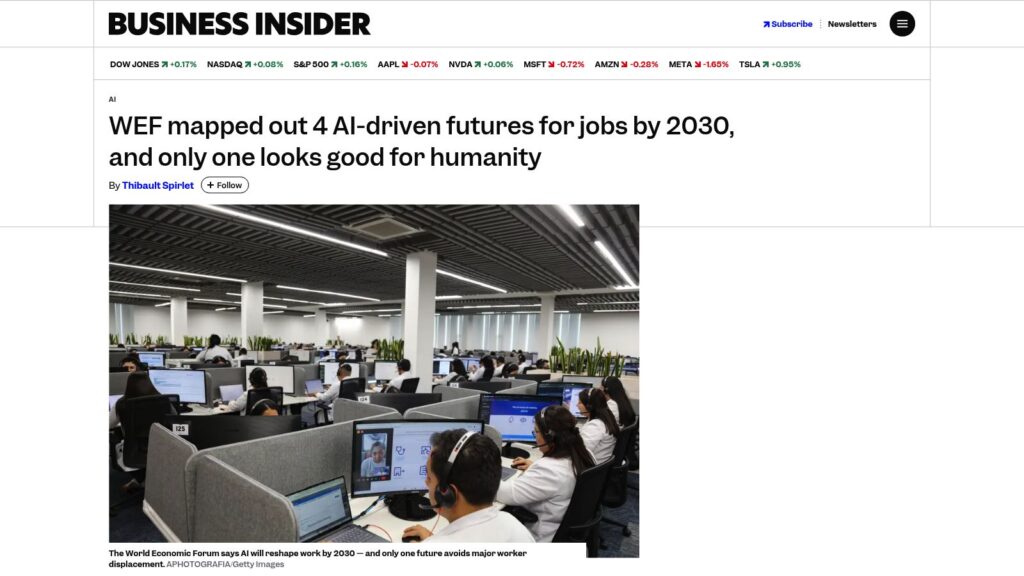
WEF Mapped Out 4 AI-driven Futures for Jobs by 2030, and Only One Looks Good for Humanity

WEF’s report outlines 4 AI-driven job scenarios by 2030, with only the “Co-Pilot Economy” minimizing worker displacement through skill augmentation. Other scenarios suggest varying levels of disruption, with rapid AI advancements outpacing adaptation leading to job loss. The future of work will depend on policy decisions and investment in skills, as experts express differing views on AI’s impact on employment.

https://www.businessinsider.com/wef-sees-4-ai-futures-for-jobs-by-2030-only-one-limits-disruption-2026-1

500,000 Tech Workers Have Been Laid Off Since ChatGPT Was Released

500,000 tech workers laid off since ChatGPT’s late 2022 release, not solely due to AI but as a pretext for cuts by executives. This reflects broader issues in the tech industry, where workers suffer due to bosses’ desires for profit, using AI as an excuse for layoffs rather than as a replacement. The ongoing layoffs cause fear and lower morale, pressuring remaining staff into compliance. Understanding these dynamics is crucial, as AI and automation often conceal deeper political and social motivations behind workforce reductions. Future resilience may arise from displaced talent forming new companies or industries.

https://www.anildash.com/2026/01/06/500k-tech-workers-laid-off/

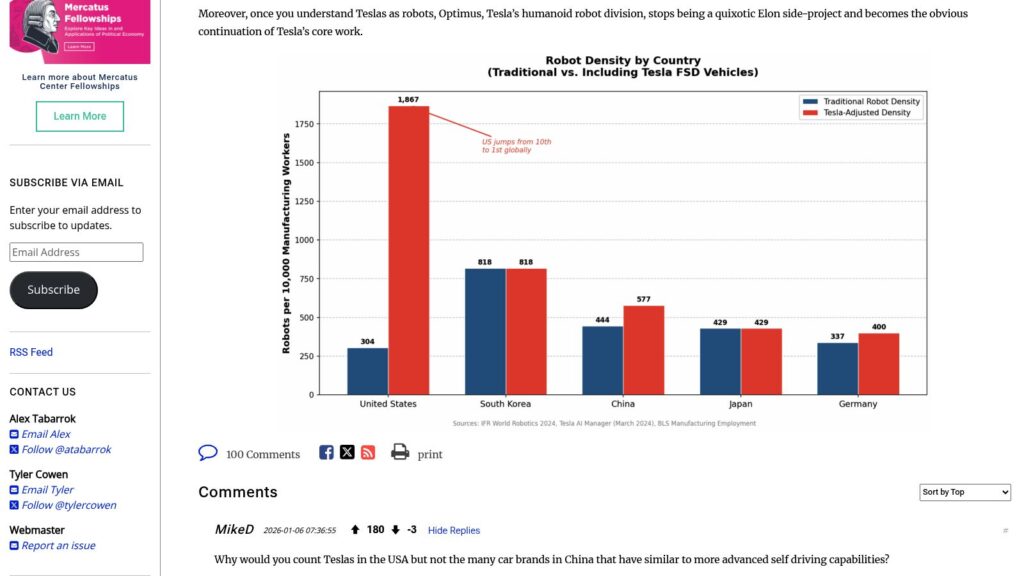
The US Leads the World in Robots (Once You Count Correctly)

US ranked low in robots per 10K manufacturing workers (304), lagging behind South Korea, China, Japan, and Germany. However, including Teslas with FSD capability elevates the US to the top, as these vehicles are highly sophisticated. This redefines Tesla’s humanoid robot division, Optimus, as a natural extension of its core technology.

https://marginalrevolution.com/marginalrevolution/2026/01/the-us-leads-the-world-in-robots-once-you-count-correctly.html?utm_source=rss

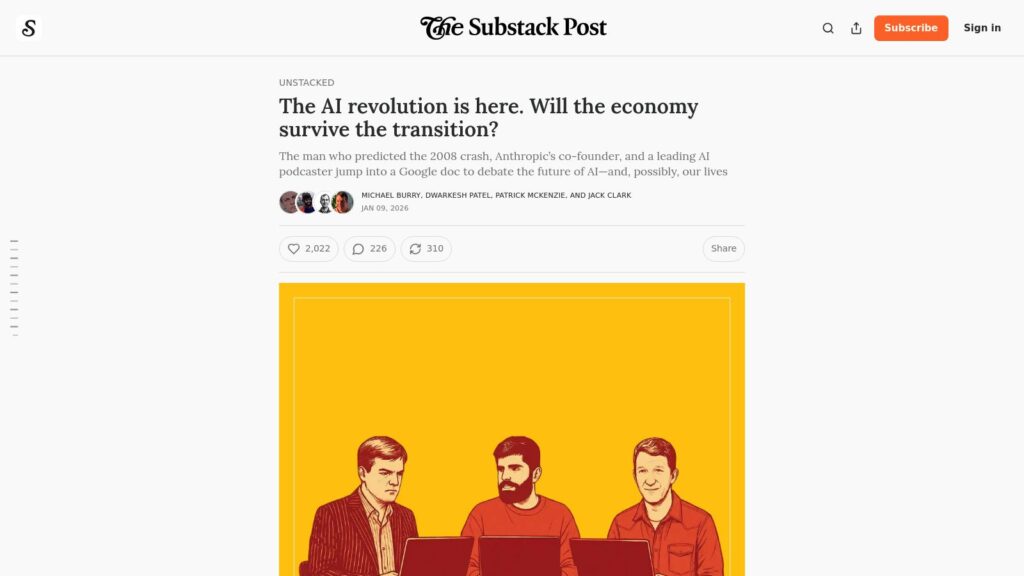
The AI Revolution Is Here. Will the Economy Survive the Transition?

AI revolution is underway; experts debate its economic impact. Participants include Michael Burry, who critiques AI’s hype and spending surge post-ChatGPT, and Jack Clark from Anthropic, focusing on AI’s rapid capability growth via Transformers. They discuss AI’s past, current productivity issues, and uncertainty in sector competition. Despite AI’s advancements, widespread job displacement remains limited. Future market dynamics hinge on whether AI can create new spending without cannibalizing existing sectors. The discussion highlights the cyclical nature of AI investments, potential stranded assets, and the challenge of measuring true productivity gains. Overall, skepticism pervades about whether AI will yield significant economic value.

https://post.substack.com/p/the-ai-revolution-is-here-will-the

Four Ways AI and Talent Trends Could Reshape Jobs by 2030

AI advancements may reshape jobs by 2030 through four scenarios: 1) Supercharged Progress – rapid AI development boosts productivity but causes job displacement; 2) The Age of Displacement – swift automation outpaces workforce adaptation, leading to high unemployment; 3) Co-Pilot Economy – gradual AI integration fosters collaboration and new opportunities; 4) Stalled Progress – slow tech advance with skill shortages results in uneven productivity gains. Businesses must adopt flexible strategies to navigate these uncertainties and invest in human-AI collaboration.

https://www.weforum.org/stories/2026/01/four-ways-ai-impact-job-markets/

Which Service Robots Will Dominate the Market in the Next 10 Years?

The service robotics industry is rapidly growing, with logistics and delivery robots projected to dominate the market, reaching over $60 billion by the next decade. Cleaning robots are expected to be the second largest market, surpassing $20 billion by 2036. While kitchen robots are currently a smaller market, they are forecasted to grow significantly over the next ten years.

https://www.idtechex.com/en/research-article/which-service-robots-will-dominate-the-market-in-the-next-10-years/34229

10 HR Trends That Matter Most As AI Transforms Organizations

AI is becoming a strategic imperative for organizations, reshaping how they compete and innovate. As AI transforms work, companies are prioritizing AI fluency, revamping hiring processes, and addressing employee concerns about job security. While some entry-level jobs are decreasing, new roles are emerging, and organizations are shifting from AI adoption to AI transformation, embedding AI into core business operations.

https://www.forbes.com/sites/jeannemeister/2026/01/06/10-hr-trends-that-matter-most-as-ai-transforms-organizations/

Cybersecurity Skills Matter More Than Headcount in the AI Era

Cybersecurity professionals face increasing skills shortages, outweighing headcount concerns, per ISC2’s 2025 workforce study. Despite budget restrictions stabilizing, 33% of professionals report insufficient resources, with 88% experiencing significant cybersecurity breaches due to skills gaps. The study highlights a pressing need for AI and cloud security skills, as nearly 69% of respondents are adopting AI tools, viewing them as essential for productivity and career advancement. High job satisfaction persists, but many express exhaustion from keeping up with evolving threats. Continued investment in skills training is crucial.

https://www.csoonline.com/article/4108270/cybersecurity-skills-matter-more-than-headcount-in-the-ai-era.html

Scroll to Top