work

MIT Study Challenges AI Job Apocalypse Narrative

New research from MIT’s Computer Science and Artificial Intelligence Laboratory finds that AI will change the workforce gradually rather than cause sudden mass job losses, challenging narratives of an impending AI-driven job apocalypse. The study shows AI can complete about 50% of text-based tasks at a minimally acceptable level in 2024, potentially rising to 80-95% by 2029, but cautions that high-quality, error-free work remains difficult, reinforcing the ongoing need for human oversight across industries.

https://www.axios.com/2026/04/02/ai-jobs-mit-study-workforce-impact

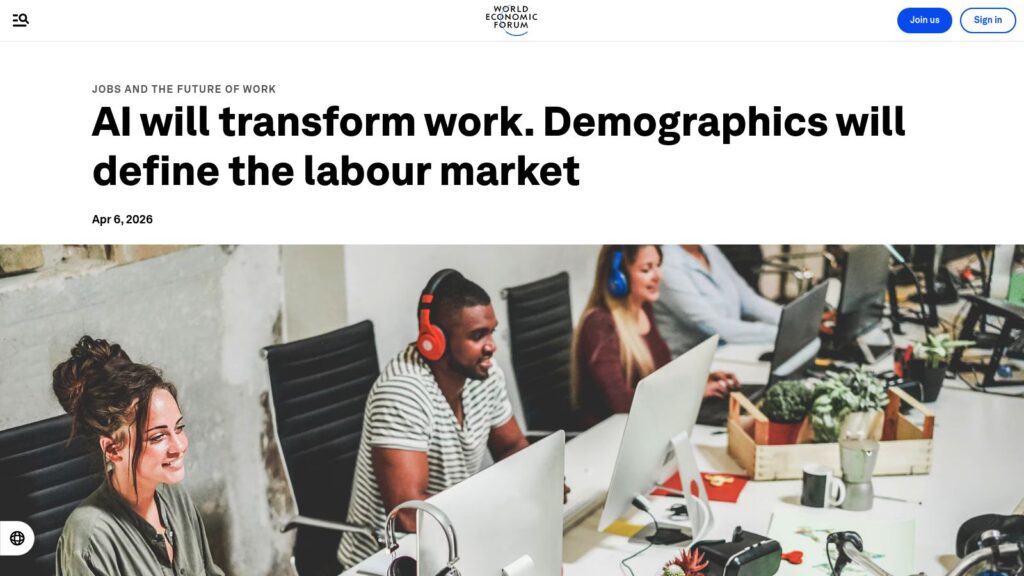
How Demographics, Not AI, Will Redefine the Labour Market

The article explains that while AI is transforming work by reshaping tasks and creating new roles, it is unlikely to cause mass unemployment, especially given demographic trends of aging populations and shrinking labor forces in advanced economies. The main challenge is not job loss but effectively managing talent allocation and helping workers adapt to changes in a labor market with constrained supply, where AI can augment workforce productivity if applied thoughtfully.

https://www.weforum.org/stories/2026/04/how-ai-demographics-change-work-labour/

AI Is Starting to Squeeze Entry-Level Jobs in the D.C.-area

Artificial intelligence is rapidly transforming the job market in the Washington D.C. metropolitan area, with younger and entry-level workers facing the greatest risk due to automation of routine tasks. In Northern Virginia, a national hotspot for AI adoption, up to 39% of jobs—including many held by young workers—are exposed to AI-related changes, although opportunities exist for those who gain AI skills. Two recent reports highlight declining tech job postings for entry-level roles and increasing employer demand for AI literacy and soft skills, underscoring how AI is reshaping employment opportunities and required skills in the region.

https://www.axios.com/local/washington-dc/2026/04/06/ai-jobs-shift-hits-young-workers-dmv

In Japan, the Robot Isn’t Coming for Your Job; It’s Filling the One Nobody Wants

Japan is rapidly advancing physical AI and robotics to address critical labor shortages caused by its declining and aging population, aiming to sustain industrial productivity and social services. Leveraging its strengths in high-precision hardware components, Japan is fostering a hybrid ecosystem where large corporations provide scale while startups drive innovation in software and system integration, supported by substantial government investment to transition from pilot projects to real-world deployments across manufacturing, logistics, and defense.

https://techcrunch.com/2026/04/05/japan-is-proving-experimental-physical-ai-is-ready-for-the-real-world/

How AI May Reshape Career Pathways to Better Jobs

The article discusses how AI is poised to disrupt not only individual jobs but also the career pathways that enable workers without four-year degrees—termed STARs—to advance to better-paying roles. It highlights that nearly 11 million STARs occupy “Gateway” jobs critical for upward mobility, many of which are highly exposed to AI, potentially threatening these established pathways, particularly in administrative and clerical roles in regions like the Northeast and Sun Belt. The authors emphasize the importance of regional, coordinated workforce strategies to ensure AI strengthens rather than weakens economic mobility for these workers.

https://www.brookings.edu/articles/how-ai-may-reshape-career-pathways-to-better-jobs/

This AI Expert Says the Job Apocalypse Isn’t Coming, Even if You’re a Coder – Here’s Why

Stanford professor Erik Brynjolfsson argues that AI will not cause a job apocalypse for coders or tech professionals, but rather transform roles by supplementing work and expanding the software profession. He emphasizes that human roles will shift toward defining the right problems and questions, managing AI-driven agents, and overseeing safe and productive AI use, which will empower a broader range of people to create software without traditional coding skills.

https://www.zdnet.com/article/ai-job-apocalypse-not-happening-for-coders/

How Organizations Are Now Using AI

A comprehensive November 2025 McKinsey study reveals that while many organizations are experimenting with AI to improve workflows and innovation, its widespread implementation has not yet translated into significant enterprise-wide profit gains. About 62% of companies are exploring AI, with 32% expecting workforce reductions due to AI efficiencies, indicating legitimate employee concerns. Overall, AI currently offers more potential than realized financial benefit as it remains insufficiently integrated into core business processes.

https://www.psychologytoday.com/us/blog/mind-of-the-manager/202603/how-organizations-are-now-using-ai

How AI Is Changing the Nature of Entry Level Work

Entry-level jobs in the US have declined by 35% over the past 18 months due to AI automating routine tasks, but entry-level hires remain essential as they help organizations adopt AI more effectively and sustain talent pipelines. Rather than disappearing, entry-level roles are evolving to focus on judgment-based work, AI oversight, and insight generation, with companies needing to support new hires through structured training and pairing them with experienced colleagues to leverage their AI proficiency for a competitive advantage.

https://www.weforum.org/stories/2026/03/how-ai-is-changing-the-nature-of-entry-level-work/

The AI Skills Gap Is Here, Says AI Company, and Power Users Are Pulling Ahead

Anthropic’s latest research shows that AI has not yet caused significant job displacement, though there are early signs of an emerging skills gap between power users and new adopters. The report highlights that those who effectively integrate AI into their work are pulling ahead, with adoption concentrated among higher-income, knowledge-based workers, suggesting potential widening inequalities as AI use expands.

https://techcrunch.com/2026/03/25/the-ai-skills-gap-is-here-says-ai-company-and-power-users-are-pulling-ahead/

A People-First Vision for the Future of Work in the Age of AI

The article outlines a “people-first” vision for the future of work in the age of AI, emphasizing policies that protect and expand human roles in care-related professions, support retraining and workforce development, and promote cooperative AI system design involving workers, employers, and government. It highlights the current decline in job quality and worker autonomy, proposing institutional reforms and tripartite collaboration to ensure AI benefits society broadly rather than exacerbating inequality or job degradation.

https://www.brookings.edu/articles/a-people-first-vision-for-the-future-of-work-in-the-age-of-ai/

Why I’m Not Worried About Running Out of Work in the Age of AI

In the article “Why I’m Not Worried About Running Out of Work in the Age of AI,” Dave Kellogg argues that despite concerns about AI-driven job displacement, there will always be more work to do because technology frequently creates new opportunities rather than eliminating all jobs. He compares current AI disruption to past industrial changes, noting that knowledge workers possess transferable skills that make transitioning easier, and emphasizes that learning to work with AI as a tool is critical for future job security and business success.

https://kellblog.com/2026/03/19/why-im-not-worried-about-running-out-of-work-in-the-age-of-ai/

Facebook Co-Founder Chris Hughes Warns AI Could Harm Workers—Even If It Doesn’t Entirely Replace Them

Facebook co-founder Chris Hughes warned that while AI may not fully replace human jobs, it could still cause significant disruption for workers and challenges in transitioning to new employment. Speaking at a panel with economists and technologists, Hughes emphasized that AI will have a meaningful impact on the labor market and urged policymakers to address the potential harm to workers rather than assuming AI will render human work obsolete.

https://www.adweek.com/media/facebook-co-founder-chris-hughes-ai-harm-workers/

US Job Market Visualizer

This research tool visualizes 342 occupations from the US Bureau of Labor Statistics Occupational Outlook Handbook, representing 143 million jobs, with tile sizes proportional to employment and colors indicating metrics like projected growth, median pay, education, or AI exposure. It includes an LLM-powered pipeline that scores occupations on criteria such as AI exposure, allowing users to explore how AI might reshape various jobs based on job descriptions and digital task components. The tool is intended for data exploration rather than formal economic analysis and reveals trends like higher growth rates for higher-paying and more educated jobs.

https://karpathy.ai/jobs/

Why Hasn’t AI Made Work Easier?

Cal Newport discusses how, despite promises, AI has not made work easier but rather intensified activity in many tasks without increasing high-value, focused work. Citing a study by ActivTrak, he highlights that AI usage leads to more time spent on emails and messaging but a decline in deep, uninterrupted concentration, mirroring past patterns seen with technologies like email and mobile computing.

https://calnewport.com/why-hasnt-ai-made-work-easier/

As AI Reshapes Work, What Should Workers Do Next?

At the 2026 SIEPR Economic Summit, experts discussed how AI is reshaping the workforce, noting that unemployment is rising slowly in AI-exposed jobs while manual labor roles see faster hiring slowdowns. They emphasized the need for government policies supporting workforce flexibility and training, and advised workers to adopt AI for learning new skills, focus on tasks where humans excel, and maintain a strong work ethic to navigate AI-driven economic changes.

https://news.stanford.edu/stories/2026/03/ai-workplace-job-disruption-advice-siepr-summit

Scroll to Top