work

AI Has Changed “the System in Which Work Happens” so the Workplace “Operating Model Has to Change With It”: Bloor Research

AI has transformed the workplace, requiring a new operating model according to Bloor Research. This model integrates human and digital labor, moving away from traditional human-only frameworks. Organizations must adapt design approaches to accommodate AI’s role and redesign workforce structures to enhance resilience and effectiveness, shifting focus from time-based roles to outcome-based strategies. Prioritizing collaboration across departments is essential for successful implementation.

https://www.unleash.ai/artificial-intelligence/ai-has-changed-the-system-in-which-work-happens-so-the-workplace-operating-model-has-to-change-with-it-bloor-research/

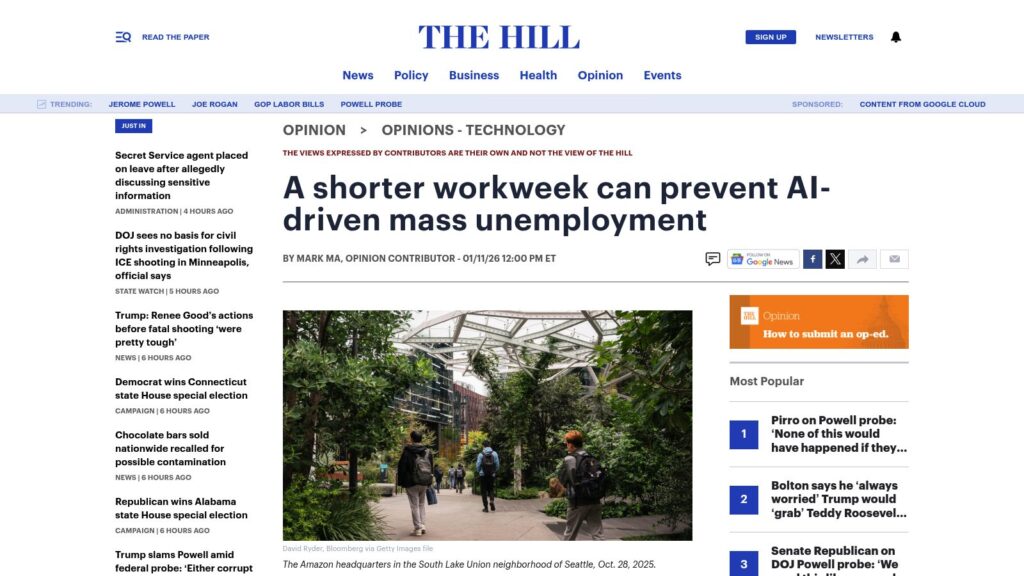
A Shorter Workweek Can Prevent AI-driven Mass Unemployment

AI-driven layoffs are increasing as firms pursue short-term profits without planning for a sustainable future, risking mass unemployment. To address this, a shorter workweek could balance labor supply and demand, maintaining employment and economic stability. Public policy is essential to implement gradual reductions in work hours, ensuring workers benefit from technological advancements without sacrificing job security.

https://thehill.com/opinion/technology/5681660-shorter-workweek-ai-economy/

Workers Rank AI Among Top Trends Shaping Their Workplace

Workers rank AI and generative AI as top workplace trends, with AI as the leading concern. According to The Adecco Group’s report, based on 37,500 workers and 2,000 executives, salary and work-life balance are primary reasons for job retention. AI training struggles persist, as many feel undertrained. The report emphasizes the demand for stability and growth opportunities in employment.

https://www.staffingindustry.com/news/global-daily-news/workers-rank-ai-among-top-trends-shaping-their-workplace

Can AI Do Your Job? See the Results From Hundreds of Tests.

A study comparing AI systems and human workers on real tasks shows AI is far from replacing jobs. Despite impressive capabilities, the best AI only completed 2.5% of projects successfully, failing mostly due to lack of long-term memory and poor visual understanding. AI produced subpar work for projects like floor plans and dashboards, highlighting its limitations. Although AI may reduce dependence on human workers, the study suggests it won’t fully automate jobs soon.

https://www.washingtonpost.com/technology/interactive/2026/ai-jobs-automation/

In Chinese Data Factories, Workers Teach Humanoid Robots Boring Tasks

China’s local governments are funding over 40 training centers to address a robotic data shortage, training humanoid robots through repetitive human actions like folding clothes. This initiative supports China’s push for advanced robotics, framed as essential for productivity and technological supremacy. The government emphasizes embodied intelligence, leading to a race among firms to develop humanoid robots. Challenges include costly data collection methods and concerns over potential industry overcapacity. Despite skepticism about training efficiency, the facilities aim to provide standardized data, aiding smaller firms and bolstering China’s competitive edge in robotics.

https://restofworld.org/2026/china-robots-training-centers-workers/

AI and the Human Condition

The rise of AI presents a paradox for content producers: while AI offers endless topics to cover, it also competes as a content producer itself. However, the author remains optimistic about the future of content creation, believing that AI’s individualized nature will drive people towards communal experiences centered around human-created content. This optimism extends to the belief that humans will continue to value human interaction and creativity, even in a world dominated by AI.

https://stratechery.com/2026/ai-and-the-human-condition/

Fair Access to AI: The Inclusion Fight That’s About to Reshape Every Career Ladder

TLDR: Access to AI is uneven in workplaces, creating inequality that affects promotions and opportunities. High earners typically receive AI tools and training first, while lower-paid and frontline workers lag behind. This inequity hinders career mobility, employee trust, and engagement, prompting some to resort to unapproved “shadow AI” tools. Organizations must prioritize fair access to AI by ensuring inclusive rollouts, structured training, and transparency to prevent exacerbating existing inequalities and fostering a two-tier workplace.

https://www.uctoday.com/workplace-management/fair-access-to-ai/

Worried About AI Taking Your Job? Experts Say That’s Only Half the Story

AI is rapidly transforming the job market in Australia, creating both anxiety about job losses and potential opportunities. Experts note that while some roles may be automated, particularly in clerical and entry-level positions, others could emerge or expand. Research indicates an increase in entry-level jobs amidst AI integration. Predicting future impacts is complex, but a shift is expected toward industries where human skills are still essential. Workers who adapt and learn to utilize AI effectively may find themselves in higher demand, while those resistant to change may struggle. The government’s National AI Plan seeks to ensure a balanced approach to AI development, promoting growth without compromising job security.

https://www.sbs.com.au/news/article/australians-are-worried-about-losing-their-job-to-ai-heres-whats-really-happening/9n1syo7k7

AI Changed Work Forever in 2025

By 2050, AI will transform work, enabling individuals to manage AI agents instead of human employees. A significant 79% of companies are utilizing AI, which enhances productivity but raises concerns about human jobs. Execution tasks will increasingly be handled by AI, shifting human roles towards asking the right questions and evaluating results as “Chief Question Officers.” This change could spark innovation, but the societal impact of AI deployment remains uncertain, posing crucial questions about control and empowerment.

https://time.com/7342494/ai-changed-work-forever/

These Companies Say AI Is Key to Their Four-day Workweeks

Some companies are adopting a four-day workweek, citing AI’s ability to automate time-consuming tasks and improve efficiency. This trend is particularly prevalent among remote and hybrid companies, where AI tools are used for coding, marketing, and data analysis. While challenges exist, such as educating teams about AI and ensuring data confidentiality, the potential for increased productivity and employee satisfaction is driving this shift.

https://www.washingtonpost.com/business/2025/12/31/ai-four-day-workweek/

The HBR Charts That Help Explain 2025

The year 2025 saw a wobbly economy, breakthroughs and disappointments with AI, and a disconnect between consumer sentiment and economic indicators. Charts help explain these trends, including the increasing use of generative AI for personal purposes, the impact of AI-generated “workslop” on workplace productivity, and the importance of cultivating joy in busy lives. Additionally, charts highlight the need for businesses to monitor specific economic indicators and provide guidance on effective leadership and coaching.

https://hbr.org/2025/12/the-hbr-charts-that-help-explain-2025

Beyond the Inflection Point: The New Forces Shaping the Transformation of Work

Rapid workplace changes, influenced by demographic shifts, deglobalization, and AI, necessitate proactive leadership and a reevaluation of skills and employment structures. There’s a significant skills scarcity as multiple generations work, yet roles remain unfilled despite automation. AI transforms job requirements, necessitating continuous reskilling. Entry-level job prospects for Gen Z decline due to automation, economic changes, and an oversupply of graduates, highlighting a mismatch between education and job market demands. Stronger connections between education and the labor market are essential to ensure students are prepared for evolving roles, promoting inclusive growth through proactive leadership and effective policy.

https://www.weforum.org/stories/2025/12/work-transformation-skills-agility-growth/

From Lab to Workplace: How Exoskeletons Are Evolving

Exoskeletons are evolving from sci-fi to practical applications in healthcare, manufacturing, and the military, with the market expected to reach $1.25 billion by 2030. They help support or augment human function, available in passive (no power needed) and active (motorized) types. Use cases include medical rehabilitation for spinal cord injuries and physical augmentation for workers in repetitive motion jobs, as well as military aid for carrying loads. Adoption faces challenges like perceived weight, comfort, effectiveness, and lack of established standards for workplace compliance. As technology and machine learning improve, exoskeletons may expand into consumer markets, enhancing mobility for the elderly and individuals recovering from injuries.

https://www.automate.org/robotics/industry-insights/from-lab-to-workplace-how-exoskeletons-are-evolving

Scroll to Top