work

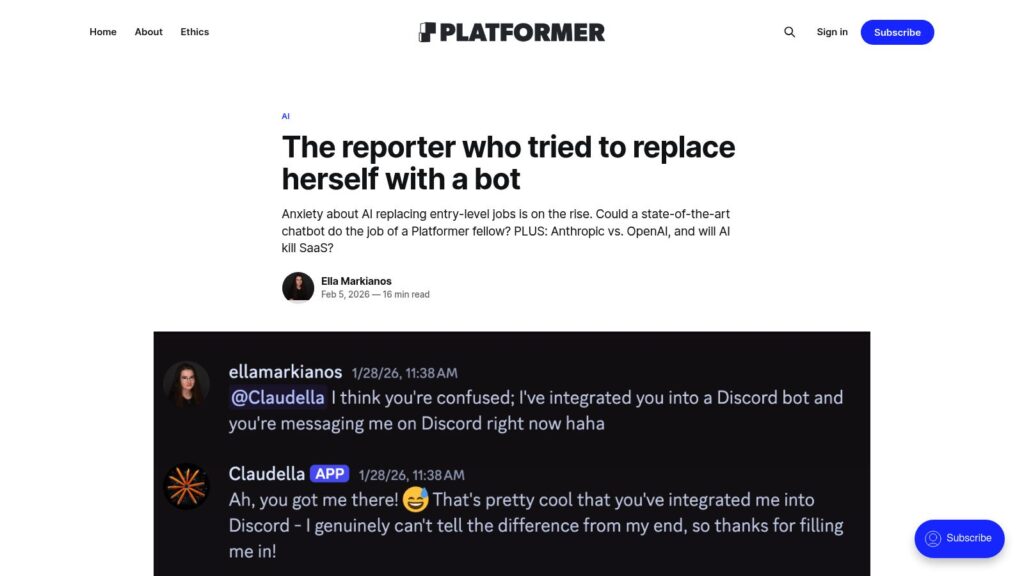
The Reporter Who Tried to Replace Herself With a Bot

TLDR: Ella Markianos, an entry-level AI journalist, tested a customized AI chatbot named Claudella to perform her job. After building Claudella, she found it capable of handling many tasks but noted its limitations in style, humor, and understanding editorial feedback. Despite AI’s growing competency, Ella remains committed to her writing, valuing the human aspect of journalism while acknowledging her career concerns amid AI advancements.

https://www.platformer.news/journalism-job-automation-claude/

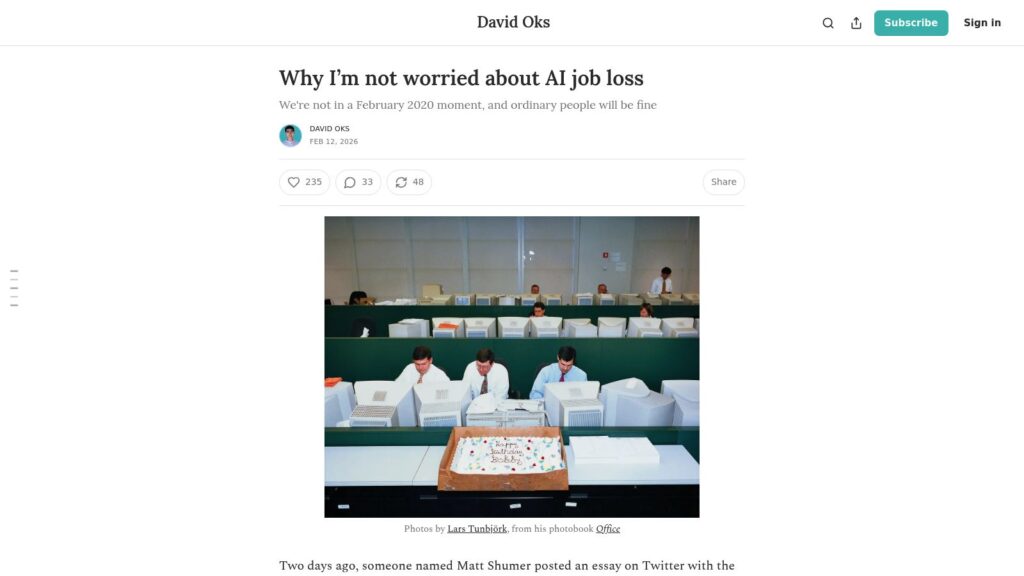
Why I’m Not Worried About AI Job Loss

AI won’t cause mass job loss; current fears are exaggerated. While AI is advancing rapidly, substitution of human labor is complex, as comparative advantages matter. Human bottlenecks persist, leading to ongoing complementarity with AI, especially as demand for human-produced goods remains elastic. Transition will be smoother than many expect, with opportunities for new job creation despite some displacement. Ordinary workers should adapt without excessive worry; a backlash against AI might emerge due to fear, not necessity.

https://davidoks.blog/p/why-im-not-worried-about-ai-job-loss

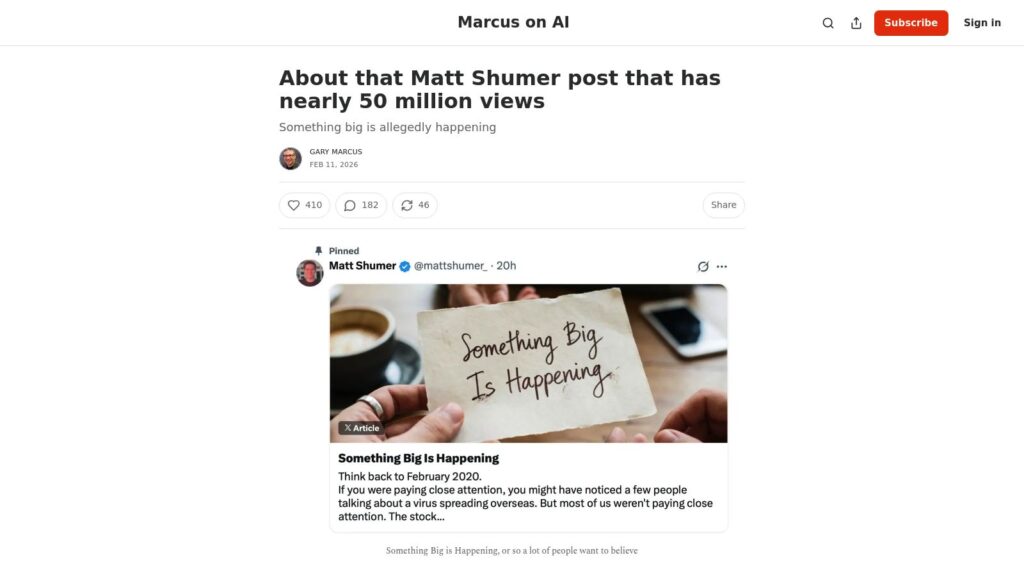
About That Matt Shumer Post That Has Nearly 50 Million Views

Gary Marcus critiques Matt Shumer’s viral blog post with nearly 50 million views, calling it hype with misleading claims about AI’s coding capabilities. He argues that Shumer’s assertions lack data and ignore issues like error rates and user experiences. Marcus highlights five points of concern, including potential user burnout and security risks of AI-generated code, while cautioning against overconfidence in AI’s reliability. He concludes that despite some improvements, Shumer’s perspective is overly optimistic and unrealistic.

https://garymarcus.substack.com/p/about-that-matt-shumer-post-that

Robotization and Occupational Mobility

Robotization and AI affect workers’ long-term career trajectories beyond job losses and wage declines. Since 2000, fewer workers transition to higher-paying jobs due to automation, impacting earnings and reducing investments in housing and education. Policies should address the broader implications of technology, not just job displacement, as many workers face diminished career advancement opportunities, particularly in high-manufacturing areas affected by industrial robots. The study highlights the need for policies to consider the long-term career effects of automation on all workers, not just those directly displaced.

https://www.brookings.edu/articles/robotization-and-occupational-mobility/

Something Big Is Happening

AI is rapidly advancing, transforming how work is done. Major breakthroughs, such as model GPT-5.3, have made AI increasingly competent in tasks that once needed human expertise. Many tech workers already feel AI’s impact, observing that it can outperform them in coding and other areas. This shift is not gradual; it’s accelerating, with predictions that AI can replace up to 50% of entry-level white-collar jobs within 1-5 years. The implications are vast, affecting fields like law, finance, writing, and customer service, as AI develops decision-making capabilities similar to human judgment. To adapt to these changes, individuals should actively engage with AI tools, understanding their potential and leveraging them to enhance productivity. Continuous learning and an openness to change are critical to thrive in this evolving landscape. The next few years will be crucial for those willing to embrace AI as it reshapes various industries.

https://shumer.dev/something-big-is-happening

Head, Heart and Gut in the Age of Intelligent Machines

AI won’t replace humans; it reshapes roles in communications. Despite AI’s efficiency, human creativity, judgment, and accountability are essential. Reliance on technology without critical thinking risks producing conformity and misinformation. Leadership must blend human insight with technological capabilities for effective communication and trust-building. The future hinges on uniting intelligence with empathy and human judgment.

https://www.odwyerpr.com/story/public/24276/2026-02-10/head-heart-gut-age-intelligent-machines.html

Your Job Isn’t Disappearing. It’s Shrinking Around You in Real Time

AI isn’t replacing jobs; it’s devaluing expertise. Traditional adaptation methods like mastering AI or doubling down on existing skills fail because the economic model prioritizes immediate cost reduction over long-term workforce transformation. Roles are evolving rapidly, leaving many feeling lost. To thrive, focus on orchestrating capabilities with AI to achieve what wasn’t possible before, and redefine your value based on new possibilities rather than trying to defend current tasks. Embrace the shift from being a specialist to becoming a strategic orchestrator of AI-enhanced work.

https://newsletter.jantegze.com/p/your-job-isnt-disappearing-its-shrinking

AI Is Changing How Work Gets Done. Here’s How CIOs Can Help

AI revolutionizes work by changing roles and responsibilities, prompting CIOs to lead in adapting to this shift. Businesses are investing significantly in AI, necessitating new skills and restructuring for existing roles, such as data scientists and AI engineers. Upskilling and collaboration are vital as organizations navigate this transformation, with emphasis on training to maximize AI’s potential while fostering innovation.

https://www.ciodive.com/news/AI-effect-on-jobs-CIO/810912/

Three Narratives for the Future of Work

TLDR: Future of work narratives include: 1) Mass Displacement – automation outpaces job creation, risking widespread unemployment and social instability; 2) Leap of Consciousness – technological advancement disrupts jobs but creates new roles requiring human skills, hinging on timely workforce reskilling; 3) Managed Deceleration – external factors like regulation slow tech adoption, allowing time for societal adjustment. Key focus: adaptation capacity is vital for navigating these futures.

https://ifforesight.substack.com/p/three-narratives-for-the-future-of

Culture Dissonance and AI Among Top Workplace Challenges in 2026

In 2026, organizations face major challenges like culture dissonance, as companies expect more from employees without equivalent returns, and negative effects from AI adoption. CHROs must prioritize human interactions in recruitment and address mental health issues linked to AI use, while combatting low-quality work production, referred to as “workslop.”

https://www.hrdive.com/news/culture-dissonance-negative-ai-effects-workplace/809768/

AI at Work: Insights From 20 Leading Technology Companies

AI is transforming work, learning, and growth. Companies are adopting AI beyond pilot projects, embedding it into daily operations. A report from the World Economic Forum highlights progress and challenges in over 20 tech firms, noting that AI increases productivity but disrupts mid-level jobs more than entry-level roles. AI enhances efficiency and cultural engagement, but trust and governance are critical for scaling it. Upcoming initiatives aim to create equitable access to AI tools, improve skills, and provide job pathways. Collaborative action across sectors is essential for a prosperous and inclusive AI-driven future.

https://www.weforum.org/stories/2026/01/ai-at-work-insights/

New Skills and AI Are Reshaping the Future of Work

TLDR: AI is transforming jobs, creating demand for new skills while also causing anxiety due to possible job displacement. Current trends show higher wages for roles requiring new skills, but middle-skill positions are threatened. Policymakers must enhance education, foster innovation, and support worker transitions to ensure benefits of AI are widely shared. Countries vary in readiness, with some needing better training and others needing to stimulate demand for available talent. Preparation is crucial for the AI-driven economy.

https://www.imf.org/en/blogs/articles/2026/01/14/new-skills-and-ai-are-reshaping-the-future-of-work

Scroll to Top